Showing posts with label Doctor Who and history. Show all posts

Saturday, May 18, 2024

Notes on Doctor Who and History: 'Space Babies', 'The Devil's Chord' and 'Boom'

The Doctor (Ncuti Gatwa) and Ruby Sunday (Millie Gibson) in Swinging London apparel (the Doctor's a blue pin-stripe suit), against a brick wall. The Doctor looks off to the left, Ruby looks at the camera.

I have neglected this series of posts about Doctor Who and human history for a long time. My Doctor Who rewatch stalled over a year ago early in Season 2 (largely because I found 'The Rescue' painfully bad), and I'm not likely to get back to it too soon. But, we've got new Doctor Who at the moment, and of course he's going to go back to the past, so it deserves writing about. Let me say right at the start, these are not reviews of the episodes concerned per se, though value judgements may creep in. Also, there are likely to be spoilers, so don't read these before you've seen the episodes if you don't want to be spoiled.

'Space Babies' is mostly set in the far future, though there are a couple of slips backwards in time. The Doctor (Ncuti Gatwa) takes Ruby Sunday (Millie Gibson) back to a beautifully-realised Wyoming 150 million years in the past. There, we get a brief gag that derives from Ray Bradbury's short story 'A Sound of Thunder'. There is also a flashback to Christmas 2004, the day on which baby Ruby was abandoned at the Church on Ruby Road, the one place the Doctor says he can't take Ruby, and therefore the one place we are guaranteed to visit before the end of the season.

But the historical meat of the first three episodes is, of course, to be found in 'The Devil's Chord'. The episode begins in 1925, with a character whose sharing a name with the third Robin (of Batman and... fame) may or may not be a coincidence. 1925 isn't sketched out in any particular detail, but it doesn't need to be. Then we switch to Ruby, asking to go to February 1963 to see The Beatles recording their first album, something the Doctor considers a much better idea than wanting to go to the Titanic or Bethlehem, presumably at the time of the birth of Jesus. (Incidentally, I don't think television Doctor Who has gone to either event, though there is a photo in 'Rose' of the Doctor with a family he persuaded not to go on the doomed liner, and in 'The End of the World' he says he was on a ship that is presumably the Titanic. No surprise that spin-off materials involve both events.)

Doctor Who has, of course, been to 1963 before, in 'An Unearthly Child', which is referenced here, and 'Remembrance of the Daleks', which is not. On neither occasion did 1963 look quite as it does here. The Beatles have also been on Doctor Who before, not that you'd know this from iPlayer, where the short clip of them playing 'Ticket to Ride' has been excised from 'The Executioners' (episode 1 of 'The Chase'), though fortunately not from the Blu-Ray, so it is still possible to watch William Russell's painful attempt to look 'hip'). 'The Devil's Chord' finds a very neat diegetic way in which to get around the fact that even Disney can't afford to license a Beatles song for this episode.

The Doctor and Ruby change into outfits that are very much Swinging London. But Swinging London didn't really exist until 1965, and the Doctor's suit is more redolent of 1967-1969. In 1963, most men dressed like accountants. Most bands dressed like scruffy accountants. Even The Beatles had yet to don their trademark collarless jackets. The truly hip (the Beat Poets, and the like) dressed all in black.
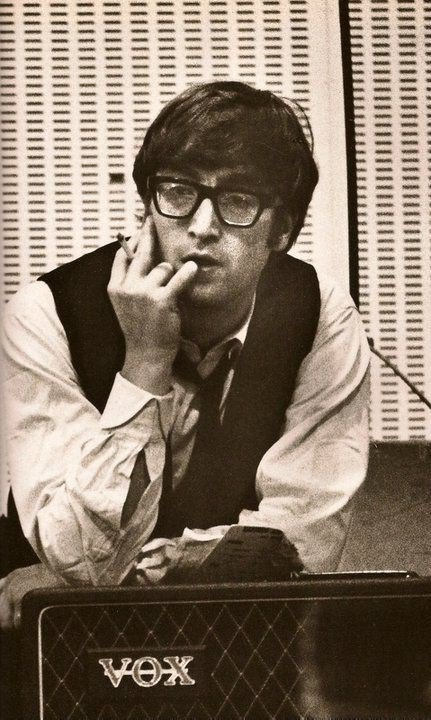
John Lennon in glasses, wearing a shirt and tie, and leaning on a Vox amplifier.
A rare photo of John Lennon in the style of glasses he wore up to 1966.
There are more anachronisms. Cilla Black wasn't even signed to a management contract by Brian Epstein until September 1963, so there's no way that she would be in a recording studio in February. John did wear glasses in the studio (though he whipped them off whenever he thought there was a camera nearby), but the round National Health 'granny glasses' were something he didn't adopt until 1966. The Beatles' hair was a lot shorter in early 1963 than it became later, and Ringo didn't even have his hair brushed forward.

Now, people can, and have, responded to lists of the anachronisms by saying 'look, it's just a silly fantasy episode, it's not meant to be the real Sixties'. To which I say, yes, that's my point. The episode presents an artificial idea of what 'The Sixties' was like. And what interests me is how and why that's been put together. So, John wears those glasses because those are the John Lennon glasses, the ones that everyone expects. The boys have longer hair because that's what everyone thinks The Beatles looked like. (Crueller writers than me might suggest such tactics are necessary because the actors don't look much like The Beatles, but then neither did Christopher Eccleston or Peter Capaldi.) The female singer could have been the more plausible Helen Shapiro (a friend of The Beatles) or Alma Cogan (a future friend of The Beatles), but that would make the viewers go 'who?' Everyone knows Cilla, and that she was associated with The Beatles. Pronouncing Brian Epstein's name as 'Epsteen' would be authentic - that's how Brian himself pronounced it - but the pronunciation as 'Epstine' is pretty ubiquitous these days (I try to avoid it when I do internet radio about the Beatles). When we see the famous Abbey Road zebra crossing, we expect there to be a white Volkswagen parked on the left, and don't worry that the car must, therefore, have been abandoned for six years.

Fiona Moore observed to me that at least since the 1980s people have forgotten how different the early 1960s were from the late, and indeed how much fashion was limited in its distribution. (For an example of this latter point, watch Get Back or Let It Be and compare how The Beatles dress with how roadie Mal Evans or even director Michael Lindsay-Hogg dresses, let alone all the people on the street listening to the band play on the rooftop at Savile Row.) Television quite often prints the legend rather than the reality; the Doctor and Ruby's outfits are all part of this, perhaps slyly sent up by the fact that they change out of outfits that actually were more suitable to 1963 (Russell T Davies' Doctor Who is nothing if not knowing). This is a phenomenon that can be seen in other television, such as, if perhaps to a lesser extent, in the recent television version of The IPCRESS File, also set in 1963. It's much more obvious in fantasy versions of the sixties such as the Austin Powers movies, and the Doctor's suit looks like a deliberate nod in that direction. This sort of conflation is a thing we tend to do to historical periods; note the way cultural differences between the Victorians of the 1840s and the Victorians of the 1890s can get elided in popular culture, or, to choose my own period, differences between first-century Rome and fifth-century Rome. 

This is an episode filled with elements derived from various bits of the 1960s, and especially The Beatles' career. Matthew Kilburn rightly draws attention to the 'Aeolian tones' recalling the 'Aeolian cadences' that music critic William Mann attributed to The Beatles in 1963, and Maestro's outfit in the latter stages has hints of The Beatles' outfits for Sergeant Pepper, and more obviously the hussar jackets that almost everybody seemed to wear in the second half of 1967. Several people have rightly observed that the plot of 'The Devil's Chord' owes quite a bit to The Beatles' 1968 animated movie Yellow Submarine. And the musical number at the end has its roots in endless 1960s pop musicals (though not any The Beatles made, with the possible exception of Magical Mystery Tour) - though again, Austin Powers is perhaps a more immediate influence.

It's a shame the final chord played by John and Paul wasn't the last chord of 'A Day In The Life', but you can't have everything.

The engagement of 'Boom' with the past is largely with the show's own history, in particular 'Genesis of the Daleks'; the main plot is based on the landmine scene from Part One of that serial, with Ruby Sunday in the role of Harry Sullivan. This follows the previous week's call back to 'Pyramids of Mars'. Apart from that, we get the Doctor singing 'The Skye Boat Song', but there's no commentary along the lines of 'I nearly met Bonnie Prince Charlie once'.

Thursday, November 23, 2023

Doctor Who, 'The Eaters of Light'


A painted Pictish Warrior and Bill Potts pointing swords at the viewer and shouting.
Doctor Who, 'The Eaters of Light' (UK, dir. Charles Palmer, scr. Rona Munro, starring Peter Capaldi, Pearl Mackie, and Matt Lucas, BBC, 2017)

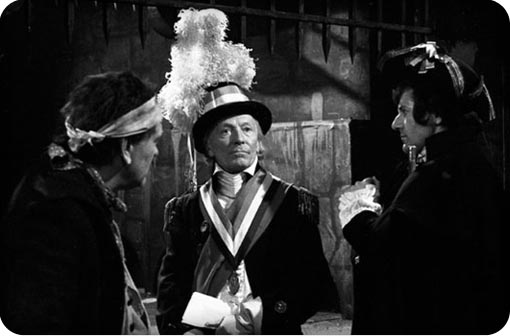
Roman Britain is one of the historical periods that is fairly central to the British imagination, so one might have expected Doctor Who to have visited there quite a bit. But, as I argue in a piece in the latest Terrible Zodin, Doctor Who, at least in its early years, went out of its way to avoid the obvious historical periods. It is true Malcolm Hulke, co-writer of the successful Target Luna/Pathfinders sf serials for ITV, submitted an outline for a serial set in Roman Britain (referred to as 'Britain 408 AD', a purely descriptive title), which at one point was planned to be the sixth serial in the first season. But even that avoided the standard periods for Roman Britain on screen (which I discuss here), instead setting itself in 408 CE (or 400 according to a summary David Whitaker wrote in September 1963), at the end of Roman Britain. When the final years of Roman Britain do appear on screen, they are generally connected to the reign of King Arthur (who will then be treated as a historical figure), but David Whitaker's summary of Hulke's story makes no mention of Arthur. In any case, Whitaker changed his mind about this serial, feeling it was overcomplicated, with an ending too like that of 'An Unearthly Child' (the full story), and instead commissioned Hulke to write up another submission, 'Hidden Planet', about a duplicate Earth the other side of the Sun. This was in turn abandoned in 1964. Hulke resubmitted 'Britain 408 AD' in 1965, for the second season, but it was rejected by new script editor Dennis Spooner, because by this point the programme had already made 'The Romans', and Spooner didn't want to repeat himself. (Hulke would have to wait until the Patrick Troughton era and 'The Faceless Ones' for an onscreen credit.)

Over much of the show's existence, Roman Britain was something only vaguely alluded to. The Doctor and his companions are thought to be from Britannia in 'The Romans' (1964), because Vicki and Barbara are overheard talking about London/Londinium. Similarly, in 'The Fires of Pompeii' (2008) Donna is thought to be Celtic/Welsh when she tries to speak Latin. You could argue that the Romans who menace the Doctor at the end of Episode Two and beginning of Episode Three of 'The War Games' (1969) are in Britain - it's not stated, and the zones in 'The War Games' are from conflicts from all over the planet, but the sequence was filmed in Sussex (the Doctor says the Roman time zone was 2,000 years ago, which would rule out Britain, but it's not clear whether he is being precise, and whether he means that in relation to 1917, the time zone from where they crossed over). In 'The Stones of Blood' (1978) the Doctor makes reference to having read Caesar and Tacitus on the Druids when discussing Druidism with sect leader De Vries. And in Battlefield (1989), the Doctor gets mixed up with post-Roman Arthurian legends, though suggesting that they had their origins in the eighth, rather than fifth or sixth centurires.

But the first actual definite television visit of the Doctor to Roman Britain is in 'The Pandorica Opens' (2010), where the Doctor meets River Song at Stonehenge in 102 CE. Even this doesn't engage closely with the typical periods of Roman Britain on screen, and has to be treated as one of the outliers, along with things like Chelmsford 123. The typical periods have been engaged with by non-television Who; so audio adventure 'Wrath of the Iceni' takes place at the time of the Boudican revolt (and is a fully-fledged 'pure' historical, with no aliens interfering with history), and another audio, 'Living History', takes place during Julius Caesar's invasion (a rare non-comedic treatment of Caesar's landing, perhaps due to the presence of a Dalek).

All of which is an excessively-long preamble to talking about 'The Eaters of Light', the point at which Doctor Who most closely engages with the tropes of Roman Britain. It engages with the supposed 'disappearance' of the Ninth Legion. As you may know, there are essentially two theories about what happened to the Ninth. Theodor Mommsen suggested that it was destroyed in some battle in the north of Britain. The discovery in the twentieth century of evidence suggesting that part of the Ninth was present in Nijmegen until c. 120 CE called Mommsen's theory into question (and it's hard to believe that, had he known of the Nijmegen material, he would have ever come up with the idea in the first place), so while the disappearance of the Ninth in Britain continued to fuel popular culture in the form of Rosemary Sutcliff's 1954 novel The Eagle of the Ninth, or the 2010 movie Centurion, the scholarly consensus rejected the notion. However, in recent years, scholars such as Miles Russell, Neil Faulkner, Nick Hodgson and Simon Elliott have come out in favour of the Mommsen idea.

Interestingly, Rona Monro has the Doctor (Peter Capaldi) and his companion Bill (Pearl Mackie) take different sides of the argument - Bill, who did a school project on the Ninth, believes that they left, whilst the Doctor says they were wiped out. The Doctor is, of course, proved right, though, being a modern Doctor Who story, they were destroyed by an alien menace.

Ninth Legion stories are often connected with Hadrian's Wall, but not here. The location of the action is moved to somewhere near Aberdeen (far further north than most people think the Ninth might have penetrated). But that location, as Juliette Harrisson has observed, allows the episode to be a love letter to Scotland, from where star, showrunner and writer all hail (though Monro is the native of the Granite City, Capaldi and Steven Moffat coming from Glasgow and Paisley respectively). A series of standard Scottish jokes about the weather are trotted out ('It's Scotland. It's supposed to be damp.'); but these also fit a standard trope of Roman Britain, where it rains all the time. Another standard trope of Roman Britain is its remoteness from the rest of the empire; here this can be linked to the perceived remoteness of Scotland from the rest of Britain. 

Other standard trope are to be seen. The Picts around Aberdeen (Picts are actually anachronistic for the second century) all have their faces painted. There is a Boudica equivalent in teenager Kar. The use of child protagonists is also something I have realised is to be seen a lot in Roman Britain tales.

And then there's folk horror (here, I am in considerably sympathy with Louis Bayman and K.J. Donnelly, who argue in the introduction to their edited collection on Folk Horror On Film that the defining characteristic of folk horror is that the horror arises from the people, customs and practices of the folk themselves, rather than anything outside that). Who has, of course, engaged with folk horror on many occasions, starting with 'The Dæmons' in 1971, continuing through 'The Stones of Blood' and 'The Awakening' (1984), through to more recent fare such as 'Human Nature'/'Family of Blood' (2007, directed by the same man who does the job here). So, much of 'Eaters of Light' takes place in dark woods, and though the threat is external, it is bound up in the Picitish traditions. Nobody mentions Druids, but there is a stone circle and a cairn, the Devil's Cairn, in fact (a name with echoes of Devil's End from 'The Dæmons').   

There is also a great deal to enjoy and appreciate. The Roman survivors are ethnically mixed, as they might well have been. They have names like 'Cornelius' and 'Lucius'. Which are the sort of names screenwriters give randomly to Romans, but they are actually the sorts of names, citizens' names, that members of a legion would have. That Bill is considered a bit weird not for being a lesbian, but for not being bisexual is a nice moment, though I'm not sure how rooted it is in Roman social mores. But I did enjoy the callback to the speech of Calgacus from Tacitus' Agricola: 'They make deserts and they call it peace.'

The Doctor claims to have lived in Roman Britain, to have 'governed, farmed, juggled', all presumably in adventures not seen on screen (but perhaps even now being written for Big Finish). He also claims to have been a Vestal Virgin, second class. Given that this is before it had been established that the Doctor had been a woman in the past, one wonders precisely what is meant by that. 

In general, there is a lot of food for thought in this episode. The main issue with it is that, like much of modern Who, the story doesn't really have time to breathe properly. It could have done with a second episode.

Writing about Doctor Who

There's a new issue of The Terrible Zodin out. I have a piece in it on history in the first season of the show, and contribute to sixty great things about Doctor Who (with a series of answers that are very '70s-centric).

And while we're on the subject of Doctor Who, I also have a piece in the upcoming volume 6 of Vworp Vworp!, which you can pre-order here. (My piece, which didn't make the highlights list, is on the history behind the Stone Age episodes of 'An Unearthly Child'.)

Friday, January 20, 2023

Notes on Doctor Who and history: ‘The Reign of Terror’

[Apologies for having left this series of posts for a while; my rewatch has rather stalled.]

‘The events will happen just as they are written. I’m afraid so, and we can’t stem the tide. But at least we can stop being carried away with the flood!’

At the beginning of ‘The Sensorites’ (Doctor Who’s first engagement with the future of the human race, and with anything resembling space opera), there’s a conversation amongst the TARDIS crew where they go back over all their previous adventures (though not, as Neil Perryman notes, ‘the weird one with the scissors’). The Doctor and Susan reminisce over an visit to England in the reign of Henry VIII, before Ian and Barbara joined them. This seems to have been a fairly typical adventure; the Doctor and Susan had to get themselves locked up in the Tower of London, because that’s where the TARDIS was, i.e. once again they’d got separated from their ship, and had to find a way of getting back, a plot mechanism that drives every story in Season 1 (except the weird one with the scissors), and indeed drives ‘The Sensorites’ and ‘The Reign of Terror’. But what is interesting is I think that this is the first reference to English history explicitly made in Doctor Who (unless we are to think of ‘An Unearthly Child’ as taking place in what would become England, of which, as I note in a comment I’ve recently made on my discussion of that story, I don’t think we can be sure).

But let us leave behind ‘The Sensorites’, a story that starts trying to do something interesting with the concept of ‘monsters’, but is too long and diffuse. Instead, we turn to a proper treat, ‘The Reign of Terror’. Here we are, on a number of levels, in different territory from the previous historicals. In contrast to the remote (at least to the original viewing audience) locations of ‘Marco Polo’ and ‘The Aztecs’, we are now in Europe. We are not yet in England (or Britain), even though the story begins with the Doctor swearing, over Ian’s scepticism, that they are in Somerset (and in a way the Doctor’s right that they are in England, because France is, as ever, reconstructed in a studio in London and, in an innovation for the series, in the fields of Denham, in Buckinghamshire). We do have our first English characters not from the twentieth century, in the ill-fated Webster and the spy James Stirling (as is often the case, printed sources are inconsistent on whether this should be spelt ‘Stirling’ or ‘Sterling’).* And we are in the French Revolution, specifically summer 1794, at the height of the so-called Reign of Terror. This was a period that was definitely taught in British schools in the 1960s; in the very first episode of Doctor Who, Susan borrows a book on the French Revolution from her teacher, Barbara (in Ian Marter’s novelization of this story, he has Barbara remember Susan borrowing the book in the earlier story; presumably the book is still somewhere in the TARDIS).

The idea of setting a story in the French Revolution was, according to the volume of Doctor Who: The Complete History that covers this (which I don’t have to hand), originally the idea of William Russell. But I strongly suspect that the period was not far from script editor David Whitaker’s mind. After all, Susan’s borrowing of a book on the French Revolution is there in Anthony Coburn’s script for the first episode, and expanded upon in the remount (as discussed below)—a scene I expect derives from Whitaker rather than Coburn. 

Early on in this story, Susan tells Ian and Barbara that the Reign of Terror (and specifically the Reign of Terror, not just the French Revolution in general) is her grandfather’s favourite period of history (Marter has the Doctor repeat this to a French peasant boy). We can well believe it. We know that the Doctor has been here before; when Susan borrows that book on the French Revolution, her first response is ‘that’s not right’. Clearly, we are meant to infer from that, at least in hindsight, that the Doctor and Susan have already visited this period of Earth’s history. In the first novel, Doctor Who and the Daleks, David Whitaker expands on this; Barbara recalls a thirty-page essay Susan wrote on Robespierre that included details of his walks and his clothes. One wonders, if Whitaker had actually written this story, whether it might have turned out that Robespierre already knew the Doctor and Susan, which might have smoothed their way, or caused a lot more problems. One also wonders exactly what it was that appealed to the Doctor about a period where the wrong word to the wrong person could get your head rapidly separated from your body (in Marter’s novel, the Doctor mourns that he has missed the Storming of the Bastille, something he always enjoys—but which, of course, belongs to a much earlier phase of the Revolution).

One suspects that Whitaker might have wanted to write this story (Simon Guerrier’s forthcoming biography of Whitaker may have something to say about this). For quite a while, Whitaker had intended writing the final historical of the first season, at first planning a story set in the aftermath of the Spanish Armada; but, in keeping with Whitaker’s instincts to avoid obvious British history, the story was to be set in Spain, looking at what the defeat of the Armada meant to the Spanish, a topic rarely treated in English classrooms. But it became obvious that, with the work he needed to do script-editing and rewriting the other stories, there simply wasn't time for Whitaker to write the final story himself, and he would have to get someone else in. Enter Dennis Spooner, a friend of Terry Nation, who had not written for Doctor Who before, but was an experienced television writer, having written for The Avengers and Fireball XL5, among others.

Evidently, Whitaker decided he was going to keep the Spanish Armada story for himself, and it was deferred to Whitaker’s outline for the second season, along with a number of other suggestions, for stories in Ancient Egypt, the American Civil War, and the Roman empire, of which only the last came to fruition. (I suspect Whitaker may have already decided in his own mind—if not actually told anyone else of his decision—that he was going to move on from the script-editor’s role at the end of the first production block, and so would have more time for writing episodes.) So, with the Armada held over, Spooner would have to write in a different setting. According to Spooner (who actually wanted to write a science fiction story, but like any jobbing writer, did the job he was given, which on this occasion, was a historical), he was given a choice of four subjects, from which he eventually chose the French Revolution, after discussions with Whitaker and producer Verity Lambert. David Howe, Mark Stammers and Stephen James Walker rather imply in The First Doctor Handbook that the setting had already been decided upon before Whitaker met Spooner, but that may be the result of compression in their account.

The important point is that Spooner had a different approach to the historicals from that practised by Whitaker and John Lucarotti. In a chapter I wrote over a decade ago,† I characterised this as the difference between being concerned with history, and being concerned with story. Lucarotti’s two scripts so far are very concerned with getting the historical details right; the plot rather emerged from a consideration of the history. Spooner, on the other hand, was most influenced by earlier fictional depictions of the period that he was writing about. The biggest influences on ‘The Reign of Terror’ are Charles Dickens’ A Tale of Two Cities (from the most recent—1957—BBC adaptation of which the Doctor Who serial borrows a shot of the guillotine, and probably some costumes, though to the audience the novel would be most familiar from the 1958 movie starring Dirk Bogarde), and Baroness Orczy’s The Scarlet Pimpernel, rather than Thomas Carlyle’s The French Revolution. One consequence of this is Spooner’s desire to put the most famous person about at the time, Napoleon Bonaparte, into the story, despite the facts, as the Napoleon I Society pointed out after broadcast, that not only was Napoleon unlikely to have supported an attempt to overthrow Robespierre, he was nowhere near Paris at the time of Robespierre’s fall. (By the time of Jon Pertwee, of course, it will turn out that the Doctor and Napoleon were friends.)

Spooner also has rather more humour on display than pervious historicals, though here Spooner’s instincts are somewhat moderated by Whitaker’s script-editing. Spooner would be completely given his head in the next historical, ‘The Romans’, by which time Spooner had taken over Whitaker’s role as script-editor. Of course, from the humour perspective, it’s not Spooner’s fault if, three years later, the Carry On team brought out a far funnier pastiche of Orczy in Don’t Lose Your Head, though inevitably it shapes how we see this Doctor Who story now (as I was writing this piece, I initially typed ‘Scarlet Fingernail’).‡

Spooner’s adapts well to a fundamental problem the story has to confront: on a BBC budget, there was simply no way that they could have crowd scenes around the guillotine, even the fairly limited ones that characterise the 1958 movie (and, indeed, Don’t Lose Your Head). So almost everything takes place inside rooms, particularly at the Conciergerie prison. This is fleshed out with a few small, tightly shot street scenes, the footage from the 1957 Tale of Two Cities showing the guillotine falling, and some footage from an educational film, The French Revolution, showing a horse-drawn carriage riding through forest, which is used (twice; the second time reversed) for the TARDIS crew’s journey from Paris back to the countryside where their ship is. 

Other points to note: This is a story replete with recalling previous adventures, with callbacks to the likes of ‘An Unearthly Child’ (though not the weird one with the scissors), amid a sense that maybe the TARDIS crew’s luck may really be about to run out this time. (As a side note, if people watching were aware that this marked the end of the first season of Doctor Who, they might have perceived there being a very real possibility that Ian and Barbara, or even Susan, might depart in this story, possibly not surviving it.) We get Barbara as history teacher again, lecturing everyone about how, no matter how bad Robespierre and his Jacobins and the Reign of Terror are, the royalist government that existed before the Revolution was also pretty awful, and deserved to be overthrown, good people supported the Revolution, and good things would come of it. Such nuance is not always a feature of Doctor Who. We also get, once again, Everybody Fancies Barbara, Especially the Villains. And as the text commentary on the DVD notes, this story sees the introduction of a feature that will be maintained in later historicals: regional English accents indicate working class characters, Received Pronunciation means upper class. 

And once again, the nature of the TARDIS crew’s involvement with history is addressed. Barbara tries to tell James Stirling that Napoleon will indeed turn Revolutionary France into a military dictatorship. The Doctor tells her not to waste her breath. She says that she’s learnt that history can’t be changed from her time amongst the Aztecs. The Doctor replies with the words quoted at the top of this post. Then, at the end of the episode, back in the TARDIS, there’s a conversation, slightly trimmed from what was in the original script, about what might have happened had they told Napoleon what was going to happen to him, or tried to shoot him. The Doctor is insistent that nothing they could have done would have made a difference. This last scene in particular feels more like Whitaker than Spooner; it echoes a lot of the themes in the prologue Whitaker wrote for Doctor Who and the Crusaders, which I’ll discuss when I get round to ‘The Crusade’. (In a way, this view will be reinforced by 'Vincent and the Doctor', where the message is that you can show someone's future to them, and be believed, and yet still history will play out as written.)** 

In the next story, ‘Planet of Giants’, the TARDIS crew actually manages to return to London in 1964, but have been shrunk to about an inch high (they also find themselves embroiled in a rather poor Avengers plot). But along the way, the Doctor reveals that he was in London during the Zeppelin raids of the First World War.

Finally on this general topic, I rediscovered a piece that I’d written on Doctor Who and history for the Open University’s OpenLearn site. I had quite forgotten about this. I think it’s still a sound discussion of the issues, though, as this post suggests, I would move the change in emphasis of the historicals forward from ‘The Romans’ to ‘The Reign of Terror’.

* And please tell me that someone has written a story around the fact that Stirling’s alias here, ‘Lemaitre’, is the French for ‘Master’.

† ‘It’s about Tempus: Greece and Rome in “classic” Doctor Who’, in David C. Wright, Jr. and Allan W. Austin (eds), Space and Time: Essays on Visions of History in Science Fiction and Fantasy Television, Jefferson, North Carolina: McFarland, 2010, pp. 100-115.

‡ Carry On director Gerald Thomas was also, at least partially, sending up his brother Ralph’s 1958 version of A Tale of Two Cities.

** The theme is, of course, also taken up in Marter’s novel: ‘it was immensely frustrating [for Ian] to be able to see into the future and yet not be able to do anything to change it!’

Tuesday, August 02, 2022

Notes on Doctor Who and history: 'The Aztecs'

‘But you can’t rewrite history! Not one line! ... Barbara, one last appeal. What you are trying to do is utterly impossible. I know, believe me, I know.’

‘The Aztecs’ is the big one in terms of how early Doctor Who views history, as embodied in that quote. John Lucarotti returns as writer, following up a period in which he was interested, having lived in Mexico. So the research is, once again, very solid.

Barbara wants to change the Aztecs, to get them to give up what she considers ‘evil’ in their culture. The Doctor, in the quotation above, insists that you just can’t change history like that, implying perhaps in his last comment that he himself has tried and failed. Although, strangely, he later tells Cameca, the Aztec woman to whom he has accidentally become engaged, that the gods wish an end to human sacrifice, thus indulging in a bit of the attempting to change history that he has told Barbara she should give up.

Eventually, Barbara is persuaded; indeed, she gives up surprisingly easily, once Ian convinces her that Tlotoxol, the High Priest of Sacrifice, represents mainstream Aztec opinion, rather than Autloc, High Priest of Knowledge. This is probably good, because in the end Barbara’s plan is essentially a white saviour narrative. But while she can’t change the Aztecs, she can change one man, Autloc. This is the ‘wiggle room’ that Doctor Who will exploit time and time again.

The Doctor, meanwhile, is still not a moral crusader. His sole objective is get back the the TARDIS, from which he has, once again, been separated. At the same time, he clearly feels some responsibility not to muck things up. It is interesting how very dedicated he is to this. The Doctor’s attitude to how to behave while in fifteenth-century Mexico is an extreme version of Star Trek’s Prime Directive. Not only must he and his companions sit back and accept human sacrifice, they must actively participate if circumstances dictate. It is hard to imagine any other Doctor taking so extreme an attitude.

Barbara is history teacher supreme again, with a detailed knowledge of the Aztecs. (Meanwhile, Ian reveals hidden l33t fighting skills.) And the costumes and set design excel again, making the most of the studio bound restrictions.

Once again, Aztec Mexico is an interesting choice for a setting. Even more so than ‘Marco Polo’, the setting is devoid of white Europeans (well, if we ignore all the white European actors portraying the Aztecs). This is not a setting that would commonly come up in an educational context, or a televisual one. And having decided to choose the Aztecs, the show takes an unusual angle on them. Most dramas about the Aztecs would have chosen to look at the arrival of the Spanish conquistadores. In Doctor Who, the fact that they will come drives Barbara’s actions, but they do not appear, not do any of the Aztecs have the slightest idea of what is about to happen to their world.  

Again, there is excellent design and costume work, even though designer Barry Newbery apparently found reference material hard to find, and costume designer Daphne Dare had to get around the fact that historical evidence suggests that male Aztecs often wore little more than loincloths, and Aztec women went around topless.

One last point: I find it extremely interesting that ‘The Aztecs’ was in production at almost exactly the same time as Peter Shaffer’s The Royal Hunt of the Sun was in rehearsal for the Chichester Festival. Of course, Shaffer’s play is about the Incas, not the Aztecs, and includes the conquistadores. I have no idea if anyone involved in Doctor Who was aware of the National Theatre production, though it’s entirely possible that they did, as members of the cast of ‘The Aztecs’ may well have auditioned for Royal Hunt. In any case, I find the coincidence of two productions about pre-Colombian American cultures interesting.


Monday, August 01, 2022

Notes on Doctor Who and History: ‘The Keys of Marinus'

‘Wait a minute,’ I hear you say, ‘“The Keys of Marinus” is a science fiction story, set on an alien planet, not in Earth’s history.’ Well, yes, that’s true, but there’s quite a lot here that relates to the show’s engagement with human history.

First of all, there’s the references. Barbara the history teacher is in action again, comparing the building they find on Marinus with the pyramids of Egypt and pre-Colombian America. (In his novelisation, Philip Hinchcliffe, in a somewhat sexist and implausible move, takes that line away from Barbara and gives it to Ian.) And we have the first occasion when the Doctor name-drops some historical character he’s met, in this case the somewhat obscure fourth/third-century BCE Greek philosopher Pyrrho of Elis. This sort of name-dropping will be taken to extremes in the Pertwee years.

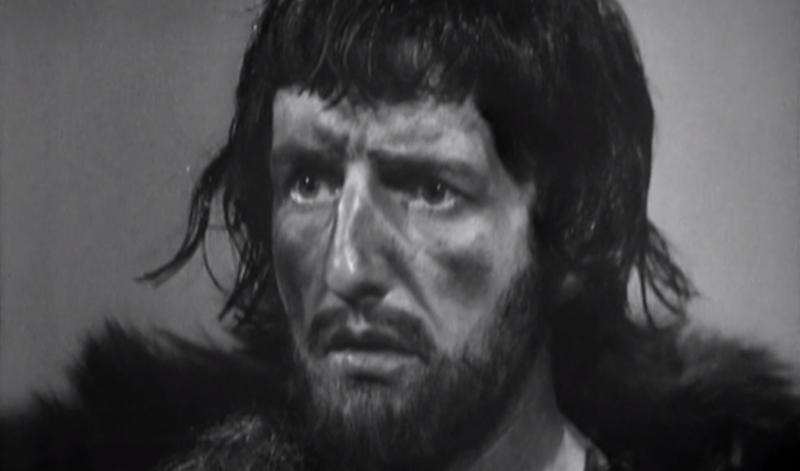
And then there is the way in which the various locations of Marinus draw heavily, and not particularly subtly, on historical cultures. Morphoton, at least in its mirage form, looks like a Roman palace, with luxurious food and clothing all around. The next location feels more medieval, though with some classical-looking statues. The snow-and-ice covered location visited in episode 4, with its heavily armoured knights (shown), seems even more medieval, and harks back to Eisenstein's Alexander Nevsky (though now it looks more like Monty Python and the Holy Grail). Millennius feels rather like something out of Franz Kafka.

It is perhaps appropriate here to talk about Terry Nation’s planned ‘The Red Fort’. Replaced either by this, or by ‘The Reign of Terror’, or by ‘The Dalek Invasion of Earth’, depending on which version you believe, the story was set in India, in the period of the British Raj. The Red Fort itself was (and is) a monument in Old Delhi, built as a palace for the Mughal emperors. In 1803 the East India Company took possession of the Fort after defeating the Maratha Empire, and one possibility, as Christopher Morley suggests, is that the story concerned these events. However, the Red Fort was occupied in 1857 by the Mughal emperor Bahadur Shah II, at the time of what was known in 1963 as the Indian Mutiny; documentation that exists makes it clear that this was the setting for Nation’s story. The story is one that concerned the British empire, and would have been the first British history story that the show had made. But this is still a relatively obscure part of British history, compared to others that could have been chosen. Unlike other lost stories, the scripts have never been published, and it may be that Nation never wrote much of them. One suspects that, whilst it might have been critical of certain members of the East India Company, it probably would not have overtly criticised the idea of British rule in India - that sort of anti-colonial material was some way off for Who. It might have been very controversial, given the South Asian population in the UK at the time (who presumably would not have been cast in main roles). Perhaps we are better off without this story.

Sunday, July 31, 2022

Notes on Doctor Who and history: ‘Marco Polo’

(I’ve fallen behind on my Doctor Who rewatch, but I’m going to try to get back on track, and will have some more of these posts.)

And so we come to Doctor Who’s first proper historical, ‘proper’ in that it was actually set in history rather than prehistory, as had been the case for the last three episodes of ‘An Unearthly Child’. 

It’s sometimes said (though generally by people whose knowledge of the show is fairly casual) that Doctor Who in its early days chose periods for its historicals based on what was being taught in schools, or on what could most easily be catered for out of the BBC costumes and props stores. Neither theory really stands up in the light of what Doctor Who actually broadcast in terms of historicals in its first two years. If either notion held true, then there ought to have been a different set of historical periods visited.

I haven’t done too much research into what was being taught in history classes in schools in the early 1960s, and I suspect that, in those pre-National Curriculum days, there was quite a lot of variety. But it seems likely to me that a lot of it centred around Our Island Story, the sort of history satirised in 1066 and All That. This was a history that took pupils through Roman Britain, the Anglo-Saxon settlement, the Norman Conquest, Tudors and Stuarts, the Industrial Revolution, and the British Empire. Doctor Who, at least in its first year, had none of this. Only in the last historical of the first season was a period shown that might have been taught widely in British schools, and then it was the French Revolution. Not until 1965 did the first English king appear, Richard I in ‘The Crusade’, and even when English and British history did feature, it did not dominate the historical periods the show visited until the era of John Nathan-Turner (1980–1989). True, there had been a plan to do a Roman Britain story in the first season; but that was in the event never made, and in any case, it focussed upon the end of Roman Britain, rather than more obvious events such as the invasion of Julius Caesar or the Boudican revolt.

As for the BBC and its stores, the Beeb had produced a number of costume dramas through the 1950s and early 1960s, though its glory days in this area still lay in the future. The backbone of the classic serial at this time, as it continued to be later, was the nineteenth-century novel, primarily Charles Dickens and Jane Austen, but also William Makepeace Thackeray (Thomas Hardy and Anthony Trollope would follow later). Additionally, the BBC had made The Age of Kings, adapting Shakespeare’s history plays. If the BBC were out to save money on Doctor Who, one might expect the periods depicted in these programmes to be represented in the show’s output. But again, they’re not. The Doctor didn’t visit the nineteenth century until one episode of ‘The Chase’ in 1965, and then not again until ‘Evil of the Daleks’ in 1967. 

The period most commonly represented on television in the early 1960s, largely through broadcasts of movies, was the Second World War. This is a topic Doctor Who steered well clear of, at least in terms of direct reference, until the Master dropped a doodlebug on UNIT in ‘The Time Monster’ (1972). (This is not the place to discuss the role of the Second World War in shaping various aspects of the show; I discuss one element of that in ‘“Went the Day of the Daleks well?” An investigation into the role of invasion narratives in shaping 1950s and 1960s British television Science Fiction, as shown in Quatermass, Doctor Who and UFO.) It is of course perfectly possible, perhaps even likely, that some of the costumes for ‘The Reign of Terror’ had previously been used in the BBC’s 1957 production of Dickens’ A Tale of Two Cities; but it seems likely that the production team chose a period and then went to see what was available in stores, rather than deciding the setting on the basis of the BBC’s holdings.  

If anything, Doctor Who seems to have deliberately gone out of its way to showcase historical periods that would not be familiar to the viewers, either from other television programmes or from their education. David Whitaker, indeed, was explicit about this, at least in terms of not duplicating other television (in a 1963 memo quoted by James Chapman, Inside the TARDIS, p. 22). Part of this may have been a desire not to turn the historicals into something that felt too much like work to schoolchildren watching. It is interesting to note the list of potential subjects that John Crockett, a staff director with the BBC, put together in 1963, as he was preparing to direct one episode of ‘Marco Polo’ (he later directed all four episodes of ‘The Aztecs’). This was sent to David Whitaker, and is quoted by Chapman (Inside the TARDIS, p. 224). They are mostly British-based, with such topics as the Peasants' Revolt, the Spanish Armada, and Boadicea (i.e. Boudica), but Crockett also included such topics as the fall of the Egyptian Pharaoh Akhenaten. Only four of the settings Crockett put forward were actually taken up by the show, and none of those before 1965. Whitaker evidently had other ideas.

‘Marco Polo’ is a case in point. Gavin Burrows of Lucid Frenzy Junior (who likes this story considerably less than I do, though his post on the story is very insightful) has said to me that the early historicals were often the opposition of educational, setting out to reinforce audience prejudices. You can make that argument for the portrayal of the Stone Age in ‘An Unearthly Child’, and it’s certainly the case for some of the later historicals, as I’ll discuss in later posts in this series. But I'm not sure if it’s true for the carefully-researched stories of John Lucarotti, who penned this Doctor Who serial (and Gav agrees). 

For their first true historical, the production team chose not the nineteenth century, or any period of British history, but the story of a medieval Italian who had ended up on the other side of the world. The BBC had made a radio serial in 1955 called The Three Journeys of  Marco Polo, written by John Lucarotti. But as far as I am aware, no television version of his story had been made by the BBC. Nor was he likely to be studied in any depth at school. No doubt Marco Polo was familiar to the audience as a name, perhaps through magazine articles or the occasional television feature, with a vague understanding of what he had done. But he would not have been as well-known a figure as Sir Francis Drake or Richard the Lionheart; hence there is a conversation in an early episode in which he establishes his backstory for the benefit of viewers. 

Doctor Who deliberately chose to take the viewer to a non-European setting, to thirteenth-century China, albeit with a European as chief mediator of that world for the Doctor and his companions. Of course, being the BBC of the early 1960s, this is a China populated by British and European actors made up to look Chinese, with half-Burmese Zienia Merton being the only actual speaking Asian on set.

Barbara the history teacher really comes to the fore here. It is Barbara who recognises Polo, and is able to supply her companions with a few useful pointers about his background. However, she clearly doesn’t know everything, and other characters such as Polo and Ping-Cho (Merton), are needed to further the knowledge available. The background to the assassins whom the travellers will encounter, for example, is provided in a story told by Ping-Cho, further commented on by Polo. (Ian, meanwhile, parallels Barbara by giving science lessons about condensation and the like; but somehow Ian’s lessons come across as much more irritating.)

The standard format for a historical, or indeed any, story of early Who is that the TARDIS and its crew arrive in a setting. Complications then ensue, usually involving the crew being separated from the TARDIS; when the Doctor was less of a moral crusader, such a separation was necessary to prevent him just dropping back into the TARDIS and flying off. From these complications our travellers must extricate themselves by the story’s end. ‘Marco Polo’ sort of follows that format, except for two things. Firstly, as Gav says, the TARDIS (from which the Doctor is only separated for part of the story; for the rest he can't leave because it is broken) is the McGuffin that drives the story; and secondly, ‘Marco Polo’ looks at the format from the other side. Instead of being centred around the Doctor, the story revolves around Marco Polo himself (Mark Eden), and how he deals with the complications and opportunities that the TARDIS crew bring in; this is perhaps why the story came to be called ‘Marco Polo’, rather than its original title of ‘Journey to Cathay’.* It is Polo who delivers bridging narration (this is a story that takes place over a longer period than is typical for historicals), and it's entirely appropriate to the structure of the story that Polo gets the final line, after the TARDIS has left. Polo is even the one who got the Radio Times cover (along with the Doctor and Derren Nesbit’s Mongol warlord Tegana), the show’s first. (One wonders if the story would have felt quite the same had illness not kept William Hartnell mostly out of the second episode.)

One final point to make about ‘Marco Polo’ is the lavish set design (by Barry Newbery) and costumes, almost all of them specially made for this serial. Those of us who watched Doctor Who in the 1980s will remember it as a period when the BBC seemed almost embarrassed to be making the show. This was not the case in 1964. ‘Marco Polo’ may not have been a Classic Serial, but it was treated as if it were, and made with exactly the same level of attention to detail.

(A sidenote: I have not yet done more than skimmed Dene October’s Black Archive volume on ‘Marco Polo’, but it's there on my TBR pile.)     

* One must be careful not to read too much into this, however; overall story titles at this point were not broadcast, and were primarily for production staff; as a consequence, they tend to be descriptive. Titles for stories before overall story titles started being used onscreen (which began with ‘The Savages’ in 1966) did not really become fixed until the 1970s (hence the multiple different titles in circulation for ‘The Daleks’).

Thursday, May 19, 2022

Notes on Doctor Who and history: 'An Unearthly Child'

One of the projects I was thinking about several years ago but never quite got round to was a book on how Doctor Who engages with human history, on which I planned to work with a couple of other scholars who have interests in that area. As I'm doing a rewatch of the show at the moment, I thought it was worth jotting down a few notes.

As is well-known, the format for Doctor Who was to alternate stories set in human history, and science fiction stories. (Script editor David Whitaker originally conceived of a third category, 'sideways' stories, but there are few examples of that, with only 'The Edge of Destruction' and 'Planet of Giants' being plausible candidates, and it's clear that this category soon got subsumed into the more general sf stories.) These two strands are represented by the audience's viewpoint characters, the science teacher Ian Chesterton (William Russell), and the history teacher Barbara Wright (Jacqueline Hill). Both take an interest in Susan Foreman because she is a prodigy in both subjects. (In Whitaker's novelisation Doctor Who and the Daleks, he adds some nuance here, making Susan very good at some historical periods, but dreadfully ignorant of other events, such as the Spanish Armada.) This is reinforced by Susan reading a book on the French Revolution, in which she spots an error (a scene, incidentally, not in the original pilot). In retrospect, we are meant to realise that she identifies this error through her personal experience.

When we finally enter the TARDIS control room in the first episode, it is a mixture of the advanced and the antique. The control console, and the walls, are a science fictional mise-en-scène, but scattered around the control room are various antique objects: a clock, a tripod of birds (Whitaker talks of a bust of Napoleon). The number of these objects in the TARDIS declined as the years went on.

In the next episode, 'The Cave of Skulls', Susan talks about the TARDIS appearing as an Ionic column or a sedan chair, both antique objects.

More importantly, the remaining three episodes of the story include the first shown trip into Earth's past, to the Stone Age. In The Television Companion, David J. Howe and Stephen James Walker say that it is not necessarily the Stone Age of Earth depicted, as this is never established on screen; but if a planet is presented that looks like Stone Age Earth, it is probably safe to assume that it is Stone Age Earth, until someone says otherwise. That this story is a historical is suggested by its being immediately followed by an sf story, 'The Daleks', and the alternative title of '100,000 BC' also suggests that someone thought the story was set on Earth (though it's not clear when it acquired this alternative title). Indeed, no-one else involved in the production of the show has ever suggested that it isn't Earth, so the idea that it isn't can be discarded. 

That said, it's a risky strategy for the first historical to be actually a prehistorical. There's a sense that what we are getting is more common assumptions about Stone Age humans (living in caves, dress in skins) rather than anything based on actual research into the Middle Paleolithic (as professional paleontologists recognised at the time). And everyone is portrayed by RADA-educated actors talking about themselves in the third person because that sounds 'primitive'.  

Saturday, April 12, 2008

Doctor Who, 'The Fires of Pompeii'

It's been forty-three years since a broadcast story of Doctor Who was set in the period of the Roman empire. The length of time between 'The Romans' and 'The Fires of Pompeii' has got a lot to do with the show's abandonment in the mid-sixties of the original plan to feature stories set in Earth's history. Part of the problem was, as Kim Newman has observed, the issue that Donna confronts the Doctor with in this episode. The Doctor saves people - that's what he does. But place him among well-known historical events, and his freedom to save people on a global scale, as opposed to on a personal one, is very much circumscribed. He can defeat the Daleks every time he encounters them, but he cannot, to take three examples from the show's first four years, prevent the Great Fire of Rome, stop the Greeks sacking Troy, or prevent Cumberland's butchers hunting down fugitive Highlanders. As a result, between 1966 and 1989, on the occasions when the Doctor did venture into the past (and they were relatively rare: Patrick Troughton and Jon Pertwee's Doctors only did so twice each, Tom Baker's five times), the stories were what has become known as 'pseudo-historicals', sf stories set in the past (usually some alien invasion). Often these stories took place against a historical background, rather than interacting directly with major historical events - if major events were used, they were often presented as being necessary evils to protect the planet as a whole (e.g. the Great Fire of London being presented in 'The Visitation' as a result of the Doctor defeating the Terileptils).

Under Russell T Davies' revamp of the programme, there has been a deliberate avoidance of stories set on far-off alien worlds. Inevitably, this leads to an increase of stories set in Earth's history. So it's no surprise that they finally got around to the Romans again.

All the stories set in the past since the revamp have been pseudo-historicals, and 'The Fires of Pompeii' is no different. There is an alien invasion, and in order to save the planet, the Doctor has not just to allow Pompeii to be destroyed, but to cause it to happen. In the end, this is actually a cheat as far as answering Donna's question goes. But the show's never really found a better answer to 'why can't the Doctor change history?' over the past forty-five years.

On the subject of cheating, the episode chooses to take a particularly apocalyptic view of Pompeii's destruction. This is probably the way most people think it happened, but the evidence actually suggests that the eruption of Vesuvius took the best part of a day, and, whilst accurate figures are impossible to calculate, a portion of the population will have escaped. It wasn't quite the complete extermination of a whole city that this episode implies. And as for the Romans not having a word for a volcano - well, strictly speaking that's true, but only because what they had was a three-word phrase. They were certainly aware of volcanoes - Etna was active at the time, and there are suggestions in some writers that Vesuvius was suspected to have had a volcanic past.

But this episode isn't a history lesson. Rather, it's a very knowing manipulation of lots of things that people know about the Romans, stuffed full of jokes. It won me over right at the beginning with a comment on how long it's been since the show went into Roman times, and then a direct reference to that particular story. It followed that up with a joke about Mary Beard's dormouse test, and then the best Spartacus joke since Life of Brian. And that's before we point out (as Davies freely confesses in Doctor Who Confidential) that all the character names for Peter Capaldi's family are lifted from the Cambridge Latin Course.

Another point at which I suspect the script is being deliberately knowing is in the opening scene. The Doctor thinks he has arrived in Rome, and only after seeing Vesuvius does he realize he's in Pompeii (why doesn't he consider the possibility that he might be in Herculaneum?). But of course, the sets he has been walking around are Rome, in a way. These are the sets that were originally built for the HBO/BBC series Rome. Credit must go to the production designers and director, who have dressed and shot these sets so that it's isn't immediately obvious that they are the same sets (this becomes plain when you watch Doctor Who Confidential, where the more obvious buildings are not hidden). Production values are high, and it certainly doesn't look like they only actually had 48 hours to film in Cinecitta.

It's interesting to compare this story with the audio adventure 'The Fires of Vulcan', produced in 2000, which was also set in Pompeii at the time of the eruption. It's not unknown for the new series to borrow from audios (Rise of the Cybermen' takes elements from 'Spare Parts', for instance), and the title of the later story is almost certainly an acknowledgment of the earlier one. But beyond that and the setting, the two stories share little. 'The Fires of Vulcan' is an actual historical, and uses historical characters (if sometimes anachronistically). It owes a great deal in terms of structure and scenes to Edward Bulwer-Lytton's 1834 novel The Last Days of Pompeii. In 'The Fires of Vulcan', the Doctor again can do nothing for Pompeii - but he does not try himself to escape, instead believing that he himself is fated to die in the eruption.

Overall, 'The Fires of Pompeii' is an extremely interesting piece of classical reception, and a pretty good episode of Doctor Who to boot. Though I could have done without the stunt casting of Phil Cornwell. And the last shot is utter nonsense.