Showing posts with label Rome. Show all posts

Thursday, October 01, 2009

Nero's rotating room


I'm usually pretty cynical about the excessive PR associated with some archaeological finds, that sometimes bends over backwards to make a link between a discovery and some known historical figure. I am not convinced that a young girl's body is that of Cleopatra's sister, because the arguments that it is are thin, and the evidence that it can't be rather compelling. I don't buy the identification of a portrait bust as Julius Caesar merely on the grounds that it looks a bit like other ones we have (though sufficiently unlike that a reason for this unlikeness has to be found).

So my first reaction when I heard that the rotating dining room of Nero's Golden House (Domus Aurea), as described by Suetonius (Life of Nero 31.2), had been found, was that of Mary Beard, to wonder if everyone had got carried away again.

But, on studying more closely the Associated Press report (here reposted on CLASSICS-L), and some good photographs, I have come to the conclusion that this is exactly what the archaeologists say it is.

For a start, the location suggests that it's part of Nero's Domus Aurea. The bit of this that tourists visit (when it's safe to be opened, which has been rare in recent years) is on the Oppian Hill, north-east of the Colosseum, the amphitheatre that Vespasian built on the site of the lake that formed the centrepiece of Nero's park.* But it's clear that this is just one part of the complex, a self-standing pavilion above the lake. The Golden House as a whole was probably many inter-linked buildings, and from Suetonius' account ranged from the Palatine Hill, where Domitian later built his palace, which still survives, across to the Esquiline Hill, of which the Oppian is the southern cusp. This new discovery comes from the eastern slopes of the Palatine. It seems pretty likely that a buried high-status building in that area would be part of the Domus Aurea.

Then there's what has actually be found. The chief feature of the room excavated is an enormous round brick-faced pillar, from the top of which buttresses emerge like spokes of a wheel. The pillar has a row of holes, that look like sockets for wooden beams. If that's the case, then this could be an enormous capstan, similar, if much larger, to what the Museum of London has driving their reconstruction of a Roman water wheel. [But see Edit below.]

It's very odd. Why would one need a room with a pillar in like this? To be honest, I find it hard to imagine what this could be for, if not for supporting a rotating platform above. Unfortunately, the photos don't show whether the pillar is bonded in to the floor, but I presume not.

It's certainly a better candidate for Nero's dining room than that previously advanced, the Octagonal Room in the Oppian pavilion. Until now, that's been as good a suggestion as any. But the trouble is, nothing in that room rotates, and one has to assume that there was a rotating false ceiling in the room. That there was a false ceiling seems probable, but that it rotated is not supported in the archaeology. And Suetonius says that the whole of the main dining room rotated, not just the ceiling.

cenationes laqueatae tabulis eburneis versatilibus, ut flores, fistulatis, ut unguenta desuper spargerentur; praecipua cenationum rotunda, quae perpetuo diebus ac noctibus vice mundi circumageretur

The dining rooms had pannelled ceilings, with versatile ivory slats, so that flowers could be showered from above, and pipes, so that the same could be done with perfume. The principal dining room was round, so that it might revolve perpetually, day and night, like the world.


Suetonius seems to be contrasting the ceilings of the other dining rooms with the whole of the main dining room. This would suggest that identifying the Octagonal Room with the main dining room is wrong, as the whole room can't possibly rotate (though it may well have had the ceiling devices Suetonius says the other dining rooms had). This hasn't stopped generations of scholars writing notes correcting Suetonius, and saying that it was only the ceiling that rotated (Robert Graves in his Penguin translation even adds the word 'roof' into Suetonius' text). But, though it is true that, by the time Suetonius wrote, all of the Golden House had been demolished or buried, he was much nearer the events, and in this case I think scholarship is wrong and the ancient source right.

So yes, I believe this one. And it's a fantastic piece of technology.

A final anecdote: a few years back, I was lucky enough to get in the Domus Aurea in the brief period between its reopening and its closing again. My partner and I were looking away from the remains of the building, out towards what once would have been the view down to the lake, but is now the under-vault of the Baths of Trajan. My partner asked me where the earth had come from that now filled Trajan's substructures. To my surprise, I realized that I was able to answer her. For the Baths of Trajan were built at the same time as the Forum of Trajan was being built a few hundred yards away. And for the latter, a hill was removed, the height of which is indicated by the height of Trajan's column. That earth had to go somewhere, and I think a lot of it must have ended up on top of the Oppian pavilion.

* As an aside, I've always been partial to the suggestion, made I think by Andrew Wallace-Hadrill, that the part of Nero's Golden House was like the Royal Parks of London; owned by the monarch, but an area to which public access was granted by the grace of that monarch, rather than shut off from all public use.

Edit: I should say that I thinking aloud here. And also I am not an engineer. So I may not 100% know what I'm talking about. And so the notion of the giant capstan probably doesn't work. Moreover, it's not what the archaeologists are saying, as quoted in a comment on Mary Beard's blog. They are suggesting the the pillar supported a wooden rotating floor, and are waiting to look inside the pillar (presumably hoping to find that it acted as a sheath for the mechanism). I still think they've found what they say they've found.

Sunday, January 06, 2008

Changing one's mind

Happy 2008 to anyone still actually reading this. I realize it's been over a month since I last posted here. If I was the sort of person who made New Year's resolutions, then I'd probably promise to make more posts this year. But don't hold your breath.

I got pointed to a webpage where 165 people were asked the question, "What have you changed your mind about? Why?" The contributors are mostly scientists of one description or another, though there's a piece by James O'Donnell that explains why he no longer cheers for the Romans, which I recommend. Reading all the contributions, I found myself thinking about what I've changed my mind about over the years. I certainly believe that the ability to change one's mind in the face of new evidence, or new interpretations of old evidence, is an important characteristic of an honest thinker.

Like O'Donnell, I have changed my mind about the Romans, and especially about the Empire. Once I believed that Augustus was a great man, who rescued Roman civilization from the chaos of the Late Republic, but no longer. Certainly I still believe that he was a highly effective ruler in terms of what he sought to achieve, and for some people life was better after he came to power - provincials undoubtedly appreciated the end of the licensed extortion and asset-stripping that characterized most provincial administration under the Late Republic. But it shouldn't be forgotten that what Augustus introduced was a military dictatorship, an inherently corrupt form of government. The likes of Caligula, Nero and Commodus were inevitable products of the system, not aberrations. And all emperors, even the 'good' ones like Augustus and Trajan, curtailed individual rights and suppressed, often ruthlessly, freedom of thought and expression. Just ask Ovid.

What else? There was certainly a time when, had you told me that there was a difference between sex and gender, I'd have looked at you as if you were mad. But then I didn't know any people who had refused to allow the sex they were born into to determine how they would behave. This year I wrote a short paper for my students explaining exactly why the two aren't identical, and why biological sex doesn't necessarily dictate gender roles (in which I used Ovid's myth of Iphis and Ianthe, just before I found out that Ali Smith had written a Canongate Myth volume around the same legend); that paper is now going to be available to all the students on the course throughout the country.

One thing I've really come to comprehend better this year, and emphasize more to students, is that there's no such thing as 'Roman attitudes'. Where once I would happily have said 'the Romans believed ...', and at the most pointed out that this meant élite male Romans, now I underline that one would have been every bit as likely to find a range of different opinions if one conducted a straw poll in the Roman Forum as if one did the same on Oxford Street. Take, for instance, Roman attitudes to sex. The HBO/BBC Rome series (of which I got the complete boxed set for Christmas, which means I really ought to get around to watching it some time) presented a Roman society in which people were happily having sex all the time. Just before the series aired Tom Holland wrote in The Times criticizing this - the Romans weren't so liberal at all, but rather prudish. I blogged that at the time, saying that I thought Holland overstated and oversimplified the case, and pointing to Ovid as an example of a different attitude to sex (basically, in the Amores and Ars Amatoria, the message is if the opportunity comes along, take it, and here's how one maximizes those opportunities). Holland's not wrong to say that Romans held the opinions he ascribes to them. What is wrong is the implication that this is how all Romans thought. Ovid and Cicero did not think the same about sex, anymore than Juvenal and Hadrian thought the same about Greeks. All one can do is point to general trends of thought, whilst highlighting that these were not universal. Which is actually quite liberating for a teacher - asked to reconcile two apparently contradictory attitudes found in ancient writers, one can simply respond "those two people didn't think the same on the subject."

But sometimes you have to rethink those prevailing opinions. For about a decade, I have believed, and been telling people, that in the ancient world sex was not generally considered a participatory act between equals, but something done by the powerful to the powerless, e.g. men to women, adults to younger men, free men to slaves. With a single article, James Davidson has blown that out of the water. The key quotation is "the ancient Greeks talked of sex not as an act of aggression, but rather as a 'conjoining' or 'commingling'". That sent me to the dictionaries, and indeed, one common, perhaps the most common, Greek word for sexual activity is συμμείγνυμι (summeignumi). The sun- prefix definitely implies doing something in equal co-operation with someone else, as does the fact that the common form is in the middle voice, rather than the active (doing something) or passive (having something done to one). This immediately put Davidson's book, The Greeks And Greek Love on the list of books I must read soon. So far I've got no further than an introductory "Note on transcription and pronunciation" (which features one brilliant comment: "Anxious readers may be comforted by the fact that pronouncing ancient Greek properly is extremely difficult, so nobody ever bothers"), but I am looking forward to it (there's a favourable review by Oliver Taplin in The Guardian).* I may not be wholly prepared to give up the idea that sex was sometimes in the ancient world an expression of power - after all, it remains so often enough today. But I can no longer say that the Greeks had no concept of sex as an act of equals, since such a concept was hardwired into their language.

You may now all speculate why most of the examples I've used relate to sex.

* I have to take issue with Taplin on one point. Criticizing Davidson's reading of a homosexual affair into Homer's portrayal of Achilles and Patroclus, he says, "there is no call to bring sex into it; and to do so Davidson has to turn a blind eye to the night in book nine where they both bed down with women." Taplin may be right about the first point - there's certainly nothing explicit in the Iliad - but, as I wrote in a piece for CA News back in 2005, their sleeping with women is irrelevant unless one assumes that heterosexual activity a priori rules out the same individuals engaging in homosexual relations. Whilst conservative thinkers have believed, and still do believe this, an open-minded glance at the history of human sexuality quickly shows that it's nonsense.

Thursday, November 15, 2007

Imperium: Augustus

I finally got to see the 2003 Italian mini-series Imperium: Augustus, also known as Augustus: The First Emperor (I have a suspicion that this was meant to be a series of films about different emperors, but never got beyond the first). I didn't really come to it with any expectations. But actually, it's rather good.

There are annoying bits, of course. I could do without Cleopatra's bikini bottoms, which make her look just a bit too much like a porn star. Augustus' narration of his past by slipping into lengthy anecdotes at the end of arguments is clumsy, and makes you think everyone around him must have thought he was really, really boring. And my jaw bounced off the floor when I realized that the incredibly camp individual introduced midway through the first episode is meant to be Augustus' literary-minded friend Maecenas.

There's some whiting of people out of existence. Maecenas disappears after the conquest of Egypt, with no hint that he continued as Augustus' helper for a number of years yet. Gone are Cleopatra's son by Caesar, Octavia's children, Livia's second son Drusus and his sons Germanicus and Claudius, and Julia's daughter Agrippina, and the son with whom she was pregnant when she learnt that her husband Agrippa was dead. Agrippina's absence is particularly curious, as the series ends with Livia ensuring that Tiberius will reign after Augustus, and Augustus saying that 'Your son's blood will run in future emperors, not mine'. Yet by making Tiberius adopt his nephew Germanicus, who was Agrippina's husband, he actually set it up so that his blood would run in future emperors, after a couple of generations (as indeed happened).

But there are so many good bit. Nice little architectural touches, like the ships prows on the rostra, or being able to work out from the shape of the altar that a building is the temple of the Divine Julius before the dialogue tells you. The series remembers that Octavius insisted on being called 'Caesar' after his adoption. It finds space for calling the Senate 'conscript fathers', the reading of Antony's will, declaring war on Cleopatra rather than Antony.

Augustus' life is not easy to dramatize. Much of it is a tale of political reform. Most treatments of him either end with Cleopatra's death (Cleopatra, Rome), or pick up with the dynastic scandals of his later life (I Claudius). Imperium puts both together, running the story of Octavius' rise to power in parallel with the events leading to the Julia scandal. They do succeed in creating a coherent narrative.

Of course, the shadow of I Claudius hangs over this series, but it makes that work for it. Charlotte Rampling's Livia is presented in such a way as to play with perceptions raised by Sian Philips' Livia. The audience expects her to murder everyone between Tiberius and the throne, and the first episode ends with her apparently poisoning Julia's children - but she actually doesn't do it. Though she considers leaving Augustus to be assassinated, in the end she can't do it.

And then there's Peter O'Toole's Augustus. He doesn't get something as meaty as 'Is there anyone in Rome who has not slept with my daughter!', but where Brian Blessed's Augustus was losing his touch, and manipulated by his wife. O'Toole's is a relatively kindly man, but nevertheless, still in control, and aware that sometimes he has to do unpleasant things. I suspect the real Augustus had a touch more of the ruthlessness of Roddy McDowell's Octavian in Cleopatra, but this is one of the most complex portrayals of Augustus that I've seen. It helps that this is a European production, and so, unlike many American films and shows, is able to view the Roman empire as something positive that deserves saving, rather than an inherently corrupt oppressor.

So it's a surprise when the very last line of the film is 'In the twenty-third year of my reign, in the province of Judaea, Jesus of Nazareth was born'. This is exactly the sort of reference to the coming of Christianity that Quo Vadis and Spartacus have. There, it's meant to show that Christianity will sweep aside the corruption of the Roman empire, and make the world good again. What it's doing here I'm really not sure.

Tuesday, October 09, 2007

Photos from Rome (not mine)

One of my (soon to be former) students went to Rome a week or so ago. She took a lot of photos, 831 in total (a few of which were, credit where it's due, taken by her husband). It's such a good collection that I asked (and got) permission to put a link in here. She photographs everything, and takes a lot of photos of objects that interest her, from angles that are often a bit unusual. This makes this a great archive for photos of famous buildings showing details that often get overlooked in the standard views.

Thursday, October 19, 2006

What year is it?

Last night the BBC carried this news item,* about a Roman cemetery under the Vatican. This particular bit of cemetery was discovered three years ago (though that there was a cemetery under the Vatican has been known for a very long time, and other tombs have been known for years, including one which may be that of Saint Peter). Clearly it's been tarted up for public display (something to do next time I'm in Rome).

However, I'm blogging this because of the text that was given to newsreader Huw Edwards to lead into the item, and which is repeated in the text accompanying the online video version. It's not the implication that this is a new discovery - that's typical hyperbole. It's the age given, 3,000 years old. The report itself says that the tombs date from the time of Christ. Which, unless I'm mistaken about the current date, is rather nearer 2,000. A bit of a failure in basic maths, there, rather like that in Battlefield Britain, where the Battle of Hastings (1066) was described as 'nearly a thousand years' after the Boudiccan revolt (AD 61), or Rageh Omar's slip in his otherwise interesting series on the miracles of Jesus, where he gave the dates of birth (63 BC) and death (AD 14) of the emperor Augustus, and then said that Augustus was dead at the age of forty-nine (he was, of course, seventy-six).

(Note that what is on the website may change, as I am going to drop a line to the BBC.)

* Actually, if you search under 'Rome' on the BBC website, you'll find a link to a rather better quality version.

Wednesday, September 13, 2006

Another Big Series

I have seen the trailer for the first of the BBC's new drama-documentary series Ancient Rome: The Rise and Fall of an Empire. This first episode deals with Nero, and Michael Sheen has been cast in the role. I note that this is one of those occasions, which are not too common, when someone close to the right age has been cast. Nero was thirty when he died, but looked older; Sheen is thirty-seven, but looks younger. Often someone significantly older is cast - Derek Francis was forty-one in the Romans story in Doctor Who, Patrick Cargill was fifty-two in Up Pompeii! (mind you, that's set in AD 79, so Nero would have been forty-two, had he been alive then - which he wasn't - Up Pompeii!'s no particular respecter of chronology), and Christopher Biggins twenty-eight when playing Nero at sixteen. On the other hand, two of the most famous portrayals are exceptions; Peter Ustinov was thirty-one when he made Quo Vadis?, and Charles Laughton thirty-two in Sign of the Cross. I note without comment that Sheen can also be seen on our screens playing Tony Blair in The Queen.

Fifty years ago this story would have been written with a clear reference to Aristophanes' Lysistrata (which was picked up by both the immediate sources that brought it to my attention). Sadly, this either is thought too highbrow for the readerships concerned, or the journalists themselves don't know - so kudos to The Washington Post.

Tuesday, December 13, 2005

Oh dear, I expected better

Brian Sewell has just rather blotted his copy book by suggesting that the Pantheon in Rome was built in the lifetime of Christ. This is true neither of Marcus Agrippa's original Pantheon, which date to 27 BC, and so is about a quarter century before Christ's birth, nor of Hadrian's replacement, the building that survives today, which was constructed in AD 125. Now, I expect to disagree with Sewell's views at times (like his preference for the dubious charms of Naples over the fantastic Rome), but I never expected him to slip up on basic facts.

Monday, November 07, 2005

Rome in the papers

A couple of articles from the weekend papers about Rome.

First off, a news article from the Sunday Times, which reveals that Michael Apted, director of the first three episodes, was not consulted about the BBC's decision to edit those down into two. He seems pretty pissed off, and rightly so. Personally, I don't believe this nonsense about the Beeb deciding that British audiences didn't need so much background information. I reckon that some idiot executive watched the first couple of episodes, decided that they were too slow, and ordered the trims. If the driving factor was to cut out what's unnecessary, then Octavia's disrobing scene could easily have gone. It's already obvious that Atia is prostituting out her daughter to Pompey, and we don't need to see the lecherous old general watching her undress to get that. But that scene had some tit and arse in it, so can't be cut. All the sex and violence has been kept (because it sells), and as a result what gets cut is the story. As Apted says, the end product is something that is quite hard to follow. Let us hope that the British audience really are as educated as the BBC assume, as I can't imagine anyone without some basic knowledge of the fall of the Roman Republic being able to understand what is going on. A.A. Gill's complaint about the programme elsewhere in the same paper, that it was "a mess of confusing storylines. Almost every utterance had to move great marble slabs of plot. It looked like a case of too many producers re-writing editing and patching up," is partly the result of this editing.

It is difficult to imagine something this crass being done with I, Claudius. But that was in the days when producers made decisions about programmes. Now, in the post-Birtian BBC, all power lies in the hands of administrators, such as Roly Keating, controller of BBC2, who has defended the series against claims of prurience by saying "Ancient Rome was a very violent society with utterly different moral values from ours. The series has been written to give the audience an authentic and unsparing portrayal of life in that era at all social levels." Unfortunately, this defence does not work when some of the scenes are made up and never happened. Which leads us to ...

Robert Harris, writing in the Telegraph, delivers a historical critique of the programme, and explanation why that matters, with which I am pretty much in agreement. If a programme puts so much effort into saying how 'authentic' it is, then it's legitimate to point out that this is undone by including scenes that simply didn't happen, especially when such scenes have no purpose other than to get in a bit of gratuitous nudity. Atia is portrayed as she is in Rome not because there is any evidence that she was actually like that, but because Livia and Messalina were memorable characters from I, Claudius, and the writers of Rome wanted a someone to fill that role. Cato becomes a doddering old codger presumably because some one in casting has heard the term 'Cato the Elder' (though this Cato is actually Cato the Younger). The danger is that all the guff about authenticity will lead people to think that this is how it actually happened, and thus educational standards are set back even further.

Thursday, November 03, 2005

Rome - not the whole story

One thing I didn't realize when writing my previous two entries on Rome was that the BBC, in its infinite wisdom, have chosen to edit the first three episodes into two. The excuse - I hesitate to call it a reason - is that we Brits are sufficiently clued up about Roman history that we don't need to have all the background information. Passing over the implicit cultural arrogance of that assertion (and it did occur to me that if you don't have any background in Roman history, it might be rather difficult to understand Caesar's motivation), I would like to know if the editing was done by people involved in the original production, or whether it was some junior bloke who was told "edit it into two episodes, don't cut any of the sex".

Essentially this means I can't give a decent judgment on the first couple of episodes, because they are not as originally intended. This sort of editing can play merry hell with the structure of a show, and it may well be that some (though I doubt all) of my criticisms would evaporate if I actually saw the full-length episodes.

Great care will have to be taken when DVDs become available, to ensure that I end up with the proper version.

Sex and the ancient city

Yes, I know everyone will be using that gag, but I'm afraid I'm not used to anything else but the Sex In The City theme tune following the HBO placecard.

In another forum, some comments have been left on my opinion of Rome. It's interesting to note that there's often an implicit assumption that my objection is on historical grounds. Now it is true that, as a historian, I do tend to spot historical inaccuracies, and sometimes point them out, especially if a production is trumpeting itself as 'the way it really was'. As a result, I guess I give the impression that this is what is most important to me, and why I have problems enjoying films and television series set in historical periods. But if you look at what I've written about historical films, such as about Troy or Kingdom of Heaven I think you'll find that I am often more exercised by poor dramatic structure than by poor history. And so it is with Rome.

This is what I wrote in response to one comment:

I should make clear that my main problem with the series is not that it's bad history. Hell, I like Gladiator, and Rome is much more historically accurate than that. My problem with it is that it seems to me to be bad drama, that it can't make up it's mind whether it's I, Claudius for the 21st-century or a Roman Upstairs, Downstairs. As a result we keep being pulled away from the main story to these two characters who not even the writers seem terribly interested in, and I'm certainly not.

'Speed bumps' only throw me when they don't make sense in context. Take, for instance, the invented husband of Octavia. Now it is entirely true that on the death of Julia, Caesar proposed a marriage alliance between Pompey and Octavia, which would have involved he divorcing her husband. But Pompey refused the alliance and the divorce never took place. By having the divorce take place before making the marriage proposal, an entirely fictional husband has to be invented. More importantly, the scheming cunning Atia ends up looking stupid, someone who acts before she needs to. And we have to believe that the fictional Glabius is a person of no importance, because Atia would be even more stupid to dissolve a marriage alliance with one family if she did not have another better one securely in place. Which contradicts what has already been established, that female relatives of important men are used as political pawns - they don't get to marry for love. Again, my problem here is not that it's bad history (though it is), but that it's bad, incoherent writing. The main object of the sequence appears to be to get Kerry Condon to take her clothes off. (Almost all the nudity in Rome fails the 'dramatically necessary' test.)

My other problem (and it's really more of a comment than a problem) is the 'Emperor's New Clothes' syndrome, that the programme has been sold as something it isn't. It's the same issue I have with Saving Private Ryan, which was sold as something Big and Important rather than the updated John Wayne war movie that it actually is. Your comment 'I'm ravished by the show. Lots of gratuitous sex and violence, by ROMANS!!!!' is illuminating, It shows that you're enjoying this as a Roman romp, in the full excessive tradition of Spartacus, Cleopatra, etc. Which is what it is. But the publicity has tried to sell it as something different, something serious, something that hasn't been seen before. And it's none of these.

I will still watch the series, and doubtless still have fun watching it. It's certainly not boring, or completely unwatchable. But it's not genuinely serious drama either - more The Cleopatras than I, Claudius.


And to another:

I got the feeling that the writing perks up when dealing with the historical individuals as opposed to the fictional ones, but that may just be me not being particularly interested in Vorenus and Pullo. But yes, it's the indecision that causes problems for me. Either there should be more Vorenus and Pullo, to make it their story, or none at all, and stick to the historical principals. As it is, Vorenus and Pullo are in it enough to be distracting, but not enough to make me care about them.

Wednesday, November 02, 2005

Rome

Well, I knew it was going to be nonsense, but I didn't realize it was going to be that much nonsense!

Spoiler details will follow. You may want to look away now. Or you could find out what happens by reading a history book.

First of all, what on earth are those two blokes Vorenus and Pullo doing in it? Do they actually serve any narrative purpose within the show? As far as I can see, no. The political story, Caesar versus Pompey, which is the story the series wants to tell, and be narrated perfectly well without recourse to these two individuals - indeed, for the most part, it does. Inserting these two tends if anything to slow up the action, and leads to such ridiculous ahistorical moments as the theft of Caesar's eagle and Octavian's kidnapping.* I'm pretty sure nothing like this ever happened (though please tell me if I'm wrong) and the whole thing is invented simply to get the fictional characters involved in the story. Oh yes, they're supposed to be viewpoint characters for the audience, but on the whole there's not many first century legionaries watching the series, so they don't do that very well. You might argue that it gives a more rounded picture of Roman life, shifting away from the elite bias that concentrating on the political narrative would do, but I don't think we actually get enough of the soldiers to make that work.

As it stands, I reckon it's an incredibly clumsy dramatic device, symptomatic of the spreading abandonment of basic narrative coherence in a lot of American cinema and television. It's like Pearl Harbor, which can never make up its mind if it's From Here To Eternity, Tora! Tora! Tora! or Thirty Seconds Over Tokyo.

Next, on Today this morning 'historical consultant' Jonathan Stamp (who is actually a producer of historical documentaries) was talking about how the series was avoiding 'HollyRome'. This might be true in the way that the city is depicted, looking more like a mediaeval city such as you might see in Kingdom of Heaven than what has been seen before in movies about Rome. Which is fair enough - ancient Rome was probably much more like a mediaeval city than is often thought. But in plot structure and approach many elements have been lifted from previous renditions. As in de Mille's films, Rome is a symbol of excess (like the very silly bull's blood scene - I don't believe you can get so soaked simply from cutting a beast's throat). And as usual the audience is both critic and voyeur, censuring the excess whilst enjoying all the gratuitous nudity and sex going on (all heterosexual, I notice - no sign of Caesar's alleged more than familial liking for young Octavian). The characterization of Atia is lifted straight from I, Claudius; like Graves' Livia Atia is manoeuvering to make her son most powerful man in Rome. And I doubt the real Atia was quite so ready to hurl off her kit and grab the nearest erection. Meanwhile, her son Octavian appears to have been cast for his resemblance to the young Roddy McDowell, in what seems a deliberate reference to the 1963 Cleopatra.

And then there's the comedy references. Some of the humour, like the troops waiting while Antony has a shag behind a tree, is deliberate. But sometimes comedy is unconsciously echoed. As Vercingetorix laid down his arms at Caesar's feet, I couldn't help but think of the same scene at the beginning of Asterix the Gaul. The opening titles, innovative though they are, remind me of the end titles of A Funny Thing Happened On The Way To The Forum, and I can't help but feel that it would look better to the theme from Up Pompeii. And I'm sure you can guess what I was thinking as they nailed Gauls to bits of wood. ("Crucifixion's a doddle!") I also laughed at the dormouse, but this was because of Mary Beard's mention of the 'dormouse test', a measure of the subtlety of a reconstruction of Rome by how long it takes anyone to be offered a dormouse, in Saturday's Guardian (I won't link to the piece, as it requires registration).

I don't want to be picky about details, like Caesar's laurel wreath, which he began wearing to hide his baldness, on a decidedly non-bald Ciaran Hinds, or the fictional first marriage of Octavian's sister. And I had fun watching it, and will watch more episodes. But in the end this is a made up piece of nonsensical fluff, that tries to impress the audience through scale (note how much of the publicity quotes statistics - 4,000 pieces of wardrobe, 750 extras, biggest set ever, etc., etc.). It's nothing more than this, and isn't half as important as it thinks it is.

* Yes, I know he ought to be Octavius at this point, but such a nitpicking name change would just confuse the audience.

Tuesday, November 01, 2005

Countdown to Rome: A tale of two buildings

The cover of the new Radio Times announces the arrival of Rome. A Roman soldier takes an aggressive stance, sword drawn, while a nubile Roman woman lies at his feet. This image speaks volumes about the approach the series will take, and the tradition into which it fits. But here I'm interested not in the figures in the foreground, but in the edifice behind them. This has a typical classical columned portico with pediment, behind which is a drum-shaped main building. It looks very like a scaled-down version of Hadrian's Pantheon, without a dome.

Hang on, you may think. The Pantheon? Isn't that a bit anachronistic?

Well, yes. Hadrian's Pantheon was built around AD 125, and was a radically new design at the time. The dome was the most original feature, but not the only one (and interestingly the original production sketches for the show also included a dome). Rome is set in the 50s and 40s BC, and it's most unlikely that there was anything that looked like the Pantheon around at this time.

However, there's more to this story than simply dressing up a set with an anachronistic building because it's Roman anyway, and most of the audience won't notice. The background for the Radio Times cover is a composite made up of elements of the Cinecitta set, rearranged for impact. But all the buildings are to be found on that set. Looking at the HBO site, it is apparent that this particular building is meant to be the Senate House, sitting in the north-west corner of the Forum Romanum. Now, it happens that there was indeed a circular edifice at approximately this point in the Republican period. It was not the Senate House, but the Comitium, where sat the popular assemblies of the Roman people, the ones which, in theory, elected the magistrates who ruled Rome. And it wasn't a building, but a circular square. The actual Senate house, the Curia Hostilia, was a rectangular building adjoining the Comitium to the rear. But this is a distinction one can expect a work of fiction to pass over. I don't believe that the real Republican Curia was anything like as elaborate as the building that Rome's producers have put in its place - with the portico, which the Curia certainly lacked, this is more elaborate than the Curia Julia built by Caesar after the Republican Senate house had burnt down - but more thought has gone into this bit of the set than might first appear.

There seems rather less justification for the Temple of Venus which the set designers have placed next to the Senate house, but perhaps they should be allowed some artistic license. But how much artistic license should be permitted to a series that, like many epics in the past, trumpets its 'authenticity'?

Is it enough to permit the triumphal arch in the corner of the Forum? This arch is modelled on the Arch of Titus, dedicated in AD 81. But there were certainly triumphal arches in the Roman Republican period. And there was indeed a triumphal arch where this one has been placed. But that was a triple arch, rather than the single one built for the set. And it was erected in 19 BC, commemoration of Augustus' diplomatic triumph in Parthia (which was regularly portrayed in imperial iconography as if it was a military victory).

Which leads on to one last thought. The first season of Rome goes as far as the assassination of Julius Caesar. It has been renewed for a second, which presumably will cover the war with Caesar's assassins and the Second Triumvirate, and take the story down to the battle of Actium in 31 BC and the defeat and deaths of Antony and Cleopatra. (According to this piece, James Purefoy, who plays Antony, has been contracted for six years, but even if one assumes it takes two years to make a season and that the six years includes the two spent on season one, it's hard to see how he can get that much work before his character is eliminated.) If it goes to a third season, that would presumably (as Penny Goodman has opined) deal with the reign of Augustus. This was a period of unprecedented development in the Forum - so will the Cinecitta set be torn down?

Tuesday, October 25, 2005

Tom Holland's "No sex please, we're Roman"

The BBC has a new epic Rome coming next month (warning: whoever did the BBC website can't spell Mark Antony's name). I had the following article from the Sunday Times, in relation to this series, brought to my attention:

http://www.timesonline.co.uk/article/0,,2092-1838250,00.html

Holland makes some interesting points about the way in which Roman attitudes to sex have been distorted and taken out of context, to make them seem more sexually amoral than they actually were. However, I think he rather over-reacts, and ends up painting an equally unrealistic picture of Roman mores. First century Rome may well not have been a society where people shagged at the drop of a hat, but equally it is not true that everyone observed the morality espoused by the aristocratic writers of the senatorial order, any more than all inhabitants of the British Isles in the nineteenth century adhered to what are now encapsulated as Victorian values. For a start, there's the 'no smoke without fire' point, that the fact that senatorial writers were railing against sexual immorality shows that some people were indulging in it, regardless of public disapproval. There may not have been as much bed-hopping as the senatorial writers say - like Daily Mail leader writers, they tend to exaggerate. And some of those professing the 'proper' Roman morality would have been the ones disregarding it in private - sexual double standards were as common then as now.

But other people had a more free-thinking attitude to sexuality, and this is to be found, for instance, in the works of Ovid. I have to say I find it odd that Holland writes about Roman sexual mores without mentioning Ovid. It means he is as guilty as the producers of Rome of not presenting the whole picture.

I'm sure the series will be sufficiently bonkers.

Saturday, July 09, 2005

Rocky rubbish

It's a new month, time to actually do a post here, I suppose.


I've just watched Iain Stewart talking rubbish on BBC2 about the fall of Rome. He claims that lead poisoning was a major factor in the fall of Rome. Now, I'm happy to accept that, due to the use of lead vessels in wine-making processes and in water piping, that many elite Romans did suffer from lead poisoning. But presumably this was the case for elite Romans in the Republican period as much as in the Empire, and all of Stewart's examples of mad Romans affected by lead poisoning came from the first century AD. Yet the 'fall' of the empire Stewart was talking about was four hundred years later. In any case, like many other explanations of the fall of the Roman empire, this runs afoul of the fact that the eastern empire, presumably as affected by lead poisoning as the west, doesn't collapse in the fifth century AD.

Sunday, February 06, 2005

Ancient monuments tour of Rome

(As a first post on this blog, here's something I wrote almost exactly a year ago, after my last visit to Rome.)

[Note: The photos below are a mixture of ones taken by me or my family (not all on this particular trip), or taken from various locations on the Internet.]


So, last weekend [31/01/04-02/02/04] I went to Rome. The Roman Catholic priest who married my brother and sister-in-law over a decade ago subsequently went to Rome to teach other priests for missionary work. And every time they have had a child, they have gone to Rome so that Father (now Monseigneur) Rod can perform the baptism. So we all trooped over there for Fergus' christening. And I can't say I was annoyed, as going to Rome is something I always like.

We flew into Ciampino, and our route took us over Rome. As it was daylight, and I had the window seat, I could make out the Victor Emmanuel Monument (the "Typewriter", as it is known), and the Colosseum as we came in. I got a bit excited over seeing a train, much to Kate's chagrin, but rather more excited about the aerial views of the aqueducts approaching Rome from the south. The first thing I saw (though I didn't know it at the time) was the sixteenth-century Aqua Felix, which follows the course of the first century AD Aqua Claudia. And then I saw the more impressive remains of the actual Aqua Claudia. I saw a few more arches of the latter on the coach journey up to central Rome.

Aqua Claudia

Aqua Claudia.


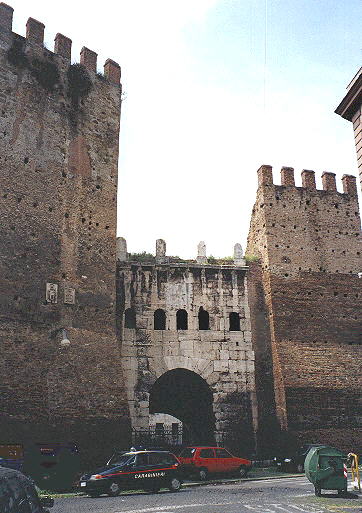
It was getting dark by the time we actually arrived in Rome, but I could still see enough to note where we came through the third-century AD Aurelian Wall, at Porta Tiburtina (Porta S. Lorenzo), where a monumental arch of Augustus took three aqueducts over the road.

Porta Tiburtina

Porta Tiburtina.


The coach then ran up the inside of the wall, which had lots of "Keep off" signs, as this bit is in the grounds of the Ministero della Difesa Aeronautica. Just beyond the Ministry is its ancient equivalent, the camp of the Praetorian Guard, though this can only be detected from the change of direction of the walls.

After that, we were deposited at Roma Termini station, from where we got a modern, clean, but unpunctual, train to Trastevere, booked into our hotel, and joined the rest of the family for pizza.

Sunday was the day of the Baptism. We were bussed out to the institute where the priest are trained, and had the ceremony. I found this fascinating. I always tell my students that the prime difference between Roman religion and Christianity is that in the latter, it is what you believe that matters most, whereas in the former, belief is unimportant, as long as you get the ritual correct. I still think that's true, but much of the belief in the importance of ritual has carried over into Roman Catholic practice - there's a considerable weight placed on getting every act of the ceremony just right.

After this was over, we went to the adjacent Basilica of San Paolo fuori le Mura (St Paul Outside the Walls) for a bit of sightseeing; Kate sat this out in the bus, being quite tired.

Basilica of St Paul

Basilica of St Paul Outside the Walls. Photo Tony Keen 2004.


The Basilica was originally built in the late fourth century, and was progressively modified by various Popes until a disastrous fire in 1823 destroyed most of the building. What is now there kept the floor plan of the pre-1823 building, but is built in a mid-nineteenth century architectural style. It's a bit naff in terms of decoration, but it is very impressive. Once inside, it doesn't take much to imagine it as a Roman basilica (Christian cathedrals took the much of the building form of the multi-purpose Roman halls), full of people busting about their business, with the local dignitary presiding over court proceedings or some such in the raised apse at the far end. Around the side is a collection of fragments from the original building, including some architectural features reused from even earlier buildings.

Then off for lunch, where Mum showed me photos she'd taken at various sites she'd been too. She took some nice photos, which she was good enough to give me a disk of, though sadly most of those in the Domus Aurea didn't come out very well.

After a flop, Mum, Kate and I headed out for the weekend walk which Kate made a New Year's Resolution to do (though we actually forgot that what we did was justified as this until we got back). I wanted to go again to Monte Testaccio. This is a little-visited site, but fascinating in its own way. In the second century BC, Rome moved its docklands area from by the Isola Tiberiana south to an area enclosed on three sides by a bend in the Tiber. This area became known as Emporium (a Latin term applied to a commercial port area). Among the imports offloaded here was olive oil. However, the Romans believed that the amphorae the olive oil came in, once emptied, could not be reused. So they broke them, and stacked them in neat rows in an area behind the wharves and warehouses. After several centuries, this resulted in a small hill, which is now, after a millennium and a half of erosion, about 35 m high. For the most part, the neat stacks have been broken and worn away at the surface of the hill, but on the north side there's a section where it's been restored, and you can see the amphorae fragments as they would have been. Mum took a nice photo of this.


Monte Testaccio. Photo Ann Keen 2004.

From there, it's a short trip along another section of the Aurelian Wall to the Pyramid Monument of Gaius Cestius.

Monument of Cestius and Porta Ostiense

Monument of Cestius (l) and Porta Ostiense (r).


The Pyramid is the mad creation of Cestius, an important Roman of the first century BC. When he died, his slaves were freed under the terms of his will, and built the monument (presumably this was also part of the terms of the will). The gate to the right of the photo above is the Porta Ostiense, also called the Porta San Paolo, because the Via Ostiense, the road to Ostia, takes one past San Paolo fuori le Mura. This became cut off from the rest of the walls by traffic 'improvements' in the 1920s. There is a museum inside it, but I don't fancy your chances of getting to it!

Behind the photographer is the station from where the trains to Ostia depart. So it's a lovely place for me, with archaeology on one side, and trains on the other.

That did for Sunday, and I went to bed reading about the Roman Forum in the rather excellent guide (warning: this links to a page in Italian) the Soprintendenza Archeologica di Roma produce. These guides are well worth picking up if you're in Rome, and I learnt a lot from reading them. Occasionally, however, you can tell it's an Italian text translated into English, such as the point at which they mention a "circular square". In context it makes sense - 'square' is translating some Italian word for a public space.

Monday we had all day for sightseeing. We got to Termini, where we would leave our bags, by tram and bus. We avoided the train, partly because we weren't sure our all-day tickets would be valid (they would have been), and partly because we wanted to see a bit more of Rome.

A Roman Tram

A Roman Tram.


The No. 8 tram brings you to Largo Argentina (the name comes from a name given to a building by an important local dignitary, and has nothing to do with South American countries - a sign at the site gave the exact details, but I can't recall them now). Here we paused to look at the four Republican temples. These all sat in a row in front of the Portico of Pompey. It was in this Portico that Julius Caesar was murdered, though not necessarily (as my Mum thought the notice said) in the bit exposed by the excavation - in fact he was probably killed at the other end, by Pompey's theatre.

The four temples in the Area Sacra Argentina, with Temple D, so-called Temple of Juturna, nearest camera

The four temples in the Area Sacra Argentina, with Temple D, so-called Temple of Juturna, nearest camera. Photo Ann Keen 2001.


From there, a bus led us around the Forum, around the backs of Trajan's Markets, and past the Baths of Diocletian, before depositing us at Termini. There I pointed out what remained of the walls of the Servian period (sixth century BC), walls Rome had outgrown by the early empire, the city being effectively unwalled from then until the time of Aurelian (AD 270-275).

We got a Metro to the Colosseum, which Kate particularly wanted to see (we went in after I'd been rude about the Arch of Constantine, which I find vulgar, not least because of the way it liberally steals its decorations from other monuments). I'd been in this three times before, so was able to give Kate a quick overview, before we prowled around. Then, in one of the arcades, we came across an exhibition called Nike, which was all about games and athletic competitions in the ancient world - we managed to go through it backwards. They had some famous artifacts there, such as the Hellenistic seated bronze boxer found in Rome, and two bronze runners from the Villa of the Papyri in Herculaneum, usually in the National Archeological Museum of Naples. But I was most interested in the graffiti from seats in the Colosseum. Here was the evidence of people whiling away the long days watching the gladiatorial fights, etc., by scratching pictures into the marble.

From there we had lunch; afterwards, Kate caught me out by asking what a building was. I didn't know. It was the Ludus Magnus, the training arena and barracks for the gladiators who fought in the Colosseum.

Ludus Magnus

Ludus Magnus. Photo Kate Bodley 2005.


Then we went to the Forum, where I wanted to take photos of various buildings for my teaching. Kate very patiently followed me round and helped take photos, and then we headed out, via the Forum of Julius Caesar, and various other Imperial Fora, and back to Colosseo Metro station. Along the way, I noticed properly for the first time the back of the Basilica of Maxentius, which I'd never really looked at before. It's pretty impressive from the Forum side, but somehow it seems more so from the Via dei Fori Imperiali.

Basilica of Maxentius, from Via dei Fori Imperiali

Basilica of Maxentius, facing the Via Sacra

Basilica of Maxentius. Top: From Via dei Fori Imperiali. Photo Tony Keen 2004. Bottom: Facing the Via Sacra. Photo Tony Keen 2005.


From there we split up. Kate went shopping, whilst I went to the Ara Pacis. Unfortunately, this is still invisible, as they have not finished the new museum (it was meant to be completed in 2000), though the Mausoleum of Augustus is still to be seen. But left that, as I had a number of places I wanted to visit. First up was the Egyptian obelisk that stands outside the Palazzo di Montecitorio (where the Italian Parliament now sits). This had once been the pointer of Augustus' massive sundial in the Campus Martius. It wasn't too easy to get to, as I found my direct route closed off by the Italian police.

The Obelisk of Montecitorio

The Obelisk of Montecitorio. Photo Ann Keen 2001.


Then I headed back to the centre. I got distracted by a sign to the Pantheon, but though I found the Temple of the Deified Hadrian, which I hadn't seen before, I have to concede I got a bit lost. By the time I'd sorted myself out, I realized I had gone beyond the Pantheon. Time was now running out if I wasn't going to miss the bus to the airport. So I headed down the Forum Boarium, by the river, passing the Capitoline Hill and the replica equestrian statue of Marcus Aurelius on the way. Then to the Theatre of Marcellus, where I actually managed to get a decent photo. Unfortunately, most of the photos I'd taken with Kate's camera were too dark, as it was taking the light reading off the sky. But here I managed to block the sky out.


Theatre of Marcellus. Photo Tony Keen 2004.

I wandered down to the two temples of the Forum Boarium, among the oldest temples in Rome, and among the best preserved.

Temples of Hercules (l) and Portunus (r)

Temples of Hercules (l) and Portunus (r).


By now I was exhausted. I wandered to the bus stop, barely noticing the Bocca della Verita, an ancient drain cover now mounted in the portico of Santa Maria in Cosmedin. I waited for a bus. A bus didn't come. I started to flap. What if the bus didn't come? What if it took ages? What if it didn't come at all? I decided that i could probably walk to Termini in the time I had left, set off to do so, and then realized the smart thing to do was walk through the Circus Maximus back to the Metro. So I did that. The Circus is, as my Mum observed, not as impressive as you might expect. But it is less littered with discarded condoms than when I first came here in 1986.

And that was more-or-less it. The last ancient monument I saw was on the bus back to Ciampino, as we went out through yet another gate in the Aurelian Wall, this time going past the Amphitheatrum Castrense, a small, late amphitheatre that was later built into the wall, and its arches bricked up.

Amphitheatrum Castrense

I didn't see that much on this trip I hadn't seen before. But that was okay. Kate hadn't seen it. And we'll go back.

(Click on the photos without credits for sources and more information.)