Sunday, October 30, 2005
Plato as done by Tarantino
This has been going around the web recently. It's moderately amusing, but what I find interesting is that originally it dates back to 1994. Yet it's being talked about as if it's brand new.

Tuesday, October 25, 2005
Tom Holland's "No sex please, we're Roman"
The BBC has a new epic Rome coming next month (warning: whoever did the BBC website can't spell Mark Antony's name). I had the following article from the Sunday Times, in relation to this series, brought to my attention:
http://www.timesonline.co.uk/article/0,,2092-1838250,00.html
Holland makes some interesting points about the way in which Roman attitudes to sex have been distorted and taken out of context, to make them seem more sexually amoral than they actually were. However, I think he rather over-reacts, and ends up painting an equally unrealistic picture of Roman mores. First century Rome may well not have been a society where people shagged at the drop of a hat, but equally it is not true that everyone observed the morality espoused by the aristocratic writers of the senatorial order, any more than all inhabitants of the British Isles in the nineteenth century adhered to what are now encapsulated as Victorian values. For a start, there's the 'no smoke without fire' point, that the fact that senatorial writers were railing against sexual immorality shows that some people were indulging in it, regardless of public disapproval. There may not have been as much bed-hopping as the senatorial writers say - like Daily Mail leader writers, they tend to exaggerate. And some of those professing the 'proper' Roman morality would have been the ones disregarding it in private - sexual double standards were as common then as now.
But other people had a more free-thinking attitude to sexuality, and this is to be found, for instance, in the works of Ovid. I have to say I find it odd that Holland writes about Roman sexual mores without mentioning Ovid. It means he is as guilty as the producers of Rome of not presenting the whole picture.
I'm sure the series will be sufficiently bonkers.
http://www.timesonline.co.uk/article/0,,2092-1838250,00.html
But other people had a more free-thinking attitude to sexuality, and this is to be found, for instance, in the works of Ovid. I have to say I find it odd that Holland writes about Roman sexual mores without mentioning Ovid. It means he is as guilty as the producers of Rome of not presenting the whole picture.
I'm sure the series will be sufficiently bonkers.
Helen of Troy
I watched Channel 4's much-trailed Helen of Troy documentary, presented by Bettany Hughes.
On the plus side, this is a programme that makes no attempt to talk down to the audience. Hughes is happy to throw in Greek verbs (or even just the concept of the verb) and assume the audience will keep up.
On the minus side, I think the programme is flawed by an attempt to do two separate things, to investigate the 'real' Helen and to examine Helen as a symbol, and blurring the distinction between the two. Hughes talks about her conviction that behind the legendary Helen lies a real Bronze Age queen. She offers no evidence to prove this, because, as she admits, there is none. This doesn't mean that she's wrong, of course. Mythology often coalesces around real individuals (just look at the American West for an example where we can still trace the historical personages concerned), and I am not unhappy to imagine that there might have been a 'real' Helen, or a 'real' Agamemnon, etc. But, as with King Arthur, I wouldn't go much further than that. It's okay to look at what we know of the lives of women in the Mycenaean period. It's okay to look at how archaeologically-attested details turn up in the later legend. It's okay to look at how the political reality revealed by Hittite documents is partially preserved in Homer. It's okay to look at how Helen developed as a symbol for later Greeks (though here Hughes cheats a little, saying at the beginning that we must strip away later interpretations, but being happy to use material from later sources when it suits her). The moment, however, that you begin to retroject details from the legendary Helen to tell the story of the 'real' queen, you're in trouble. The legends have passed through many hands even before they are first written down. Each retelling will add something new, and by the time it gets to Homer, much of the story will be made up. Homer will make stuff up himself - it's what writers do. This isn't to say that some of what we find in the legends of Helen doesn't go back to a real person's life, but to say that it is irrecoverable what is real and what is made up.
Take, for instance, the eloping of Helen and Paris. Now, it may very well be the case that had a foreign prince arrived at Sparta as a xenos, a 'guest-friend', then it would be a very serious breach of etiquette and protocol to run off with the king's wife, and that this could have very serious consequences. Hughes points to records of two Hittite vassal states coming close to war over a princess. But Helen and Paris is also a great romantic story, and simply showing that it is plausible that states might go to war over a woman doesn't show that this story is true.
This programme took the most recent developments in archaeology and Hittitology (which seems to have moved on considerably since I last had any idea what was going on) and weds it to a very traditional approach, the search for the 'truth' behind the legend.
On the minus side, I think the programme is flawed by an attempt to do two separate things, to investigate the 'real' Helen and to examine Helen as a symbol, and blurring the distinction between the two. Hughes talks about her conviction that behind the legendary Helen lies a real Bronze Age queen. She offers no evidence to prove this, because, as she admits, there is none. This doesn't mean that she's wrong, of course. Mythology often coalesces around real individuals (just look at the American West for an example where we can still trace the historical personages concerned), and I am not unhappy to imagine that there might have been a 'real' Helen, or a 'real' Agamemnon, etc. But, as with King Arthur, I wouldn't go much further than that. It's okay to look at what we know of the lives of women in the Mycenaean period. It's okay to look at how archaeologically-attested details turn up in the later legend. It's okay to look at how the political reality revealed by Hittite documents is partially preserved in Homer. It's okay to look at how Helen developed as a symbol for later Greeks (though here Hughes cheats a little, saying at the beginning that we must strip away later interpretations, but being happy to use material from later sources when it suits her). The moment, however, that you begin to retroject details from the legendary Helen to tell the story of the 'real' queen, you're in trouble. The legends have passed through many hands even before they are first written down. Each retelling will add something new, and by the time it gets to Homer, much of the story will be made up. Homer will make stuff up himself - it's what writers do. This isn't to say that some of what we find in the legends of Helen doesn't go back to a real person's life, but to say that it is irrecoverable what is real and what is made up.
Take, for instance, the eloping of Helen and Paris. Now, it may very well be the case that had a foreign prince arrived at Sparta as a xenos, a 'guest-friend', then it would be a very serious breach of etiquette and protocol to run off with the king's wife, and that this could have very serious consequences. Hughes points to records of two Hittite vassal states coming close to war over a princess. But Helen and Paris is also a great romantic story, and simply showing that it is plausible that states might go to war over a woman doesn't show that this story is true.
This programme took the most recent developments in archaeology and Hittitology (which seems to have moved on considerably since I last had any idea what was going on) and weds it to a very traditional approach, the search for the 'truth' behind the legend.
Monday, October 24, 2005
Orestes
Euripides' Orestes, Oxford Playhouse
Performance seen: Saturday 15th October (evening)
As a rule (as I've probably said in this blog before) I don't have high expectations of student performances of Greek tragedy. Undergraduate actors can often lack the necessary emotional maturity to cope with the texts, and there can be a slightly amateurish sense to proceedings.
Every so often, however, I encounter a student production that blows all my preconceptions out of the water. The Oxford University Classical Drama Society's staging of Euripides' Orestes, in the original Greek, is one such. One or two minor points aside, it looks like a professional staging (partly due to the involvement in the crew of people with considerable theatrical experience), and is one of the best productions of Greek tragedy I've seen. Certainly it stands favourable comparison with the RSC's recent London production of Hecuba.*
Orestes is rarely seen, being rather over-shadowed by Aeschylus' Oresteia, which Euripides clearly had in mind when he was writing. The action of Orestes takes place between the second and third plays of the earlier trilogy, and explicitly refers to the famous trial in Eumenides. The characterization of Orestes and his friend and companion Pylades clearly riffs off how they appear in Aeschylus. And, as one of my fellow theatre-goers pointed out, a line where Orestes praises Electra for being a woman with a man's heart echoes a line in Agamemnon where the same quality is thrown at Clytemnestra as an insult (clearer in Morshead's "She in whose woman's breast beats heart of man" than in Browning's near-incomprehensible "The man's-way-planning hoping heart of woman").
There is much else of interest. A work of Euripides' old age, Orestes is the last play that survives which was written before he left Athens (Bacchae and Iphigenia at Aulis were composed in Macedon). It may be a four-actor play.** It has the most sympathetic of Euripides' five portrayals of the Spartan king Menelaus, a character who clearly fascinated him.
It is also the most extreme expression of the deus ex machina that was a noted feature of Euripides' work, whereby conflict is resolved by divine intervention. At the end of the play Orestes and Pylades have murdered Helen, are threatening the life of her daughter Hermione, and have set fire to Agamemnon's palace. Menelaus is raising the population of Argos to storm the building. Just about everyone is going to die, and nothing can avert that. Only the intervention of the god Apollo can restore the characters' destinies to what the audience knows them to be. It's a ridiculous rabbit-out-of-the-hat moment, and is of course meant to be - Euripides is mocking easy solutions and those who proffer them.
As noted, this production is in the original Greek, with English surtitles giving an abridged version of the dialogue, a fairly recent innovation at Greek plays of which I thoroughly approve, as it increases the audience's ability to follow the action (even if, like me, you were so close to the front of the auditorium that it was a bit of a strain to look up from the action on stage to the surtitles). The text itself has been trimmed a bit - a couple of interjections by the Chorus into dialogue between actors appeared to have been lost, and the second half of the Phrygian Slave's scene, his confrontation with Orestes, has been wholly excised. None of these cuts harm the play as a whole. (Also, mischievously, a reference was included in the surtitles to the loss of a bottle of oil, alluding to Aristophanes' send-up of Euripides' style in Frogs, where he demonstrates how many of Euripides' prologues can be ended with 'lost his little bottle of oil'. As far as I know, that line is not actually in Orestes, nor indeed anywhere else in Euripides' extant writings.)
The first thing that impresses one about the Oxford production is the set design. The action is transferred from Argos, where the tragedians placed Agamemnon, back to his Homeric location of Mycenae, which is where a modern audience automatically associates with him. The set is made to look like Mycenae's ruins, because, as director Pippa Needs says in the programme, "the way in which we all interpret these relics says as much, if not more, about us today as ... about the ancient Greeks." It also conjures up, deliberately or not, the spirit of Michael Cacoyannis' films of Euripides (Electra, Trojan Women, and Iphigenia at Aulis). The set is cleverly lit, with the lighting changing to reflect the mood of the action.
Then there is the acting. Rose Heiney's Electra makes the language emote. Matt Trueman as Orestes takes the character from a tortured soul who has the audience's sympathies to an out-of-control paranoiac who rails at anyone who frustrates his wishes (the point at which this is made clear to the audience is a scene which appears at first redundant, where Orestes explains to Pylades the action of the first half of the play - the point is that Orestes' version of events is so far removed from what has been seen that it signals his disconnection with reality). Alex Kalderimis gives us a Pylades clearly more interested in Orestes than Electra, and carries well the moment that he goes beyond the loyal friend to psychopathic killer (one of few moments that elicit laughter from the audience, but this is in reaction to the text in the surtitles, not to Kalderimis' performance). Sheridan Edwards invests the Phrygian Slave with both comedy and dignity. Best of all is Himanshu Ojha as Menelaus. Clad as an eastern prince (presumably a deliberate visual echo of Tyndareus' accusation that Menelaus has 'gone native' after a decade in Troy), this is a Menelaus worth watching even when he isn't speaking - through facial expression Ojha tells us much about the thought processes going on in Menelaus' head. He also doubles up as the Messenger without making it too obvious to the audience that it is the same actor.
It is to the credit of speech coach Ben Cartlidge that this production is never hurt by the typical curse of Greek plays, cast members who appear to be reciting their lines with no real idea of the meaning of what they are saying; instead everyone conveys an awareness of both the literal and emotional content of the text (though occasionally a line gets forgotten). It's a pity, then, that Cartlidge's own performance as Apollo seems rather stilted, though, as the same companion said, it could be argued that this is deliberately emphasizing the artificiality of the deus ex machina ending.
One might find fault with some of the other performances. After a strong start, Heiney is a little single-level in the second act, shunning opportunities to vary her tone. Guy Westwood is visibly too young and lacks enough gravitas in his voice to fully carry off Tyndareus (one of the moments where the student nature of the production shows through). But it should be emphasized that these are merely moments of actors being less good than others in the production - overall, the standard of acting is high.
The Chorus rightly blend movement and music in measured proportion. Again, the music is often reminiscent of Cacoyannis and his use of traditional Greek music, but other influences, such as from the European classical tradition are allowed, particularly in the second act. Impressively, the production attempts arias for the actors as well as choral songs. These were an integral part of the original performance, but are often difficult to carry off with a modern audience. This production gives Electra a sung lament, and the Phrygian Slave's conversation with the Chorus is conducted part spoken, part sung, almost like Gilbert and Sullivan. Both of these work, and rather better than the attempts at the same approach in the RSC's Hecuba, where Vanessa Redgrave's (lack of a) singing voice imposed severe limitations.
A great deal of thought has gone into this production - this is emphasized by a moment noted by another companion, Dr Penny Goodman, where Orestes pleads with Menelaus in a pose of supplication taken from Greek vase painting, clasping Menelaus' knees and beard. The result is a bold, imaginative and high quality production, that all involved can be proud of.
* I got halfway through writing a blog entry about that production, but never finished it. To quickly summarize, I thought it was an interesting production rather let down by a muted performance by Vanessa Redgrave in the title role.
** Early on in the play Helen calls her daughter Hermione on stage to instruct her in making an offering at Clytemnestra's tomb. Two other actors apart from Helen are already on stage, as Electra and Orestes (though the latter has yet to speak). Hermione says nothing at this point, but does when she returns on stage later on. So either the role was meant to be played in the first scene by one of the non-speaking performers who often took the roles of slaves or children (such as Oedipus' daughters at the end of Oedipus the King), and only later played by one of the actors - which would be perfectly possible in a masked production - or there was a fourth actor who played Hermione. Given that Sophocles appears to be doing something similar at the end of Oedipus at Colonus (where either there are four actors or the role of Ismene is split between two), I like to think that towards the end of the fifth century the tragedians were experimenting with going beyond the rigid three-actor format.
Performance seen: Saturday 15th October (evening)
Every so often, however, I encounter a student production that blows all my preconceptions out of the water. The Oxford University Classical Drama Society's staging of Euripides' Orestes, in the original Greek, is one such. One or two minor points aside, it looks like a professional staging (partly due to the involvement in the crew of people with considerable theatrical experience), and is one of the best productions of Greek tragedy I've seen. Certainly it stands favourable comparison with the RSC's recent London production of Hecuba.*
Orestes is rarely seen, being rather over-shadowed by Aeschylus' Oresteia, which Euripides clearly had in mind when he was writing. The action of Orestes takes place between the second and third plays of the earlier trilogy, and explicitly refers to the famous trial in Eumenides. The characterization of Orestes and his friend and companion Pylades clearly riffs off how they appear in Aeschylus. And, as one of my fellow theatre-goers pointed out, a line where Orestes praises Electra for being a woman with a man's heart echoes a line in Agamemnon where the same quality is thrown at Clytemnestra as an insult (clearer in Morshead's "She in whose woman's breast beats heart of man" than in Browning's near-incomprehensible "The man's-way-planning hoping heart of woman").
There is much else of interest. A work of Euripides' old age, Orestes is the last play that survives which was written before he left Athens (Bacchae and Iphigenia at Aulis were composed in Macedon). It may be a four-actor play.** It has the most sympathetic of Euripides' five portrayals of the Spartan king Menelaus, a character who clearly fascinated him.
It is also the most extreme expression of the deus ex machina that was a noted feature of Euripides' work, whereby conflict is resolved by divine intervention. At the end of the play Orestes and Pylades have murdered Helen, are threatening the life of her daughter Hermione, and have set fire to Agamemnon's palace. Menelaus is raising the population of Argos to storm the building. Just about everyone is going to die, and nothing can avert that. Only the intervention of the god Apollo can restore the characters' destinies to what the audience knows them to be. It's a ridiculous rabbit-out-of-the-hat moment, and is of course meant to be - Euripides is mocking easy solutions and those who proffer them.
As noted, this production is in the original Greek, with English surtitles giving an abridged version of the dialogue, a fairly recent innovation at Greek plays of which I thoroughly approve, as it increases the audience's ability to follow the action (even if, like me, you were so close to the front of the auditorium that it was a bit of a strain to look up from the action on stage to the surtitles). The text itself has been trimmed a bit - a couple of interjections by the Chorus into dialogue between actors appeared to have been lost, and the second half of the Phrygian Slave's scene, his confrontation with Orestes, has been wholly excised. None of these cuts harm the play as a whole. (Also, mischievously, a reference was included in the surtitles to the loss of a bottle of oil, alluding to Aristophanes' send-up of Euripides' style in Frogs, where he demonstrates how many of Euripides' prologues can be ended with 'lost his little bottle of oil'. As far as I know, that line is not actually in Orestes, nor indeed anywhere else in Euripides' extant writings.)
The first thing that impresses one about the Oxford production is the set design. The action is transferred from Argos, where the tragedians placed Agamemnon, back to his Homeric location of Mycenae, which is where a modern audience automatically associates with him. The set is made to look like Mycenae's ruins, because, as director Pippa Needs says in the programme, "the way in which we all interpret these relics says as much, if not more, about us today as ... about the ancient Greeks." It also conjures up, deliberately or not, the spirit of Michael Cacoyannis' films of Euripides (Electra, Trojan Women, and Iphigenia at Aulis). The set is cleverly lit, with the lighting changing to reflect the mood of the action.
Then there is the acting. Rose Heiney's Electra makes the language emote. Matt Trueman as Orestes takes the character from a tortured soul who has the audience's sympathies to an out-of-control paranoiac who rails at anyone who frustrates his wishes (the point at which this is made clear to the audience is a scene which appears at first redundant, where Orestes explains to Pylades the action of the first half of the play - the point is that Orestes' version of events is so far removed from what has been seen that it signals his disconnection with reality). Alex Kalderimis gives us a Pylades clearly more interested in Orestes than Electra, and carries well the moment that he goes beyond the loyal friend to psychopathic killer (one of few moments that elicit laughter from the audience, but this is in reaction to the text in the surtitles, not to Kalderimis' performance). Sheridan Edwards invests the Phrygian Slave with both comedy and dignity. Best of all is Himanshu Ojha as Menelaus. Clad as an eastern prince (presumably a deliberate visual echo of Tyndareus' accusation that Menelaus has 'gone native' after a decade in Troy), this is a Menelaus worth watching even when he isn't speaking - through facial expression Ojha tells us much about the thought processes going on in Menelaus' head. He also doubles up as the Messenger without making it too obvious to the audience that it is the same actor.
It is to the credit of speech coach Ben Cartlidge that this production is never hurt by the typical curse of Greek plays, cast members who appear to be reciting their lines with no real idea of the meaning of what they are saying; instead everyone conveys an awareness of both the literal and emotional content of the text (though occasionally a line gets forgotten). It's a pity, then, that Cartlidge's own performance as Apollo seems rather stilted, though, as the same companion said, it could be argued that this is deliberately emphasizing the artificiality of the deus ex machina ending.
One might find fault with some of the other performances. After a strong start, Heiney is a little single-level in the second act, shunning opportunities to vary her tone. Guy Westwood is visibly too young and lacks enough gravitas in his voice to fully carry off Tyndareus (one of the moments where the student nature of the production shows through). But it should be emphasized that these are merely moments of actors being less good than others in the production - overall, the standard of acting is high.
The Chorus rightly blend movement and music in measured proportion. Again, the music is often reminiscent of Cacoyannis and his use of traditional Greek music, but other influences, such as from the European classical tradition are allowed, particularly in the second act. Impressively, the production attempts arias for the actors as well as choral songs. These were an integral part of the original performance, but are often difficult to carry off with a modern audience. This production gives Electra a sung lament, and the Phrygian Slave's conversation with the Chorus is conducted part spoken, part sung, almost like Gilbert and Sullivan. Both of these work, and rather better than the attempts at the same approach in the RSC's Hecuba, where Vanessa Redgrave's (lack of a) singing voice imposed severe limitations.
A great deal of thought has gone into this production - this is emphasized by a moment noted by another companion, Dr Penny Goodman, where Orestes pleads with Menelaus in a pose of supplication taken from Greek vase painting, clasping Menelaus' knees and beard. The result is a bold, imaginative and high quality production, that all involved can be proud of.
* I got halfway through writing a blog entry about that production, but never finished it. To quickly summarize, I thought it was an interesting production rather let down by a muted performance by Vanessa Redgrave in the title role.
** Early on in the play Helen calls her daughter Hermione on stage to instruct her in making an offering at Clytemnestra's tomb. Two other actors apart from Helen are already on stage, as Electra and Orestes (though the latter has yet to speak). Hermione says nothing at this point, but does when she returns on stage later on. So either the role was meant to be played in the first scene by one of the non-speaking performers who often took the roles of slaves or children (such as Oedipus' daughters at the end of Oedipus the King), and only later played by one of the actors - which would be perfectly possible in a masked production - or there was a fourth actor who played Hermione. Given that Sophocles appears to be doing something similar at the end of Oedipus at Colonus (where either there are four actors or the role of Ismene is split between two), I like to think that towards the end of the fifth century the tragedians were experimenting with going beyond the rigid three-actor format.
Friday, October 07, 2005
Publicity for an upcoming Greek play
The Oxford Greek Play, Euripides' Orestes, has just got mentioned on Newsnight Review. They did mention that it's being performed in the original Greek - but interestingly didn't put it in context that this is a long standing tradition (the first Greek play was done 125 years ago, though they don't put one on annually as King's College, London do). Also, it wasn't mentioned that this is a student production - perhaps the BBC haven't realized.
I'll let you know what I think of the production after I've seen it next Saturday.
I'll let you know what I think of the production after I've seen it next Saturday.
Monday, October 03, 2005
Claudius, Nero, and the Imperial succession
[The following is an article that I had in the summer 2005 OU Classical Studies Newsletter. I've taken the opportunity of making a couple of minor corrections, and adding the source passages.]
Claudius, Nero, and the Imperial succession
This short paper intends to examine some issues relating to the emperor Claudius' apparently strange decision in AD 49 to marry his niece Agrippina, and advance her son Nero towards the imperial throne, at the expense of his own son Britannicus. It derives from a tutorial I have presented to students taking [the OU course] AA309 Culture, Identity and Power in the Roman Empire.
The first thing to note is the intrinsic bias in the sources against Claudius, to which students are introduced in AA309 Block One, section 3.4. In essence, most of our sources represent the senatorial tradition. This tradition was hostile to the very idea of the principate, though reluctantly accepting its necessity (the debate in the Senate following the death of Gaius Caligula considered not just the restoration of the Republic, but also, more realistically, the elevation of one of their number to the purple). It was also hostile to Claudius in particular, for two reasons. First, Claudius' physical disability (sometimes thought to be cerebral palsy) meant that he was believed to be a fool, and senators were unwilling to accept that they had been wrong. Secondly, he took away much of what had previously been the Senate's responsibility in the running of the empire; like Tiberius, he attempted to co-operate with the Senate, and like Tiberius, often faced stalemate in trying to get them to do what he needed them to do. But where Tiberius had given up in despair, Claudius took the Senate out of the equation.[1] Finally, the tradition was hostile to Claudius' niece and wife Agrippina, because it was intrinsically hostile to powerful women.

Figure 1 Gold aureus of Nero, AD 54, obverse. Facing portraits of Nero and Agrippina the Younger. Legend: AGRIPP. AVG. DIVI CLAVD. NERONIS CAES. MATER ('Agrippina Augusta, wife of the Divine Claudius, mother of Nero Caesar'). Found at Herculaneum, among victims of the eruption of Vesuvius. Naples, National Archaeological Museum. Photo: Barbara McManus. (http://www.vroma.org/images/mcmanus_images/nero_agrippinacoin.jpg)
This quote comes from Brian Walden's 1999 television programme on Nero, from the series Walden on Villains, and gives a common modern view of Nero's approach to the throne; Walden presents Nero as a usurper, advanced to the principate by his ambitious mother. This is a picture that goes back to the ancient sources. Cassius Dio (History of Rome 61.34; passage (b) below) says that Britannicus by rights should have succeeded. Tacitus (Annals 12.1-3; passage (c)) and Suetonius (Life of Claudius 26; passage (d)) present an account in which Agrippina used her sexual wiles to win over Claudius after the execution of his previous wife, Messalina, for treason.

Figure 2 Head of Claudius, found in River Alde, Suffolk. British Museum, London. (Photo © British Museum.) From AA309 Illustrations Book, Plate 4.15.
However, behind this tale of tabloid sleaze lies serious dynastic politics. Cassius Dio's opinion is based on the empire of his own time, when the son of an emperor would be an obvious candidate to succeed his father (though the truth is that the Roman empire never formalized the process of succession until the time of Diocletian). Matters were somewhat different in the Julio-Claudian period. If one looks at the family tree a different picture emerges. A biological link can be traced between Nero, through his mother Agrippina the Younger, her mother Agrippina the Elder, and her mother Julia the Elder, to Augustus himself. Nero was Augustus' great-great-grandson. The importance of this has been noted by Barrett (1996, p. 97), and though Fagan (1998, n. 24) is sceptical, it seems to me that the relationship is key to the promotion of Nero.
Augustus, perhaps aware of the weak position only being Julius Caesar's testamentary heir had put him in, had pushed the blood relationship to himself as an important qualification for the principate. He first marked out his son-in-law Marcellus as a potential successor, with the intention that the children of his daughter should eventually succeed. For the same reason he adopted his grandsons Gaius and Lucius Caesar. When he adopted Tiberius as his son, he made Tiberius adopt Germanicus; the importance of the adoption was that Germanicus was married to Augustus' grand-daughter Agrippina, so that the succession, after passing through Tiberius and Germanicus, would revert to Augustus' blood descendants, as it did with the accession of Gaius.[2] As Robert Graves put it (I, Claudius, ch. 13): 'It was a satisfaction to Augustus that Germanicus ... was Tiberius's natural successor, and that Germanicus's infant sons ... were his own great-grandsons. Though Fate had decreed against his grandsons succeeding him he would surely one day reign again, as it were, in the persons of his great-grandchildren.' Despite the different attitude of Romans to adoption compared to our own (see Jones and Sidwell, 1997, p. 216; passage (e)), this blood relationship was evidently extremely important to Augustus. Even the descendants of his sister Octavia, often held up as being significant in terms of the succession, were mainly used by Augustus as husbands, wives and guardians for his blood descendants. Hence, Agrippina could view the principate as her son's birthright.
A similar connection cannot be traced from Claudius or his son Britannicus to Augustus. Claudius did not even have an adoptive link with Augustus, as his uncle Tiberius and his brother Germanicus had. He took the name Caesar on his accession, but had no title to it other than that he gave himself and a tenuous descent from Julius Caesar's father, through four generations of women. He was descended from Augustus' sister Octavia; but so was Nero. (It is reported that Claudius revived a rumour that his father, with whom his grandmother Livia was pregnant when she divorced her husband to marry Augustus, was actually Augustus’ illegitimate son, a rumour that would allege the blood relationship that Claudius otherwise could not prove.)
This made Claudius' position very weak. He came to the throne largely through default, there being nobody better available; only by his promotion had a civil war between rival senatorial candidates for the principate been avoided. As the young Lucius Domitius Ahenobarbus (the future Nero) grew up, he would be a potential focus around which opposition to Claudius could gather. That opposition could be side-stepped by bringing the boy into his own family. By promoting a genuine descendant of Augustus as his successor, Claudius could strengthen his own position. Hence he rapidly made Nero his stepson, adopted son, and son-in-law. The dynastic arguments were so strong that Claudius was prepared to countenance a marriage that was, by Roman law, incestuous. From the moment of his marriage to Agrippina, Britannicus was sidelined. Given the fates of Agrippa Postumus and Tiberius Gemellus (see Goodman, 1997, pp. 48 & 54) he may well have recognized that he was effectively signing his own son's death warrant; but if so he clearly thought a smooth unchallenged succession, avoiding the possibility of civil war, more important.[3]

Figure 3 Detail of a statue of Augustus, found in Via Labicana, Rome. Date: after 12 BC (from the toga fold draped over his head, indicating his role as pontifex maximus). Muzeo Nationale, Rome. (Photo © Alinari.) From AA309 Illustrations Book, Plate 1.5.
There were other male descendants of Augustus around; the Junii Silani, Marcus, Lucius and Decimus. Their mother was Aemilia Lepida, who was daughter of the younger Julia, the eldest daughter of Marcus Agrippa and Augustus' daughter Julia. A number of these were alive in Claudius' reign, and older than Ahenobarbus (Nero). Why did Claudius not turn to one of them? Well, in a sense, he had. The second son, Lucius Silanus was, until Claudius' marriage to Agrippina, betrothed to Claudius' daughter, Octavia.
However, there was something about the Junii Silani that made them unsuitable as imperial heirs. Marcus had been born in AD 14, so was an adult at the time of the assassination of Gaius, who was only a couple of years older. Yet he was never considered a serious alternative to the disabled Claudius. Though the Junii Silani were an old Roman patrician family (they belonged to the same gens as the Junii Bruti, who had produced one of the founders of the Republic and, much later, Caesar's assassin Marcus Junius Brutus), they seem not to have had great standing with the army. Ahenobarbus, on the other hand, as well as being a descendant of Augustus, and also of his sister Octavia, was a grandson of Germanicus, who had been immensely popular with the army. Since Claudius' own elevation had shown the importance of the army in supporting the emperor, Ahenobarbus was a better-placed candidate.
One might ask why Claudius ever bothered with the Junii Silani at all. It's not very clear, but my own suspicion is that originally Claudius based his hopes for the succession around his son Britannicus. Lucius Silanus would be a suitable husband for his daughter, but would not prove a rival to Britannicus. Ahenobarbus would be a more significant threat to Britannicus' succession. Yet Claudius seems to have hedged his bets, and not taken permanent action to remove Ahenobarbus. His wife Messalina may have seen things differently. Suetonius certainly says (Life of Nero 6) that she saw Ahenobarbus as a threat to Britannicus, and alleges that she tried to have the child assassinated.
After the crisis of Messalina's conspiracy in AD 48 (possibly, though this is complete speculation, inspired by Claudius' failure to eliminate the growing threat from Ahenobarbus), things looked rather different. Claudius' own vulnerability was apparent, and there was now a cloud over Britannicus as the son of a traitor. In order the strengthen his own position, and improve the chances of a smooth succession, Claudius had to turn to Agrippina and Ahenobarbus. Agrippina subsequently engineered the disgrace of Lucius Silanus, and after Claudius' death made sure she eliminated his older brother Marcus. (It is notable that Seneca mentions the death of Lucius as one of Claudius' crimes in Apocolocyntosis 10, passing over the fact that his removal helped Nero's passage to the throne.)
As an appendix to this, it is worth considering the supposed murder of Claudius by Agrippina. All the ancient sources suggest this. Josephus, Jewish Antiquities 20.148 (passage (f)), makes it a rumour, but Tacitus (Annals 12.65-9; passage (g)) and Suetonius (Life of Claudius 43-6; passage (h)) are quite certain that Claudius was poisoned. The tale, given by Tacitus and as one version by Suetonius, is that Agrippina administered a fatal dose of poisoned mushrooms to her husband. Most scholars accept the murder without question, feeling that Claudius' death comes too conveniently after the time when Nero was capable of taking the reigns of power himself (yet still young enough that he could be guided by his mother, who hoped to rule through him), but before Britannicus was old enough to do so. However, a number of points need to be considered.
First, this is exactly the sort of story told about powerful imperial women. A similar accusation was made about Livia, who was alleged to have killed Augustus in a very similar fashion (figs instead of mushrooms). Allegations of poison were easy to make and difficult to disprove, and unless any of the individuals involved confessed, which seems unlikely, the details of the murder can only be hearsay, and are contradictory in the sources - some, indeed, such as the poisoned feather that Tacitus says was administered by Claudius' doctor Xenophon, after Claudius had vomited up the original mushrooms, must be invention, as no poison known to the Romans was that fast-acting.
Secondly, Agrippina had already achieved her objective. Nero was the clear successor, and Britannicus was not a serious candidate. There might appear to have been no need to kill Claudius to secure Nero's position.
Thirdly, Claudius was gravely ill in late AD 52 and early AD 53, and some of his acts in his last years (see Suetonius, Life of Claudius 46) look like those of a man aware he had not much longer to live. Agrippina had only to wait.
On the other hand, if Claudius really was expressing intentions to put aside Nero, as Suetonius says he was (Life of Claudius 43), then it is not too surprising that Agrippina acted swiftly. She knew, having seen two of her brothers die in custody, that people could be easily taken out of the line of succession, and the consequences would no doubt have been fatal for her and her son.
The case must remain unproven.
Sources
The marriage to Agrippina
(a)
Pushed on by his overbearing mother, Agrippina, [Nero] was only 16 when crowned. Indeed it was his mother's machinations that had seen this patently ill-equipped and unprepared boy to power.
(Grabsky, 2001, p. 34)
(b)
At the death of Claudius the rule in strict justice belonged to Britannicus, who was a legitimate son of Claudius and in physical development was in advance of his years; yet by law the power fell also to Nero because of his adoption. But no claim is stronger than that of arms; for everyone who possesses superior force always appears to have the greater right on his side, whatever he says or does. And thus Nero, having first destroyed the will of Claudius and having succeeded him as master of the whole empire, put Britannicus and his sisters out of the way. Why, then, should one lament the misfortunes of the other victims?
(Cassius Dio, History of Rome 61.34)
(c)
1 Messalina’s death convulsed the imperial household. Claudius was impatient of celibacy and easily controlled by his wives, and the ex-slaves quarrelled about who should choose his next one. Rivalry among the women was equally fierce. Each cited her own high birth, beauty, and wealth as qualifications for this exalted marriage. The chief competitors were Lollia Paulina, daughter of the former consul Marcus Lollius, and Germanicus' daughter Agrippina. Their backers were Callistus and Pallas respectively. Narcissus supported Aelia Paetina, who was of the family of the Aelii Tuberones. The emperor continually changed his mind according to whatever advice he had heard last.
Finally, he summoned the disputants to a meeting and requested them to give reasoned opinions.
2 At the meeting, Narcissus reminded Claudius that he had been married to Aelia Paetina before; that the union had been productive (a daughter, Claudia Antonia, had been born to them); that remarriage would necessitate no domestic innovations; and that, far from entertaining a stepmother's dislike for Britannicus and Octavia, Paetina would cherish them next to her own children. Callistus objected that Claudius had divorced Paetina long ago and that this disqualified her – remarriage would make her arrogant, and Lollia was far more eligible since, being childless, she would be a mother to her stepchildren without jealousy. Pallas, proposing Agrippina, emphasized that the son whom she would bring with her was Germanicus' grandson, eminently deserving of imperial rank; let the emperor ally himself with a noble race and unite two branches of the Claudian house, rather than allow this lady of proved capacity for child-bearing, still young, to transfer the glorious name of the Caesars to another family.
3 These arguments prevailed. Agrippina's seductiveness was a help. Visiting her uncle frequently – ostensibly as a close relation – she tempted him into giving her the preference and into treating her, in anticipation, as his wife. Once sure of her marriage, she enlarged the scope of her plans and devoted herself to scheming for her son Lucius Domitius Ahenobarbus, whose father was Cnaeus Domitius Ahenobarbus. It was her ambition that this boy, the future Nero, should be wedded to the emperor’s daughter Octavia. Here criminal methods were necessary, since Claudius had already betrothed Octavia to Lucius Junius Silanus Torquatus – and had won popularity for his distinguished record by awarding him an honorary Triumph, and giving a lavish gladiatorial display in his name. But with an emperor whose likes and dislikes were all sug-gested and dictated to him anything seemed possible.
(Tacitus, Annals 12.1-3, tr. Grant, 1996, pp. 252-3)
(d)
Almost at once, however, he planned either to marry Lollia Paulina, Caligula's widow, or to re-marry his divorced wife Aelia Paetina; but it was Agrippina, daughter of his brother Germanicus, who hooked him. She had a niece's privilege of kissing and caressing Claudius, and exercised it with a noticeable effect on his passions: when the House next met, he persuaded a group of senators to propose that a union between him and her should be compulsorily arranged, in the public interest; and that other uncles should likewise be free to marry their nieces, though this had hitherto counted as incest. The wedding took place with scarcely a single day’s delay, but no other uncle cared to follow Claudius's example, except one freedman, and one leading-centurion [primus pilus] whose marriage he and Agrippina both attended.
(Suetonius, Life of Claudius 26, tr. Graves, 1989, p. 203)
(e)
Another striking freedom was over adoption. European aristocracies operating under feudal rules have been much encumbered by primogeniture (the automatic privileging of the elder son), absence of female succession, and impossibility of adoption. Roman rules not only treated all children more equally, but made it easy to produce substitute sons and heirs by adoption. By given rituals, a son passed from one familia to another (interestingly, the rituals might involve the same use of weights and scales as for the acquisition of a wife under coemptio, or a slave). But even if the formalities had not been completed, it was possible to use your will to nominate someone as heir to your property and name. Though this was not technically an adoption, the ease with which Caesar's testamentary heir (Octavian) passed himself off as his son shows that custom accepted the situation.
(Jones and Sidwell, 1997, p. 216)
The death of Claudius
(f)
Now Claudius Caesar died when he had reigned thirteen years, eight months, and twenty days; and a report went about that he was poisoned by his wife Agrippina. Her father was Germanicus, the brother of Caesar. Her husband was Domitius Ahenobarbus, one of the most illustrious persons that was in the city of Rome; after whose death, and her long continuance in widowhood, Claudius took her to wife. She brought along with her a son, Domitius, of the same name with his father. He had before this slain his wife Messalina, out of jealousy, by whom he had his children Britannicus and Octavia; their eldest sister was Antonia, whom he had by Paetina his first wife.[5] He also married Octavia to Nero; for that was the name that Caesar gave him afterward, upon his adopting him for his son.
(Josephus, Jewish Antiquities 20.148, tr. Whiston)
(g)
65 However, the charge against Lepida[6] was attempting the life of the empress by magic, and disturbing the peace of Italy by failing to keep her Calabrian slave-gangs in order. On these charges she was sentenced to death – in spite of vigorous opposition by Narcissus. His suspicions of Agrippina continually grew deeper. 'Whether Britannicus or Nero comes to the throne,' he was said to have told his friends, 'my destruction is inevitable. But Claudius has been so good to me that I would give my life to help him. The criminal intentions for which Messalina was condemned with Gaius Silius have re-emerged in Agrippina. With Britannicus as his successor the emperor has nothing to fear. But the intrigues of his stepmother in Nero's interests are fatal to the imperial house – more ruinous than if I had said nothing about her predecessor's unfaithfulness. And once more there is unfaithfulness. Agrippina's lover is Pallas. That is the final proof that there is nothing she will not sacrifice to imperial ambition – neither decency, nor honour, nor chastity.'
Talking like this, Narcissus would embrace Britannicus and pray he would soon be a man. With hands outstretched – now to the boy, now to heaven – he besought that Britannicus might grow up and cast out his father's enemies, and even avenge his mother's murderers.
66 Then Narcissus' anxieties caused his health to fade. He retired to Sinuessa, to recover his strength in its mild climate and health-giving waters.
Agrippina had long decided on murder. Now she saw her opportunity. Her agents were ready. But she needed advice about poisons. A sudden, drastic effect would give her away. A gradual, wasting recipe might make Claudius, confronted with death, love his son again. What was needed was something subtle that would upset the emperor’s faculties but produce a deferred fatal effect. An expert in such matters was selected – a woman called Locusta, recently sentenced for poisoning but with a long career of imperial service ahead of her. By her talents, a preparation was supplied. It was administered by the eunuch Halotus who habitually served the emperor and tasted his food.
67 Later, the whole story became known. Contemporary writers stated that the poison was sprinkled on a particularly succulent mushroom. But because Claudius was torpid – or drunk – its effect was not at first apparent; and an evacuation of his bowels seemed to have saved him. Agrippina was horrified. But when the ultimate stakes are so alarmingly large, immediate disrepute is brushed aside. She had already secured the complicity of the emperor’s doctor Xenophon; and now she called him in. The story is that, while pretending to help Claudius to vomit, he put a feather dipped in a quick poison down his throat. Xenophon knew that major crimes, though hazardous to undertake, are profitable to achieve.
68 The senate was summoned. Consuls and priests offered prayers for the emperor's safety. But meanwhile his already lifeless body was being wrapped in blankets and poultices. Moreover, the appropriate steps were being taken to secure Nero's accession. First Agrippina, with heart-broken demeanour, held Britannicus to her as though to draw comfort from him. He was the very image of his father, she declared. By various devices she prevented him from leaving his room and likewise detained his sisters, Claudia Antonia and Octavia. Blocking every approach with troops, Agrippina issued frequent encouraging announcements about the emperor's health, to maintain the Guards' morale and await the propitious moment forecast by the astrologers.
69 At last, at midday on October the thirteenth, the palace gates were suddenly thrown open. Attended by Sextus Afranius Burrus, commander of the Guard, out came Nero to the battalion which, in accordance with regulations, was on duty. At a word from its commander, he was cheered and put in a litter. Some of the men are said to have looked round hesitantly and asked where Britannicus was. However, as no counter-suggestion was made, they accepted the choice offered them. Nero was then conducted into the Guards' camp. There, after saying a few words appropriate to the occasion – and promising gifts on the generous standard set by his father – he was hailed as emperor.[7] The army's decision was followed by senatorial decrees. The provinces, too, showed no hesitation.
Claudius was voted divine honours, and his funeral was modelled on that of the divine Augustus – Agrippina imitating the grandeur of her great-grandmother Livia, the first Augusta. But Claudius' will was not read, in case his preference of stepson to son should create a public impression of unfairness and injustice.
(Tacitus, Annals 12.65-9, tr. Grant, 1996, pp. 281-3)
(h)
43 In his last years Claudius made it pretty plain that he repented of having married Agrippina and adopted Nero. For example, when his freedmen congratulated him on having found a certain woman guilty of adultery, he remarked that he himself seemed fated to marry wives who 'were unchaste but remained unchastened'; and presently, meeting Britannicus, embraced him with deep affection. 'Grow up quickly, my boy,' he said, 'and I will then explain what my policy has been.' With that he quoted in Greek from the tale of Telephus and Achilles:
and declared his intention of letting Britannicus come of age because although immature, he was tall enough to wear the toga of manhood; adding 'which will at last provide Rome with a true-born Caesar.'[8]
44 Soon afterwards he composed his will and made all the magistrates put their seals to it as witnesses; but Agrippina, being now accused of many crimes by informers as well as her own conscience, prevented him from going any further.
Most people think that Claudius was poisoned; but when, and by whom, is disputed. Some say that the eunuch Halotus, his official taster, administered the drug while he was dining with the priests in the Citadel; others, that Agrippina did so herself at a family banquet, poisoning a dish of mushrooms, his favourite food. An equal discrepancy exists between the accounts of what happened next. According to many, he lost his power of speech, suffered frightful pain all night long, and died shortly before dawn. A variant version is that he fell into a coma but vomited up the entire contents of his overloaded stomach and was then poisoned a second time, either by a gruel – the excuse being that he needed food to revive him – or by means of an enema, the excuse being that his bowels required relief and must be emptied too.
45 Claudius' death was not revealed until all arrangements had been completed to secure Nero's succession. As a result, people made vows for his safety as though he still lived, and a troop of actors were summoned, under the pretence that he had asked to be diverted by their antics. He died on 13th October,[9] during the consulship of Asinius Marcellus and Acilius Aviola [AD 54], in his sixty-fourth year, and the fourteenth of his reign. He was given a princely funeral and officially deified, an honour which Nero later neglected and then cancelled; but which Vespasian restored.
46 The main omens of Claudius' death included the rise of a long haired star, known as a comet, lightning that struck his father's tomb, and an unusual mortality among magistrates of all ranks. There is also evidence that he foresaw his end and made no secret of it: while choosing the Consuls he provided for no appointment after the month in which he died; and on his last visit to the House offered an earnest plea for harmony between his children,[10] begging the Senate to guide both of them with great care through the years of their youth. During a final appearance on the tribunal he said more than once that he had reached the close of his career; though everyone present cried: 'The Gods forbid!'
(Suetonius, Life of Claudius 43-6, tr. Graves, 1989, pp. 211-12; see Lewis and Reinhold, 1990, pp. 355-6, for chs. 43-4)
Notes
[1] This issue is gone into in more detail in Potter, 1982, pp. 27-9.
[2] Goodman, 1997, in the caption on p. 53, Plate 3, says that Augustus was Gaius' great-grandfather by adoption. This is true, but he was also his natural great-grandfather. In contrast on p. 56 he says that Nero's wife Octavia was descended from Julius Caesar, which is not true.
[3] There is, however, circumstantial evidence that Britannicus may have died not from poison, as alleged, but from an epileptic seizure; see Barrett, 1998, pp. 170-2.
[4] Note that Gaius Appius Junius Silanus, who was executed by Claudius in AD 42, belonged to a different branch of the family from that which had married into the descendants of Augustus (Robert Graves got this wrong in I, Claudius and Claudius The God).
[5] Actually his second.
[6] Domitia Lepida, mother of Claudius' third wife Messalina, and grandmother of Britannicus and Octavia. She was also Claudius' cousin, her mother and his being sisters, and therefore a great-niece of Augustus.
[7] I.e. as imperator. Hailing a new emperor as 'Imperator' was standard practice.
[8] Arguably, that description fitted Nero better.
[9] The Latin says 'the third of the Ides of October'.
[10] Britannicus and Nero are meant.
References
Barrett, A.A. (1996) Agrippina: Sister of Caligula, Wife of Claudius, Mother of Nero, London, Routledge.
Fagan, G.G. (1998) De Imperatoribus Romanis: An Online Encyclopedia of Roman Emperors, 'Claudius (41-54 A.D.)', http://www.roman-emperors.org/claudius.htm.
Goodman, M. (1997) The Roman World 44 BC - AD 180, London, Routledge.
Grabsky, P. (2001) 'Nero's pleasure palace', BBC History Magazine, vol. 2 no. 2, pp. 34-5.
Grant, M. (trans.) (1996) Tacitus: The Annals of Imperial Rome, Harmondsworth, Penguin Books. (First published 1956. Revised edition 1971. Reprinted with a new bibliography 1996.)
Graves, R. (trans.) (1989) Gaius Suetonius Tranquillus: The Twelve Caesars, revised by Michael Grant, Harmondsworth, Penguin Books. (First published 1957. Revised edition 1979. Reprinted with a new bibliography 1989.)
Jones, P. and Sidwell, K. (eds) (1997) The World of Rome: an Introduction to Roman Culture, Cambridge, Cambridge University Press.
Lewis, N. and Reinhold, M. (1990) Roman Civilization: Selected Readings. Volume II: The Empire, New York, Columbia University Press. (First published 1955. Revised edition with new bibliography 1966. Third edition 1990.)
Potter, J. (1982) Rome: The Augustan Age, Unit 9: Tiberius, Gaius and Claudius, Milton Keynes, Open University.
Walden, B. (1999) Walden on Villains 'Nero', BBC Television (a transcript was available on the BBC's website, but has now been removed).
This short paper intends to examine some issues relating to the emperor Claudius' apparently strange decision in AD 49 to marry his niece Agrippina, and advance her son Nero towards the imperial throne, at the expense of his own son Britannicus. It derives from a tutorial I have presented to students taking [the OU course] AA309 Culture, Identity and Power in the Roman Empire.
The first thing to note is the intrinsic bias in the sources against Claudius, to which students are introduced in AA309 Block One, section 3.4. In essence, most of our sources represent the senatorial tradition. This tradition was hostile to the very idea of the principate, though reluctantly accepting its necessity (the debate in the Senate following the death of Gaius Caligula considered not just the restoration of the Republic, but also, more realistically, the elevation of one of their number to the purple). It was also hostile to Claudius in particular, for two reasons. First, Claudius' physical disability (sometimes thought to be cerebral palsy) meant that he was believed to be a fool, and senators were unwilling to accept that they had been wrong. Secondly, he took away much of what had previously been the Senate's responsibility in the running of the empire; like Tiberius, he attempted to co-operate with the Senate, and like Tiberius, often faced stalemate in trying to get them to do what he needed them to do. But where Tiberius had given up in despair, Claudius took the Senate out of the equation.[1] Finally, the tradition was hostile to Claudius' niece and wife Agrippina, because it was intrinsically hostile to powerful women.
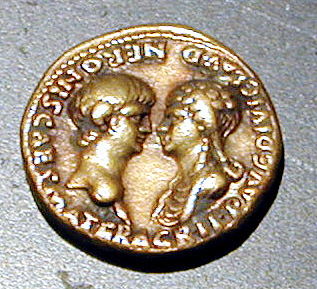
Figure 1 Gold aureus of Nero, AD 54, obverse. Facing portraits of Nero and Agrippina the Younger. Legend: AGRIPP. AVG. DIVI CLAVD. NERONIS CAES. MATER ('Agrippina Augusta, wife of the Divine Claudius, mother of Nero Caesar'). Found at Herculaneum, among victims of the eruption of Vesuvius. Naples, National Archaeological Museum. Photo: Barbara McManus. (http://www.vroma.org/images/mcmanus_images/nero_agrippinacoin.jpg)
But however appalling his reputation, it paled into insignificance in comparison with the reputation of Nero's mother, Agrippina. She was universally regarded as the wickedest woman in Rome - a very hotly contested title, but Agrippina won it. There wasn't any immorality that she hadn't been involved in, and there was no crime that she hesitated to commit. She'd been born into the imperial family and, to be fair, that might have warped anybody. Her father, Germanicus, was poisoned. Her mother was murdered ‚- so were two of her brothers. Her third brother became the insane emperor, Caligula, who threatened her life. She survived, but I suppose her lack of caution and good sense was down to her background.
This extraordinary woman resolved to make her son Nero emperor of Rome. The existing emperor was her uncle, Claudius. Claudius liked as wives exciting immoral women, and he had a whole string of them. When the last of them went a bit too far and had to be executed, Agrippina resolved to take her place. She had, of course, all the qualities necessary for the job, and the Emperor Claudius enjoyed all the benefits of wedlock well in advance of the ceremony. So the uncle married the niece, which was of course incest, and created a bit of a scandal in the Senate, which had to be bribed a bit and threatened a bit. Once Agrippina was Empress she quickly cleared the remaining obstacles out of Nero's way to the throne, including Claudius himself.
This quote comes from Brian Walden's 1999 television programme on Nero, from the series Walden on Villains, and gives a common modern view of Nero's approach to the throne; Walden presents Nero as a usurper, advanced to the principate by his ambitious mother. This is a picture that goes back to the ancient sources. Cassius Dio (History of Rome 61.34; passage (b) below) says that Britannicus by rights should have succeeded. Tacitus (Annals 12.1-3; passage (c)) and Suetonius (Life of Claudius 26; passage (d)) present an account in which Agrippina used her sexual wiles to win over Claudius after the execution of his previous wife, Messalina, for treason.
Figure 2 Head of Claudius, found in River Alde, Suffolk. British Museum, London. (Photo © British Museum.) From AA309 Illustrations Book, Plate 4.15.
However, behind this tale of tabloid sleaze lies serious dynastic politics. Cassius Dio's opinion is based on the empire of his own time, when the son of an emperor would be an obvious candidate to succeed his father (though the truth is that the Roman empire never formalized the process of succession until the time of Diocletian). Matters were somewhat different in the Julio-Claudian period. If one looks at the family tree a different picture emerges. A biological link can be traced between Nero, through his mother Agrippina the Younger, her mother Agrippina the Elder, and her mother Julia the Elder, to Augustus himself. Nero was Augustus' great-great-grandson. The importance of this has been noted by Barrett (1996, p. 97), and though Fagan (1998, n. 24) is sceptical, it seems to me that the relationship is key to the promotion of Nero.
Augustus, perhaps aware of the weak position only being Julius Caesar's testamentary heir had put him in, had pushed the blood relationship to himself as an important qualification for the principate. He first marked out his son-in-law Marcellus as a potential successor, with the intention that the children of his daughter should eventually succeed. For the same reason he adopted his grandsons Gaius and Lucius Caesar. When he adopted Tiberius as his son, he made Tiberius adopt Germanicus; the importance of the adoption was that Germanicus was married to Augustus' grand-daughter Agrippina, so that the succession, after passing through Tiberius and Germanicus, would revert to Augustus' blood descendants, as it did with the accession of Gaius.[2] As Robert Graves put it (I, Claudius, ch. 13): 'It was a satisfaction to Augustus that Germanicus ... was Tiberius's natural successor, and that Germanicus's infant sons ... were his own great-grandsons. Though Fate had decreed against his grandsons succeeding him he would surely one day reign again, as it were, in the persons of his great-grandchildren.' Despite the different attitude of Romans to adoption compared to our own (see Jones and Sidwell, 1997, p. 216; passage (e)), this blood relationship was evidently extremely important to Augustus. Even the descendants of his sister Octavia, often held up as being significant in terms of the succession, were mainly used by Augustus as husbands, wives and guardians for his blood descendants. Hence, Agrippina could view the principate as her son's birthright.
A similar connection cannot be traced from Claudius or his son Britannicus to Augustus. Claudius did not even have an adoptive link with Augustus, as his uncle Tiberius and his brother Germanicus had. He took the name Caesar on his accession, but had no title to it other than that he gave himself and a tenuous descent from Julius Caesar's father, through four generations of women. He was descended from Augustus' sister Octavia; but so was Nero. (It is reported that Claudius revived a rumour that his father, with whom his grandmother Livia was pregnant when she divorced her husband to marry Augustus, was actually Augustus’ illegitimate son, a rumour that would allege the blood relationship that Claudius otherwise could not prove.)
This made Claudius' position very weak. He came to the throne largely through default, there being nobody better available; only by his promotion had a civil war between rival senatorial candidates for the principate been avoided. As the young Lucius Domitius Ahenobarbus (the future Nero) grew up, he would be a potential focus around which opposition to Claudius could gather. That opposition could be side-stepped by bringing the boy into his own family. By promoting a genuine descendant of Augustus as his successor, Claudius could strengthen his own position. Hence he rapidly made Nero his stepson, adopted son, and son-in-law. The dynastic arguments were so strong that Claudius was prepared to countenance a marriage that was, by Roman law, incestuous. From the moment of his marriage to Agrippina, Britannicus was sidelined. Given the fates of Agrippa Postumus and Tiberius Gemellus (see Goodman, 1997, pp. 48 & 54) he may well have recognized that he was effectively signing his own son's death warrant; but if so he clearly thought a smooth unchallenged succession, avoiding the possibility of civil war, more important.[3]
Figure 3 Detail of a statue of Augustus, found in Via Labicana, Rome. Date: after 12 BC (from the toga fold draped over his head, indicating his role as pontifex maximus). Muzeo Nationale, Rome. (Photo © Alinari.) From AA309 Illustrations Book, Plate 1.5.
There were other male descendants of Augustus around; the Junii Silani, Marcus, Lucius and Decimus. Their mother was Aemilia Lepida, who was daughter of the younger Julia, the eldest daughter of Marcus Agrippa and Augustus' daughter Julia. A number of these were alive in Claudius' reign, and older than Ahenobarbus (Nero). Why did Claudius not turn to one of them? Well, in a sense, he had. The second son, Lucius Silanus was, until Claudius' marriage to Agrippina, betrothed to Claudius' daughter, Octavia.
However, there was something about the Junii Silani that made them unsuitable as imperial heirs. Marcus had been born in AD 14, so was an adult at the time of the assassination of Gaius, who was only a couple of years older. Yet he was never considered a serious alternative to the disabled Claudius. Though the Junii Silani were an old Roman patrician family (they belonged to the same gens as the Junii Bruti, who had produced one of the founders of the Republic and, much later, Caesar's assassin Marcus Junius Brutus), they seem not to have had great standing with the army. Ahenobarbus, on the other hand, as well as being a descendant of Augustus, and also of his sister Octavia, was a grandson of Germanicus, who had been immensely popular with the army. Since Claudius' own elevation had shown the importance of the army in supporting the emperor, Ahenobarbus was a better-placed candidate.
One might ask why Claudius ever bothered with the Junii Silani at all. It's not very clear, but my own suspicion is that originally Claudius based his hopes for the succession around his son Britannicus. Lucius Silanus would be a suitable husband for his daughter, but would not prove a rival to Britannicus. Ahenobarbus would be a more significant threat to Britannicus' succession. Yet Claudius seems to have hedged his bets, and not taken permanent action to remove Ahenobarbus. His wife Messalina may have seen things differently. Suetonius certainly says (Life of Nero 6) that she saw Ahenobarbus as a threat to Britannicus, and alleges that she tried to have the child assassinated.
After the crisis of Messalina's conspiracy in AD 48 (possibly, though this is complete speculation, inspired by Claudius' failure to eliminate the growing threat from Ahenobarbus), things looked rather different. Claudius' own vulnerability was apparent, and there was now a cloud over Britannicus as the son of a traitor. In order the strengthen his own position, and improve the chances of a smooth succession, Claudius had to turn to Agrippina and Ahenobarbus. Agrippina subsequently engineered the disgrace of Lucius Silanus, and after Claudius' death made sure she eliminated his older brother Marcus. (It is notable that Seneca mentions the death of Lucius as one of Claudius' crimes in Apocolocyntosis 10, passing over the fact that his removal helped Nero's passage to the throne.)
As an appendix to this, it is worth considering the supposed murder of Claudius by Agrippina. All the ancient sources suggest this. Josephus, Jewish Antiquities 20.148 (passage (f)), makes it a rumour, but Tacitus (Annals 12.65-9; passage (g)) and Suetonius (Life of Claudius 43-6; passage (h)) are quite certain that Claudius was poisoned. The tale, given by Tacitus and as one version by Suetonius, is that Agrippina administered a fatal dose of poisoned mushrooms to her husband. Most scholars accept the murder without question, feeling that Claudius' death comes too conveniently after the time when Nero was capable of taking the reigns of power himself (yet still young enough that he could be guided by his mother, who hoped to rule through him), but before Britannicus was old enough to do so. However, a number of points need to be considered.
First, this is exactly the sort of story told about powerful imperial women. A similar accusation was made about Livia, who was alleged to have killed Augustus in a very similar fashion (figs instead of mushrooms). Allegations of poison were easy to make and difficult to disprove, and unless any of the individuals involved confessed, which seems unlikely, the details of the murder can only be hearsay, and are contradictory in the sources - some, indeed, such as the poisoned feather that Tacitus says was administered by Claudius' doctor Xenophon, after Claudius had vomited up the original mushrooms, must be invention, as no poison known to the Romans was that fast-acting.
Secondly, Agrippina had already achieved her objective. Nero was the clear successor, and Britannicus was not a serious candidate. There might appear to have been no need to kill Claudius to secure Nero's position.
Thirdly, Claudius was gravely ill in late AD 52 and early AD 53, and some of his acts in his last years (see Suetonius, Life of Claudius 46) look like those of a man aware he had not much longer to live. Agrippina had only to wait.
On the other hand, if Claudius really was expressing intentions to put aside Nero, as Suetonius says he was (Life of Claudius 43), then it is not too surprising that Agrippina acted swiftly. She knew, having seen two of her brothers die in custody, that people could be easily taken out of the line of succession, and the consequences would no doubt have been fatal for her and her son.
The case must remain unproven.
Sources
The marriage to Agrippina
(a)
Pushed on by his overbearing mother, Agrippina, [Nero] was only 16 when crowned. Indeed it was his mother's machinations that had seen this patently ill-equipped and unprepared boy to power.
(Grabsky, 2001, p. 34)
(b)
At the death of Claudius the rule in strict justice belonged to Britannicus, who was a legitimate son of Claudius and in physical development was in advance of his years; yet by law the power fell also to Nero because of his adoption. But no claim is stronger than that of arms; for everyone who possesses superior force always appears to have the greater right on his side, whatever he says or does. And thus Nero, having first destroyed the will of Claudius and having succeeded him as master of the whole empire, put Britannicus and his sisters out of the way. Why, then, should one lament the misfortunes of the other victims?
(Cassius Dio, History of Rome 61.34)
(c)
1 Messalina’s death convulsed the imperial household. Claudius was impatient of celibacy and easily controlled by his wives, and the ex-slaves quarrelled about who should choose his next one. Rivalry among the women was equally fierce. Each cited her own high birth, beauty, and wealth as qualifications for this exalted marriage. The chief competitors were Lollia Paulina, daughter of the former consul Marcus Lollius, and Germanicus' daughter Agrippina. Their backers were Callistus and Pallas respectively. Narcissus supported Aelia Paetina, who was of the family of the Aelii Tuberones. The emperor continually changed his mind according to whatever advice he had heard last.
Finally, he summoned the disputants to a meeting and requested them to give reasoned opinions.
2 At the meeting, Narcissus reminded Claudius that he had been married to Aelia Paetina before; that the union had been productive (a daughter, Claudia Antonia, had been born to them); that remarriage would necessitate no domestic innovations; and that, far from entertaining a stepmother's dislike for Britannicus and Octavia, Paetina would cherish them next to her own children. Callistus objected that Claudius had divorced Paetina long ago and that this disqualified her – remarriage would make her arrogant, and Lollia was far more eligible since, being childless, she would be a mother to her stepchildren without jealousy. Pallas, proposing Agrippina, emphasized that the son whom she would bring with her was Germanicus' grandson, eminently deserving of imperial rank; let the emperor ally himself with a noble race and unite two branches of the Claudian house, rather than allow this lady of proved capacity for child-bearing, still young, to transfer the glorious name of the Caesars to another family.
3 These arguments prevailed. Agrippina's seductiveness was a help. Visiting her uncle frequently – ostensibly as a close relation – she tempted him into giving her the preference and into treating her, in anticipation, as his wife. Once sure of her marriage, she enlarged the scope of her plans and devoted herself to scheming for her son Lucius Domitius Ahenobarbus, whose father was Cnaeus Domitius Ahenobarbus. It was her ambition that this boy, the future Nero, should be wedded to the emperor’s daughter Octavia. Here criminal methods were necessary, since Claudius had already betrothed Octavia to Lucius Junius Silanus Torquatus – and had won popularity for his distinguished record by awarding him an honorary Triumph, and giving a lavish gladiatorial display in his name. But with an emperor whose likes and dislikes were all sug-gested and dictated to him anything seemed possible.
(Tacitus, Annals 12.1-3, tr. Grant, 1996, pp. 252-3)
(d)
Almost at once, however, he planned either to marry Lollia Paulina, Caligula's widow, or to re-marry his divorced wife Aelia Paetina; but it was Agrippina, daughter of his brother Germanicus, who hooked him. She had a niece's privilege of kissing and caressing Claudius, and exercised it with a noticeable effect on his passions: when the House next met, he persuaded a group of senators to propose that a union between him and her should be compulsorily arranged, in the public interest; and that other uncles should likewise be free to marry their nieces, though this had hitherto counted as incest. The wedding took place with scarcely a single day’s delay, but no other uncle cared to follow Claudius's example, except one freedman, and one leading-centurion [primus pilus] whose marriage he and Agrippina both attended.
(Suetonius, Life of Claudius 26, tr. Graves, 1989, p. 203)
(e)
Another striking freedom was over adoption. European aristocracies operating under feudal rules have been much encumbered by primogeniture (the automatic privileging of the elder son), absence of female succession, and impossibility of adoption. Roman rules not only treated all children more equally, but made it easy to produce substitute sons and heirs by adoption. By given rituals, a son passed from one familia to another (interestingly, the rituals might involve the same use of weights and scales as for the acquisition of a wife under coemptio, or a slave). But even if the formalities had not been completed, it was possible to use your will to nominate someone as heir to your property and name. Though this was not technically an adoption, the ease with which Caesar's testamentary heir (Octavian) passed himself off as his son shows that custom accepted the situation.
(Jones and Sidwell, 1997, p. 216)
The death of Claudius
(f)
Now Claudius Caesar died when he had reigned thirteen years, eight months, and twenty days; and a report went about that he was poisoned by his wife Agrippina. Her father was Germanicus, the brother of Caesar. Her husband was Domitius Ahenobarbus, one of the most illustrious persons that was in the city of Rome; after whose death, and her long continuance in widowhood, Claudius took her to wife. She brought along with her a son, Domitius, of the same name with his father. He had before this slain his wife Messalina, out of jealousy, by whom he had his children Britannicus and Octavia; their eldest sister was Antonia, whom he had by Paetina his first wife.[5] He also married Octavia to Nero; for that was the name that Caesar gave him afterward, upon his adopting him for his son.
(Josephus, Jewish Antiquities 20.148, tr. Whiston)
(g)
65 However, the charge against Lepida[6] was attempting the life of the empress by magic, and disturbing the peace of Italy by failing to keep her Calabrian slave-gangs in order. On these charges she was sentenced to death – in spite of vigorous opposition by Narcissus. His suspicions of Agrippina continually grew deeper. 'Whether Britannicus or Nero comes to the throne,' he was said to have told his friends, 'my destruction is inevitable. But Claudius has been so good to me that I would give my life to help him. The criminal intentions for which Messalina was condemned with Gaius Silius have re-emerged in Agrippina. With Britannicus as his successor the emperor has nothing to fear. But the intrigues of his stepmother in Nero's interests are fatal to the imperial house – more ruinous than if I had said nothing about her predecessor's unfaithfulness. And once more there is unfaithfulness. Agrippina's lover is Pallas. That is the final proof that there is nothing she will not sacrifice to imperial ambition – neither decency, nor honour, nor chastity.'
Talking like this, Narcissus would embrace Britannicus and pray he would soon be a man. With hands outstretched – now to the boy, now to heaven – he besought that Britannicus might grow up and cast out his father's enemies, and even avenge his mother's murderers.
66 Then Narcissus' anxieties caused his health to fade. He retired to Sinuessa, to recover his strength in its mild climate and health-giving waters.
Agrippina had long decided on murder. Now she saw her opportunity. Her agents were ready. But she needed advice about poisons. A sudden, drastic effect would give her away. A gradual, wasting recipe might make Claudius, confronted with death, love his son again. What was needed was something subtle that would upset the emperor’s faculties but produce a deferred fatal effect. An expert in such matters was selected – a woman called Locusta, recently sentenced for poisoning but with a long career of imperial service ahead of her. By her talents, a preparation was supplied. It was administered by the eunuch Halotus who habitually served the emperor and tasted his food.
67 Later, the whole story became known. Contemporary writers stated that the poison was sprinkled on a particularly succulent mushroom. But because Claudius was torpid – or drunk – its effect was not at first apparent; and an evacuation of his bowels seemed to have saved him. Agrippina was horrified. But when the ultimate stakes are so alarmingly large, immediate disrepute is brushed aside. She had already secured the complicity of the emperor’s doctor Xenophon; and now she called him in. The story is that, while pretending to help Claudius to vomit, he put a feather dipped in a quick poison down his throat. Xenophon knew that major crimes, though hazardous to undertake, are profitable to achieve.
68 The senate was summoned. Consuls and priests offered prayers for the emperor's safety. But meanwhile his already lifeless body was being wrapped in blankets and poultices. Moreover, the appropriate steps were being taken to secure Nero's accession. First Agrippina, with heart-broken demeanour, held Britannicus to her as though to draw comfort from him. He was the very image of his father, she declared. By various devices she prevented him from leaving his room and likewise detained his sisters, Claudia Antonia and Octavia. Blocking every approach with troops, Agrippina issued frequent encouraging announcements about the emperor's health, to maintain the Guards' morale and await the propitious moment forecast by the astrologers.
69 At last, at midday on October the thirteenth, the palace gates were suddenly thrown open. Attended by Sextus Afranius Burrus, commander of the Guard, out came Nero to the battalion which, in accordance with regulations, was on duty. At a word from its commander, he was cheered and put in a litter. Some of the men are said to have looked round hesitantly and asked where Britannicus was. However, as no counter-suggestion was made, they accepted the choice offered them. Nero was then conducted into the Guards' camp. There, after saying a few words appropriate to the occasion – and promising gifts on the generous standard set by his father – he was hailed as emperor.[7] The army's decision was followed by senatorial decrees. The provinces, too, showed no hesitation.
Claudius was voted divine honours, and his funeral was modelled on that of the divine Augustus – Agrippina imitating the grandeur of her great-grandmother Livia, the first Augusta. But Claudius' will was not read, in case his preference of stepson to son should create a public impression of unfairness and injustice.
(Tacitus, Annals 12.65-9, tr. Grant, 1996, pp. 281-3)
(h)
43 In his last years Claudius made it pretty plain that he repented of having married Agrippina and adopted Nero. For example, when his freedmen congratulated him on having found a certain woman guilty of adultery, he remarked that he himself seemed fated to marry wives who 'were unchaste but remained unchastened'; and presently, meeting Britannicus, embraced him with deep affection. 'Grow up quickly, my boy,' he said, 'and I will then explain what my policy has been.' With that he quoted in Greek from the tale of Telephus and Achilles:
The hand that wounded you shall also heal,
and declared his intention of letting Britannicus come of age because although immature, he was tall enough to wear the toga of manhood; adding 'which will at last provide Rome with a true-born Caesar.'[8]
44 Soon afterwards he composed his will and made all the magistrates put their seals to it as witnesses; but Agrippina, being now accused of many crimes by informers as well as her own conscience, prevented him from going any further.
Most people think that Claudius was poisoned; but when, and by whom, is disputed. Some say that the eunuch Halotus, his official taster, administered the drug while he was dining with the priests in the Citadel; others, that Agrippina did so herself at a family banquet, poisoning a dish of mushrooms, his favourite food. An equal discrepancy exists between the accounts of what happened next. According to many, he lost his power of speech, suffered frightful pain all night long, and died shortly before dawn. A variant version is that he fell into a coma but vomited up the entire contents of his overloaded stomach and was then poisoned a second time, either by a gruel – the excuse being that he needed food to revive him – or by means of an enema, the excuse being that his bowels required relief and must be emptied too.
45 Claudius' death was not revealed until all arrangements had been completed to secure Nero's succession. As a result, people made vows for his safety as though he still lived, and a troop of actors were summoned, under the pretence that he had asked to be diverted by their antics. He died on 13th October,[9] during the consulship of Asinius Marcellus and Acilius Aviola [AD 54], in his sixty-fourth year, and the fourteenth of his reign. He was given a princely funeral and officially deified, an honour which Nero later neglected and then cancelled; but which Vespasian restored.
46 The main omens of Claudius' death included the rise of a long haired star, known as a comet, lightning that struck his father's tomb, and an unusual mortality among magistrates of all ranks. There is also evidence that he foresaw his end and made no secret of it: while choosing the Consuls he provided for no appointment after the month in which he died; and on his last visit to the House offered an earnest plea for harmony between his children,[10] begging the Senate to guide both of them with great care through the years of their youth. During a final appearance on the tribunal he said more than once that he had reached the close of his career; though everyone present cried: 'The Gods forbid!'
(Suetonius, Life of Claudius 43-6, tr. Graves, 1989, pp. 211-12; see Lewis and Reinhold, 1990, pp. 355-6, for chs. 43-4)
Notes
[1] This issue is gone into in more detail in Potter, 1982, pp. 27-9.
[2] Goodman, 1997, in the caption on p. 53, Plate 3, says that Augustus was Gaius' great-grandfather by adoption. This is true, but he was also his natural great-grandfather. In contrast on p. 56 he says that Nero's wife Octavia was descended from Julius Caesar, which is not true.
[3] There is, however, circumstantial evidence that Britannicus may have died not from poison, as alleged, but from an epileptic seizure; see Barrett, 1998, pp. 170-2.
[4] Note that Gaius Appius Junius Silanus, who was executed by Claudius in AD 42, belonged to a different branch of the family from that which had married into the descendants of Augustus (Robert Graves got this wrong in I, Claudius and Claudius The God).
[5] Actually his second.
[6] Domitia Lepida, mother of Claudius' third wife Messalina, and grandmother of Britannicus and Octavia. She was also Claudius' cousin, her mother and his being sisters, and therefore a great-niece of Augustus.
[7] I.e. as imperator. Hailing a new emperor as 'Imperator' was standard practice.
[8] Arguably, that description fitted Nero better.
[9] The Latin says 'the third of the Ides of October'.
[10] Britannicus and Nero are meant.
References
Barrett, A.A. (1996) Agrippina: Sister of Caligula, Wife of Claudius, Mother of Nero, London, Routledge.
Fagan, G.G. (1998) De Imperatoribus Romanis: An Online Encyclopedia of Roman Emperors, 'Claudius (41-54 A.D.)', http://www.roman-emperors.org/claudius.htm.
Goodman, M. (1997) The Roman World 44 BC - AD 180, London, Routledge.
Grabsky, P. (2001) 'Nero's pleasure palace', BBC History Magazine, vol. 2 no. 2, pp. 34-5.
Grant, M. (trans.) (1996) Tacitus: The Annals of Imperial Rome, Harmondsworth, Penguin Books. (First published 1956. Revised edition 1971. Reprinted with a new bibliography 1996.)
Graves, R. (trans.) (1989) Gaius Suetonius Tranquillus: The Twelve Caesars, revised by Michael Grant, Harmondsworth, Penguin Books. (First published 1957. Revised edition 1979. Reprinted with a new bibliography 1989.)
Jones, P. and Sidwell, K. (eds) (1997) The World of Rome: an Introduction to Roman Culture, Cambridge, Cambridge University Press.
Lewis, N. and Reinhold, M. (1990) Roman Civilization: Selected Readings. Volume II: The Empire, New York, Columbia University Press. (First published 1955. Revised edition with new bibliography 1966. Third edition 1990.)
Potter, J. (1982) Rome: The Augustan Age, Unit 9: Tiberius, Gaius and Claudius, Milton Keynes, Open University.
Walden, B. (1999) Walden on Villains 'Nero', BBC Television (a transcript was available on the BBC's website, but has now been removed).
Bibliographies
I popped into the British Museum on Saturday, to pick up the catalogue for the new exhibition, Forgotten Empire: the world of ancient Persia. I did this in preparation for going to the exhibition itself, which I shall probably do later in the month. Out of idle curiosity, I usually browse the bibliographies to see if I'm in them. I never am, of course. Except on this occasion. For there it is under 'K' - 'A.G. Keen, Dynastic Lycia'.
I feel quite chuffed about that.
Of course, had my career gone the way I once hoped, this would be happening all the time.
I feel quite chuffed about that.
Of course, had my career gone the way I once hoped, this would be happening all the time.
Troy: a reflection
Writing up a piece for the Classical Association newsletter, I revisited something I wrote last year about Wolfgang Petersen's movie Troy, and which is now on the OU's website. I thought I'd post a link here:
http://www.open.ac.uk/Arts/classtud/troy/keen-troy.htm
[I should add, though, that I've changed my mind about whether the erastes-eromenos relationship can be read into Homer, as I will say in the upcoming article.]
The whole text follows:
http://www.open.ac.uk/Arts/classtud/troy/keen-troy.htm
[I should add, though, that I've changed my mind about whether the erastes-eromenos relationship can be read into Homer, as I will say in the upcoming article.]
Troy: views and reviews
A reflection by Tony Keen
The following is not intended as a review per se of Wolfgang Petersen's Troy. Rather, it seeks to examine some of the issues arising out of one of the most-discussed aspects, the changes made from the 'canon' of Greek mythology. I expected, from advance information, to spend the entirety of the film in open-mouthed shock at what had been done. I didn't.
The first reason is that it's quite obvious within the first ten minutes that this is Wolfgang Petersen doing (for reasons best known to himself) a Cecil B. DeMille movie, and what do you expect from such a film? Historical accuracy?
But there is a more complex reason, one which relates to what we consider important in the retelling of mythology and adaptation of literature. Back in the 1950s, an American television company made a version of Ian Fleming’s Casino Royale, in which James Bond was made into an American. Horrifying idea, isn't it? Yet when I actually saw said programme, what struck me was not how much had been changed, but how much of Fleming survived – even Americanized, Bond remains a nasty piece of work. And that's how I feel about Troy. It's not the departures from Homer you note – it's how much of Homer is still there, such as Paris' feebleness in single combat with Menelaus (even if Paris isn't here the sort of person to whom even his close relatives and lover say, "Go out and fight like a man, and if you get yourself killed, well, no real harm done"), and Priam's begging Achilles for his son's body.
Besides, these myths are not immutable. Homer himself probably altered some of the stories he used. The great Attic tragedians, Aeschylus, Sophocles and Euripides, certainly did. Three surviving plays by Euripides feature Helen of Troy on stage – all are mutually inconsistent. Virgil too modified the legends to suit his purpose of praising Rome and Augustus.
Some of the changes made by ancient authors are quite substantial, the most momentous being the tradition that Helen never went to Troy at all, the whole war being fought over her simulacrum or likeness. I wonder if the sort of people now complaining that Helen escapes the sack of Troy at the end of Petersen's film would be up in arms at Euripides' Helen: "A ghost Helen at Troy, and the real one in Egypt? What does this bloody playwright think he's doing, following Steisichorus?"
It's silly to be precious about these stories. Petersen and his screenwriter, David Benioff, are only doing what writers from the beginning of time have done. Granted, many of their changes are more drastic than those performed by any writer of antiquity, especially when all done at the same time. But let's face it, far less violence has been done to the stories in this film than in the average episode of Hercules: The Legendary Journeys or Xena: Warrior Princess. And I could always forgive Robert Tapert, Sam Raimi and their cohorts, because clearly they knew the material that they were transforming. And that's true of Troy's creators too – for instance, they know Homer well enough to have everyone call Menelaus 'Menelaos', in proper Greek fashion.
We have to remember that when Homer wrote the Iliad, everyone knew what happened before and after the small part of the story Homer chooses to tell. Nowadays, most of the demographic for Troy would have no knowledge that Agamemnon should go home to be killed by his wife, because of his sacrifice of their daughter, that Menelaus will be charmed again by Helen, and they will live in quite contentment, that Aeneas will lead a ragged band of escaped Trojans to found Rome (or London, depending on which empire the writer is living under). A movie that tried to tell the whole story, including the dispute over the armour of Odysseus and the suicide of Ajax, and that tried to fit in Hecuba and Cassandra and the fate of Astyanax, would be extremely long and very complicated, not to mention the fact that any modern Hollywood production would have great difficulty in dealing with the blatant unfairness of many characters' fates. Frankly, such a film would never get made. So I don't mind that the fates of Menelaus and Agamemnon are tidied up before the end of the film. Indeed, since Briseis in the film is a amalgam not just of Homer's slave-girl Briseis, and Chryseis, daughter of the priest of Apollo, but also of Cassandra, daughter of Priam, it is almost appropriate that she deals the fatal blow – it remains Agamemnon's lust that finally undoes him. This is what the film does all the time – remembers its primary audience is not familiar with the Trojan cycle, but includes little bits for people who are.
As for Menelaus and Helen, having established Menelaus as a violent and possessive man, the film could hardly have Helen meekly return to Sparta with him at the end. I think far more people would be offended by a film that suggested battered wives should go back to their husbands than by one which alters the eventual fate of Helen of Troy, and rightly so. Once that is decided, Menelaus plays no further dramatic role in the story beyond providing the excuse for Agamemnon's war, so it makes sense in terms of the film to get rid of him as soon as possible. But when Menelaus is killed the look of surprise on his face almost says, "I'm not supposed to die yet! What about Book IV of the Odyssey? What about the Andromache?"
Had the film killed Odysseus, then I would have been annoyed. That would have been to misunderstand something crucial about the character of Odysseus. Whether you admire him, as Homer does, or not, as per the tragedians and Latin poets, the whole point of Odysseus is that he is a survivor. Fortunately, as soon as the undiluted Sheffield vowels of Sean Bean (who I still think would have been better cast as Menelaus) are heard in the introductory narration, it is clear Odysseus will survive. The film even gives him an arch final line about "if they ever write my story ..."
Odysseus is not the only person whose broad characterization the film gets right. Achilles is a petulant baby, Agamemnon a manipulative tyrant, Menelaus a boorish prig. Hector is more noble and heroic than anyone on the Greek side can dream of being, whilst his brother is a pretty-boy who lacks the inner steel to make a true hero. Priam is everything a wise and noble elder statesman should be, except that every important decision he makes is wrong; Helen is tortured by her responsibility for the war, and by the Trojans' refusal to condemn her for it. Many of these characterizations can be found in Homer – almost all are in classical literature somewhere. But, of course, classical literature contains many different versions of these figures. I've already mentioned different views of Odysseus above; Helen is almost a tabula rasa to be depicted how one likes, from the now-dutiful wife who regrets her past that we find in the Odyssey, to the self-regarding manipulative bitch of Trojan Women.
What I am suggesting here is that, for all the variations in detail, Troy never actually misses the point of the Trojan War stories. Troy still falls. And if you think it's silly to suggest it might have been otherwise, something very similar has happened to Alexandre Dumas' The Man in the Iron Mask. That novel concerns a plot to replace Louis XIV of France with his (fictional) identical twin bother Philippe. In Dumas, this plot is thwarted, and Louis remains King. In every single film adaptation, the plot succeeds.
The one change in Troy I didn't think was acceptable was Paris' survival, and that’s not because it breaks from the traditional legend, but because it's dramatically not right within the film. When he leaves Helen at the escape tunnel, and passes on the Sword of Troy to Aeneas (supporting his aged father, which I thought was a nice touch), Paris is having one of those moments where he knows, and so does Helen, that he's going off to die. Except he then doesn't die, and the last we see of him he is fleeing with Briseis, the implication being that he will get both of them to the escape route and safety. (And no, this can't be excused by saying, "Oh, but we don’t see that he escapes." The film gives us no reason to believe that he doesn't.) Quite what is supposed to happen when he rejoins his fellow escapees isn't clear – will he ask for the Sword of Troy back?
This mishandling of Paris is a shame, because otherwise, the deaths, at least of major characters, all take place for a good dramatic reason, because there is some flaw in each individual for which they must pay the price. Patroclus dies because he is too eager for the fray, Menelaus because he has not the wit to treat Helen as more than an object to possess, Hector because, for all his honour, he loves his brother more than he loves his city, Priam because he arrogantly assumes that the gods are on his side, Agamemnon because his lust for power blinds him to all else, Achilles because his lust for war leads him to care nothing about those he kills. Though Paris' discovery of archery skills (no typecasting for Orland Bloom there, then!) compensates for his earlier cowardice, he still ought to pay the price for carelessly stealing another man's wife, and for killing the hero.
The change that has excited most comment is the down playing of the relationship between Achilles and Patroclus. Both Brad Pitt and Benioff have said that they can’t see anything in the Iliad to support a homoerotic subtext (has Brad really read all twenty-four books?), but that's because it was so obvious in the social context when Homer wrote that he didn't need to be explicit. In any case, any homoeroticism that Benioff removed in his script is put back in by Petersen. Not only are Achilles and Patroclus clearly doing it, for those who have eyes to see, but the film is packed full of athletic men with their kit off, lingering shots tastefully cut off just above the pubic hair. In fact, not since Batman Forever have I seen a Hollywood blockbuster quite so in love with the male body.
There are plenty of legitimate reasons to criticise Troy (e.g. the embarrassing dialogue, the failure to make the battle scenes as exciting as Lord of the Rings or Gladiator, the varying level of acting), but it should be criticised on its own terms, and the artistic license the film grants itself should be allowed. By focusing on the changes made, and attacking them simply because they are changes, without trying to understand them in context, classicists and other critics risk appearing as silly pedants. Not to mention inconsistent. The license being denied to Petersen's film is extended without question to Euripides or Virgil, or even to modern playwrights such as John Barton, whose Tantalus cycle is quite prepared to bend the legends when it seems necessary. This raises suspicions of elitism, that what is permitted to ancient authors or on stage cannot be allowed in a populist film. Regular citations of the Iliad as 'the basis of western literature', and by implication somehow sacrosanct, do not dispel such worries.
Even in the arena of film people are being inconsistent. One film often mentioned as a better way to do Homer than Troy is the Coen brothers' O Brother Where Art Thou?, in which the Odyssey is taken as inspiration for a story set in the southern United States in the 1930s. Now, I am not going to promote the notion that Troy is a better movie than O Brother …, since it clearly isn’t, but I am interested in the idea that the changes the Coens make are more acceptable than those of Peterson's film. Are we really suggesting that it is intrinsically truer to Homer to shift him into the Depression (or, say, turn of the century Dublin), and make the free adaptation that such a setting requires, than to keep him in the Bronze Age, but then change some of the details?
One wonders whether critics of Troy might benefit from another read of the Iliad themselves. The central theme of the epic is Achilles' anger at the removal of Briseis by Agamemnon, an anger that blinds him to what's really important, winning the war. Troy is a blockbuster film, that will raise the profile of Homer and the Classics in general. Classics as a profession should be ready to take advantage of that. Instead, I have the impression we're sulking in our tents.
Monday, September 26, 2005
Shifting televisions
We've just upgraded to Digital Cable. As a result, we no longer get a number of the channels that I used to watch history programmes on. I'm not worried about UKTV Documentary, as their programmes come round to UKTV History, and Discovery Channel only had Time Team that I was interested in, and even that seemed to be just repeating itself. But I shall miss the History Channel, which when it wasn't doing Nazis and murderers could show some interesting programmes (mainly from Channel 4's output). I could have these, of course, but to get The History Channel I'd have to take the total package of channels, and it's not worth it for the full range of channels I have no interest in watching (like the chance to ignore Living TV three times a day).
Still, BBC Four and UKTV History will compensate, I'm sure, and maybe one day Telewest will see the advantage of offering packages that just have all the factual channels wrapped up together. Or is that not what consumer choice is supposed to be about?
Still, BBC Four and UKTV History will compensate, I'm sure, and maybe one day Telewest will see the advantage of offering packages that just have all the factual channels wrapped up together. Or is that not what consumer choice is supposed to be about?
Friday, September 23, 2005
I can see our house from up here!
Just watched the episode 'The Romans in Britain' from The History of Britain from the Air (on Channel 5). I was pleased to see that I recognized most of the sites before we were told what they were, and some of the aerial views made me slightly regret not putting a tape in to record the programme. But the commentary was pretty dire - traditional and full of what we now know to be false, or at least misleading.
Thursday, September 22, 2005
Tuesday, September 20, 2005
Britain A.D.
I finally caught the last episode of Francis Pryor's series Britain A.D. on The History Channel this lunchtime. I remain unconvinced by some of what Pryor is trying to argue.
At the core of Pryor's argument is the notion that the so-called 'Anglo-Saxon settlement' was nothing of the sort, that no more than a few bands of soldiers came across, and what actually happened was that a fashion for Germanic culture spread across the south and east of Britain. Much archaeological evidence for continuity of settlement is advanced, and the absence of clear unequivocal evidence for conquest noted.
Now, as I've said when I've discussed this issue before, I don't have a problem with rejecting the common picture of the Anglo-Saxons driving out the British root-and-branch. But Pryor goes too far for me for a couple of reasons.
Nobly, he doesn't shirk the question of the British adoption of the German language, and has a talking head argue that English looks to have been considerably influenced by attempts of Celtic-speakers to learn a Germanic language. But he never really answers why the British should have so totally taken up Germanic culture. They were 'realigning themselves according to the shifts in Europe after the collapse of Rome', he says. Yes, maybe, but why? One explanation would be the arrival of a new Germanic elite, through military conquest - but Pryor doesn't want to accept that. Yet he advances nothing much in its place. (Another archaeologist talking head says that just because she is wearing jeans doesn't make her American, which is true - but if you think that the spread of American culture through Britain is unconnected with America's military might, and the presence of American military forces in Britain, then you'd be wrong.)
The other concern I have is his attitude to the written sources. He is absolutely right that we should not accept without question what our histories tell us. That is naive. But Pryor seems to want to totally ignore the histories. The assumption seems to be that, once one has established that a historian has his own agenda, he can then be dismissed as having nothing to tell us. Pryor replaces the unquestioned primacy of the written sources with the equally unhelpful unquestioned primacy of archaeology.
At the end of the programme he talks about the way in which Britain after the Roman conquest never lost its own identity. But how can that be? He has spent the best part of an hour arguing that many of the national stories that make us who we think we are, are myths. In the end, I can't help thinking that Pryor's version of what happened after the Romans left Britain is as much an invention as the Arthurian romance and Anglo-Saxon conquest that he rails against.
Now, as I've said when I've discussed this issue before, I don't have a problem with rejecting the common picture of the Anglo-Saxons driving out the British root-and-branch. But Pryor goes too far for me for a couple of reasons.
Nobly, he doesn't shirk the question of the British adoption of the German language, and has a talking head argue that English looks to have been considerably influenced by attempts of Celtic-speakers to learn a Germanic language. But he never really answers why the British should have so totally taken up Germanic culture. They were 'realigning themselves according to the shifts in Europe after the collapse of Rome', he says. Yes, maybe, but why? One explanation would be the arrival of a new Germanic elite, through military conquest - but Pryor doesn't want to accept that. Yet he advances nothing much in its place. (Another archaeologist talking head says that just because she is wearing jeans doesn't make her American, which is true - but if you think that the spread of American culture through Britain is unconnected with America's military might, and the presence of American military forces in Britain, then you'd be wrong.)
The other concern I have is his attitude to the written sources. He is absolutely right that we should not accept without question what our histories tell us. That is naive. But Pryor seems to want to totally ignore the histories. The assumption seems to be that, once one has established that a historian has his own agenda, he can then be dismissed as having nothing to tell us. Pryor replaces the unquestioned primacy of the written sources with the equally unhelpful unquestioned primacy of archaeology.
At the end of the programme he talks about the way in which Britain after the Roman conquest never lost its own identity. But how can that be? He has spent the best part of an hour arguing that many of the national stories that make us who we think we are, are myths. In the end, I can't help thinking that Pryor's version of what happened after the Romans left Britain is as much an invention as the Arthurian romance and Anglo-Saxon conquest that he rails against.
Sunday, September 18, 2005
Prometheus Bound
Prometheus Bound, in a new translation by James Kerr
Sound Theatre, London
Performance seen: 6th September 2005
Prometheus Bound is an odd play. It is preserved in a collection of the works of Aeschylus, but it may have actually been written by his son Euphorion. It is commonly thought to be the first play in a trilogy, but there is a case for it being the second.[1] If by Aeschylus, it is a late work, yet only uses two actors, neglecting the third which Sophocles had introduced and which Aeschylus himself employed in the Oresteia.[2] As the text stands, it seems to imply considerable use of stage machinery - and for that reason some scholars would pronounce these passages inauthentic. The play has the ultimate messenger speech when the messenger-god Hermes appears; yet Hermes comes not to impart information, but in an unsuccessful attempt to gather it.
Little actually happens in Prometheus Bound. Once Prometheus is chained to his rock at the opening, he spends the rest of the play telling stories, of one sort or another, to a series of visitors - the Chorus of Oceanids, Oceanus himself, Io and finally Hermes. Throughout the play, Prometheus is on stage, never able to leave (another unusual feature of the play). It is positively Beckett-like, and I thought that before reading Michael Billington's review in The Guardian, where the same point is made. The dark and stark staging of the Sound Theatre's production suggests that they had thought of the comparison too.
Kerr's new translation was worked out in performance with his lead, David Oyelowo. For a translation worked on for its stageability, it seems quite close to the Greek, closer than, say, the late Don Taylor's early eighties adaptations of Sophocles and Euripides.
The Chorus are comprised of actors either fresh out of or still in drama school. This gives an air of the student production to their contribution, and they giggle more than seems appropriate. But it must be said that they execute well some complicated interlocking polyphony during one of the late choral odes, and the use of music in the choruses is in general well-done. Billington mentions the 'sexy slips' that the Chorus are wearing; it seems that the production meant that feature not to be noticed, as the Chorus are dimly lit almost throughout the play, and spend much of it hiding in the wings or amongst the audience.
The other supporting cast are certainly competent enough, though casting to have regional accents speaking classical verse was radical in the 1970s, but a bit old hat now. However, the doubling of the roles of Hephaestus and Oceanus does not work, as they are too obviously the same person. Multiple roles played by the same actor is becoming something of a vogue in the mounting of Greek tragedy these days, but too often ignores the fact that the Greeks made this work through mask and costume. The approach can succeed in modern productions - the recent RSC Hecuba had the same actor in the roles of Polymestor and Odysseus, distinguishing the two through costume, hair styling and performance (in particular accent). Costume alone appeared to be the approach of the Sound Theatre's Prometheus Bound. This works with the doubling of Force and Io, as Force is a non-speaking role, and does not draw the attention of the audience. It almost works with Power and Hermes, as they are respectively at the very beginning and very end of the play (but as both are mouthpieces for Zeus, a cleverer move might have been to combine the roles). But Hephaestus and Oceanus appear in too quick succession. (In the original masked production, Hephaestus was probably doubled with Prometheus, with the second actor taking all the other speaking roles.)
In the end this is a play which stands or falls on the portrayal of Prometheus himself, the one character onstage from beginning to end. Prometheus is the victim, yet he is not always one who engages the audience's sympathies. He is arrogant and self-righteous, in comparison to the much more easy-going and likeable Oceanus. But Prometheus is also right, and Oceanus is wrong, because Prometheus makes a stand against the new tyranny of Zeus (though - Hermes apart - Zeus' side of the dispute is not really put in the play). Billington in his Guardian piece suggests that Prometheus gives in to despair and suffering. This is surely incorrect - Prometheus is in pain, and is momentarily overwhelmed by it, but his foreknowledge has prepared him for the agony, and provides him with the certainty, not just the hope, that eventually he will be released. It is this knowledge of what is to come that fuels his arrogance.
It is not an easy role to essay, made harder by the fact that the actor is likely to be restrained, and denied freedom of movement (rather like Beckett's Winnie in Happy Days, who spends the whole play buried in a mound of earth). David Oyelowo, whose performance has been critically acclaimed, makes it all harder for himself by performing with his eyes closed right up until the very last moment before the lights fade. I'm not quite sure what this is meant to symbolize (perhaps that Prometheus doesn't need his eyes to see things clearly, or that he is slowly waking up throughout the play), but it's undeniably a striking visual image. Oyelowo's Prometheus is dragged on stage in a state of almost epileptic near-catatonia, twitching and moaning as he is chained to the rock (as good a means of any as dealing with Prometheus' silence in the opening scene). There is then five minutes of bestial shrieking and screaming as Prometheus struggles futilely against the pain and his bondage, before he actually begins to speak. At first, it's not quite clear what the fuss over Oyelowo. His performance is good, but not one that immediately looks like it will remain in ones memory. But Oyelowo gradually warms into his performance, and by the final scene, as a bound Prometheus shows that he is free in spirit, and the physically-unrestrained Hermes bonded in servitude to Zeus, and, buoyed by his foreknowledge, treats the messenger god with the utter contempt of the free for the slave who has no power over them, Oyelowo is on sizzling form.
Overall, then, though there are a few bumps along the way this production must be judged a success.
[1] The trilogy is usually given as Prometheus Bound, Prometheus Unbound and Prometheus the Fire-carrier. But, as has been observed, if the Prometheus Unbound contains Prometheus' release from his imprisonment and his revelation of the prophecy about Thetis to Zeus, little action is left for the third play. It seems to make more dramatic sense for Prometheus the Fire-carrier to be the first play, and to deal with Prometheus' giving the gift of fire to Man (and the Oxford Companion to Classical Literature agrees with me, though the OCD thinks that this title is a variant for another Aeschylus play known to have been presented as part of another trilogy).
[2] At the opening Prometheus is dragged on stage by two speaking characters, Hephaestus and Kratos (Power), accompanied by a non-speaking character, Bia (Force). Yet, although Prometheus is the main speaking character in the play, he says nothing until these three have departed the stage (something that can cause problems for modern productions), and the rest of the play is constructed for two actors. Given that Prometheus is supposed to be impaled on stage, the suspicion is that Prometheus was represented by a puppet, and the actor playing Hephaestus left the stage and then returned to voice Prometheus.
In any case, the assumption that Greek tragedy can necessarily be placed on a fixed line of progression is flawed, as was shown by the discovery of the date of the Suppliants. With a Chorus of fifty, a feature of early tragedy before the numbers were reduced, this was thought to be one of Aeschylus' earliest plays. Papyrus discoveries have now shown it to be about twenty to thirty years later than originally thought, and later than some supposedly more 'advanced' plays.
Sound Theatre, London
Performance seen: 6th September 2005
Little actually happens in Prometheus Bound. Once Prometheus is chained to his rock at the opening, he spends the rest of the play telling stories, of one sort or another, to a series of visitors - the Chorus of Oceanids, Oceanus himself, Io and finally Hermes. Throughout the play, Prometheus is on stage, never able to leave (another unusual feature of the play). It is positively Beckett-like, and I thought that before reading Michael Billington's review in The Guardian, where the same point is made. The dark and stark staging of the Sound Theatre's production suggests that they had thought of the comparison too.
Kerr's new translation was worked out in performance with his lead, David Oyelowo. For a translation worked on for its stageability, it seems quite close to the Greek, closer than, say, the late Don Taylor's early eighties adaptations of Sophocles and Euripides.
The Chorus are comprised of actors either fresh out of or still in drama school. This gives an air of the student production to their contribution, and they giggle more than seems appropriate. But it must be said that they execute well some complicated interlocking polyphony during one of the late choral odes, and the use of music in the choruses is in general well-done. Billington mentions the 'sexy slips' that the Chorus are wearing; it seems that the production meant that feature not to be noticed, as the Chorus are dimly lit almost throughout the play, and spend much of it hiding in the wings or amongst the audience.
The other supporting cast are certainly competent enough, though casting to have regional accents speaking classical verse was radical in the 1970s, but a bit old hat now. However, the doubling of the roles of Hephaestus and Oceanus does not work, as they are too obviously the same person. Multiple roles played by the same actor is becoming something of a vogue in the mounting of Greek tragedy these days, but too often ignores the fact that the Greeks made this work through mask and costume. The approach can succeed in modern productions - the recent RSC Hecuba had the same actor in the roles of Polymestor and Odysseus, distinguishing the two through costume, hair styling and performance (in particular accent). Costume alone appeared to be the approach of the Sound Theatre's Prometheus Bound. This works with the doubling of Force and Io, as Force is a non-speaking role, and does not draw the attention of the audience. It almost works with Power and Hermes, as they are respectively at the very beginning and very end of the play (but as both are mouthpieces for Zeus, a cleverer move might have been to combine the roles). But Hephaestus and Oceanus appear in too quick succession. (In the original masked production, Hephaestus was probably doubled with Prometheus, with the second actor taking all the other speaking roles.)
In the end this is a play which stands or falls on the portrayal of Prometheus himself, the one character onstage from beginning to end. Prometheus is the victim, yet he is not always one who engages the audience's sympathies. He is arrogant and self-righteous, in comparison to the much more easy-going and likeable Oceanus. But Prometheus is also right, and Oceanus is wrong, because Prometheus makes a stand against the new tyranny of Zeus (though - Hermes apart - Zeus' side of the dispute is not really put in the play). Billington in his Guardian piece suggests that Prometheus gives in to despair and suffering. This is surely incorrect - Prometheus is in pain, and is momentarily overwhelmed by it, but his foreknowledge has prepared him for the agony, and provides him with the certainty, not just the hope, that eventually he will be released. It is this knowledge of what is to come that fuels his arrogance.
It is not an easy role to essay, made harder by the fact that the actor is likely to be restrained, and denied freedom of movement (rather like Beckett's Winnie in Happy Days, who spends the whole play buried in a mound of earth). David Oyelowo, whose performance has been critically acclaimed, makes it all harder for himself by performing with his eyes closed right up until the very last moment before the lights fade. I'm not quite sure what this is meant to symbolize (perhaps that Prometheus doesn't need his eyes to see things clearly, or that he is slowly waking up throughout the play), but it's undeniably a striking visual image. Oyelowo's Prometheus is dragged on stage in a state of almost epileptic near-catatonia, twitching and moaning as he is chained to the rock (as good a means of any as dealing with Prometheus' silence in the opening scene). There is then five minutes of bestial shrieking and screaming as Prometheus struggles futilely against the pain and his bondage, before he actually begins to speak. At first, it's not quite clear what the fuss over Oyelowo. His performance is good, but not one that immediately looks like it will remain in ones memory. But Oyelowo gradually warms into his performance, and by the final scene, as a bound Prometheus shows that he is free in spirit, and the physically-unrestrained Hermes bonded in servitude to Zeus, and, buoyed by his foreknowledge, treats the messenger god with the utter contempt of the free for the slave who has no power over them, Oyelowo is on sizzling form.
Overall, then, though there are a few bumps along the way this production must be judged a success.
[1] The trilogy is usually given as Prometheus Bound, Prometheus Unbound and Prometheus the Fire-carrier. But, as has been observed, if the Prometheus Unbound contains Prometheus' release from his imprisonment and his revelation of the prophecy about Thetis to Zeus, little action is left for the third play. It seems to make more dramatic sense for Prometheus the Fire-carrier to be the first play, and to deal with Prometheus' giving the gift of fire to Man (and the Oxford Companion to Classical Literature agrees with me, though the OCD thinks that this title is a variant for another Aeschylus play known to have been presented as part of another trilogy).
[2] At the opening Prometheus is dragged on stage by two speaking characters, Hephaestus and Kratos (Power), accompanied by a non-speaking character, Bia (Force). Yet, although Prometheus is the main speaking character in the play, he says nothing until these three have departed the stage (something that can cause problems for modern productions), and the rest of the play is constructed for two actors. Given that Prometheus is supposed to be impaled on stage, the suspicion is that Prometheus was represented by a puppet, and the actor playing Hephaestus left the stage and then returned to voice Prometheus.
In any case, the assumption that Greek tragedy can necessarily be placed on a fixed line of progression is flawed, as was shown by the discovery of the date of the Suppliants. With a Chorus of fifty, a feature of early tragedy before the numbers were reduced, this was thought to be one of Aeschylus' earliest plays. Papyrus discoveries have now shown it to be about twenty to thirty years later than originally thought, and later than some supposedly more 'advanced' plays.
Saturday, July 09, 2005
Rocky rubbish
It's a new month, time to actually do a post here, I suppose.
I've just watched Iain Stewart talking rubbish on BBC2 about the fall of Rome. He claims that lead poisoning was a major factor in the fall of Rome. Now, I'm happy to accept that, due to the use of lead vessels in wine-making processes and in water piping, that many elite Romans did suffer from lead poisoning. But presumably this was the case for elite Romans in the Republican period as much as in the Empire, and all of Stewart's examples of mad Romans affected by lead poisoning came from the first century AD. Yet the 'fall' of the empire Stewart was talking about was four hundred years later. In any case, like many other explanations of the fall of the Roman empire, this runs afoul of the fact that the eastern empire, presumably as affected by lead poisoning as the west, doesn't collapse in the fifth century AD.
I've just watched Iain Stewart talking rubbish on BBC2 about the fall of Rome. He claims that lead poisoning was a major factor in the fall of Rome. Now, I'm happy to accept that, due to the use of lead vessels in wine-making processes and in water piping, that many elite Romans did suffer from lead poisoning. But presumably this was the case for elite Romans in the Republican period as much as in the Empire, and all of Stewart's examples of mad Romans affected by lead poisoning came from the first century AD. Yet the 'fall' of the empire Stewart was talking about was four hundred years later. In any case, like many other explanations of the fall of the Roman empire, this runs afoul of the fact that the eastern empire, presumably as affected by lead poisoning as the west, doesn't collapse in the fifth century AD.
Thursday, June 09, 2005
Arthur again!
Richard and Judy had 'historian' Graham Phillips talking about how the 'real' King Arthur came from Shropshire. The basis of the theory was that the 'real' Arthur was a man called Owain Ddantgwyn, who, Phillips says, called himself Arth, 'the Bear'. Ddantgwyn is supposedly 'Pendragon'. His father's name, Girt, is very similar to Uther Pendragon. This figure ruled in the Welsh borders around AD 500. Well, yes it sounds interesting, but when Phillips started arguing that a castle in Shropshire could be the castle of the Grail story, thus suggesting not just that the 'real' Arthur was based around Shropshire, but that the writers of the mediaeval romances knew this as well, I lost patience. In fact, as revealed at the end of the item, there's nothing new about this theory - Phillips published it in King Arthur: The True Story in 1992. What's new is that Shropshire Council are now taking up the notion to promote local archaeological and historical sites.
As it happens, I have a copy of King Arthur: The True Story, so I did a quick browse. And the problem is, the earliest mention of this individual comes in the tenth-century Annales Cambriae. By this time, the historical record has already been corrupted by the Arthurian legend, so in the end I don't think the similarities in the names prove anything. I'll add Owain Ddantgwyn, if he existed, to the list of people who might have contributed to the Arthur legend. But he is no more the 'true' Arthur than any of the other candidates.
And I had to sit through Piers Morgan blathering about Cherie Blair.
As it happens, I have a copy of King Arthur: The True Story, so I did a quick browse. And the problem is, the earliest mention of this individual comes in the tenth-century Annales Cambriae. By this time, the historical record has already been corrupted by the Arthurian legend, so in the end I don't think the similarities in the names prove anything. I'll add Owain Ddantgwyn, if he existed, to the list of people who might have contributed to the Arthur legend. But he is no more the 'true' Arthur than any of the other candidates.
And I had to sit through Piers Morgan blathering about Cherie Blair.
Tuesday, June 07, 2005
Boudicca again
I've been thinking, and not for the first time, about Boudicca quite a bit recently (the subject will probably come up in Saturday's tutorial). I've come to the conclusion that many modern treatments are flawed on three counts:
1) Use of sources:
We have surprisingly few sources on Boudicca - essentially, parts of three works by two authors, Tacitus (Annals 14.31-9 and Agricola 16) and Cassius Dio (62.1-12). In the Supplementary Texts volume that goes with the course I teach, all these sources take up less than ten pages. After that, we're in the realms of extrapolation.
Modern accounts tend to be quite credulous and unsophisticated in the way they handle the sources. For a start, they don't pay enough attention to what the sources actually say. For instance, Boudicca's daughters, who, according to Tacitus, were raped by Roman slaves, are often presented as underage. But Tacitus does not say how old the daughters were.
Nor are the contradictions between the sources properly addressed. Tacitus and Dio actually have completely different accounts of the revolt's origins. Tacitus tells the well-known tale of the kingdom of Boudicca's husband Prasutagus being left jointly to his daughters (note, not his wife and daughters, as people often assume) and the emperor Nero, and the Romans moving in, taking the lot, and brutalizing the royal family. (Though it should be noted that Tacitus does not blame the governor Suetonius Paulinus, for this latter incident - he blames centurions and slaves. Suetonius was certainly not actually present when Boudicca was flogged.) Dio's version is all about the recalling of loans, and blames the procurator, Catus Decianus. The usual approach has been to combine these accounts, while laying the emphasis on Tacitus' version (as Dio's makes for dull history lessons). But to do that without drawing attention to the differences is not a sophisticated approach to ancient sources.
Which leads to the third point that gets overlooked, why the sources say what they say. Almost everything gets taken at face value, except where the Roman sources reflect badly upon Boudicca. So the atrocities that Dio claims Boudicca's army perpetrated in Colchester and London get dismissed as Roman propaganda, but his description of the queen, which is equally part of a presentation of Boudicca as something alien and other to Roman eyes, is accepted without question, because to modern eyes it seems impressive.
The writers' motives get overlooked. Tacitus' history is a construction in which he is critiquing Roman imperialism and presenting it in the worst possible fashion, and in Book 14 he is very concerned with slaves getting above themselves, and killing their masters. So this story suits his purpose. As a result, and given the incident's absence from Dio's account, we don't actually know that the brutalization of the Iceni royal family actually took place at all. Nor can we be sure that Dio's version of the revolt's origins is correct. All we can actually say for certain is that, somehow, the Romans pushed the Iceni and the Trinovantes too far. The revolt certainly took place, and the cities burnt. That's clear in the archaeological record. But the spark may have been what Tacitus describes, it may have been Dio's recalling of loans. It may even be that it's correct to say both factors were at play (which may be what the brief account in Tacitus' Agricola implies), or it may be that neither story has any truth to it.
Accounts need to signal when they are in the world of extrapolation. Connections have been made with the notion of Celtic matrilineality. Now, this isn't a subject I know a great deal about, but it wouldn't surprise me if the evidence was quite thin. For a start, one's on shaky ground if one starts to say "The Celts were ..." This was a very wide cultural grouping, and what Celts in northern Scotland might have done might be very different from the practice of Celts in Asia Minor. There's some evidence, I understand, for matrilineal practices amongst the Picts, but I wouldn't be astonished to find that this had been combined with Roman accounts that the British accepted leaders who were women to produce a blanket assertion that goes beyond the evidence. Matrilineality was very popular amongst certain Victorian antiquarians, and quite a lot of their theories have been shown not to match up with the evidence. Certainly Tacitus does not say that Boudicca's daughters were raped because they carried the royal line, so again we're into extrapolation. It can't be shown that this wasn't why they were raped, but nor can it confidently be asserted that it was.
2) Too nationalistic:
Boudicca is often presented as a 'British' queen, and her revolt is a 'British' revolt (a view the ancient sources encourage). But her revolt actually did not spread far beyond East Anglia - the Roman allies and territories west of Watling Street and south of the Thames were not directly affected. I suspect Boudicca did not think of herself as 'British' - 'Britain' was an invention of the Romans.
In this context, the sack of Verulamium is often underplayed. It shouldn't be. Because whilst Colchester and London were Roman settlements, Verulamium was mostly populated by locals, whom the Romans would have called Britons - yet Boudicca still destroyed it. The only inhabitants of the British Isles she cared about were her own tribe and her allies the Trinovantes.
3) Too narrow a context:
The revolt is only seen in terms of the history of the province of Britannia. But there seems to have been something going generally wrong with provincial administration in the reign of Nero. At the beginning of his reign, there were a number of trials of provincial governors for financial misconduct while in post, charges brought by provincials after the governor's term of office. In every one of these, the governor got off. About AD 60, these trials stopped, and it looks to me as if this is because the provincials just gave up using the legitimate mechanisms of complaint, as they no longer worked. Instead, they sought other avenues for protest, and it is then that we get not just the Boudiccan revolt, but also the great Jewish revolt in AD 66, and the revolt of Julius Vindex in Gaul in AD 68, which, though directed at Nero personally, had definite nationalistic overtones. I'm not suggesting a direct link - but three major revolts in a decade is a bit of a coincidence, and it suggests that there are conditions repeating themselves through the empire.
One day I'll give Boudicca a proper treatment.
We have surprisingly few sources on Boudicca - essentially, parts of three works by two authors, Tacitus (Annals 14.31-9 and Agricola 16) and Cassius Dio (62.1-12). In the Supplementary Texts volume that goes with the course I teach, all these sources take up less than ten pages. After that, we're in the realms of extrapolation.
Modern accounts tend to be quite credulous and unsophisticated in the way they handle the sources. For a start, they don't pay enough attention to what the sources actually say. For instance, Boudicca's daughters, who, according to Tacitus, were raped by Roman slaves, are often presented as underage. But Tacitus does not say how old the daughters were.
Nor are the contradictions between the sources properly addressed. Tacitus and Dio actually have completely different accounts of the revolt's origins. Tacitus tells the well-known tale of the kingdom of Boudicca's husband Prasutagus being left jointly to his daughters (note, not his wife and daughters, as people often assume) and the emperor Nero, and the Romans moving in, taking the lot, and brutalizing the royal family. (Though it should be noted that Tacitus does not blame the governor Suetonius Paulinus, for this latter incident - he blames centurions and slaves. Suetonius was certainly not actually present when Boudicca was flogged.) Dio's version is all about the recalling of loans, and blames the procurator, Catus
Which leads to the third point that gets overlooked, why the sources say what they say. Almost everything gets taken at face value, except where the Roman sources reflect badly upon Boudicca. So the atrocities that Dio claims Boudicca's army perpetrated in Colchester and London get dismissed as Roman propaganda, but his description of the queen, which is equally part of a presentation of Boudicca as something alien and other to Roman eyes, is accepted without question, because to modern eyes it seems impressive.
The writers' motives get overlooked. Tacitus' history is a construction in which he is critiquing Roman imperialism and presenting it in the worst possible fashion, and in Book 14 he is very concerned with slaves getting above themselves, and killing their masters. So this story suits his purpose. As a result, and given the incident's absence from Dio's account, we don't actually know that the brutalization of the Iceni royal family actually took place at all. Nor can we be sure that Dio's version of the revolt's origins is correct. All we can actually say for certain is that, somehow, the Romans pushed the Iceni and the Trinovantes too far. The revolt certainly took place, and the cities burnt. That's clear in the archaeological record. But the spark may have been what Tacitus describes, it may have been Dio's recalling of loans. It may even be that it's correct to say both factors were at play (which may be what the brief account in Tacitus' Agricola implies), or it may be that neither story has any truth to it.
Accounts need to signal when they are in the world of extrapolation. Connections have been made with the notion of Celtic matrilineality. Now, this isn't a subject I know a great deal about, but it wouldn't surprise me if the evidence was quite thin. For a start, one's on shaky ground if one starts to say "The Celts were ..." This was a very wide cultural grouping, and what Celts in northern Scotland might have done might be very different from the practice of Celts in Asia Minor. There's some evidence, I understand, for matrilineal practices amongst the Picts, but I wouldn't be astonished to find that this had been combined with Roman accounts that the British accepted leaders who were women to produce a blanket assertion that goes beyond the evidence. Matrilineality was very popular amongst certain Victorian antiquarians, and quite a lot of their theories have been shown not to match up with the evidence. Certainly Tacitus does not say that Boudicca's daughters were raped because they carried the royal line, so again we're into extrapolation. It can't be shown that this wasn't why they were raped, but nor can it confidently be asserted that it was.
2) Too nationalistic:
Boudicca is often presented as a 'British' queen, and her revolt is a 'British' revolt (a view the ancient sources encourage). But her revolt actually did not spread far beyond East Anglia - the Roman allies and territories west of Watling Street and south of the Thames were not directly affected. I suspect Boudicca did not think of herself as 'British' - 'Britain' was an invention of the Romans.
In this context, the sack of Verulamium is often underplayed. It shouldn't be. Because whilst Colchester and London were Roman settlements, Verulamium was mostly populated by locals, whom the Romans would have called Britons - yet Boudicca still destroyed it. The only inhabitants of the British Isles she cared about were her own tribe and her allies the Trinovantes.
3) Too narrow a context:
The revolt is only seen in terms of the history of the province of Britannia. But there seems to have been something going generally wrong with provincial administration in the reign of Nero. At the beginning of his reign, there were a number of trials of provincial governors for financial misconduct while in post, charges brought by provincials after the governor's term of office. In every one of these, the governor got off. About AD 60, these trials stopped, and it looks to me as if this is because the provincials just gave up using the legitimate mechanisms of complaint, as they no longer worked. Instead, they sought other avenues for protest, and it is then that we get not just the Boudiccan revolt, but also the great Jewish revolt in AD 66, and the revolt of Julius Vindex in Gaul in AD 68, which, though directed at Nero personally, had definite nationalistic overtones. I'm not suggesting a direct link - but three major revolts in a decade is a bit of a coincidence, and it suggests that there are conditions repeating themselves through the empire.
One day I'll give Boudicca a proper treatment.
Sunday, May 29, 2005
Kingdom of Heaven
We finally got around to seeing Kingdom of Heaven last night.
I shan't try to deconstruct it historically. It's not really my period, but from what I've been able to read up it is rather more true to history than Gladiator. You can find a discussion of the film in relation to history here. I do think Ridley Scott has actually been quite clever. By choosing an event, Saladin's capture of Jerusalem, that most people know happened, yet which few people know any details about, he is able to capitalize on familiarity with some of the characters (Saladin in particular), whilst being able to heavily fictionalize without most of his audience being able to catch him at it - take, for instance, the central character, Balian of Ibelin, a combination of the real Balian and his brother Baldwin, neither of whom were blacksmiths, or indeed French. Scott ends his film where most treatments of the Third Crusade would begin, with Richard Coeur de Lion's departure for the Holy Land.
The Crusades setting gives Scott a useful device with which to critique twentieth and twenty-first century policy in the Middle East. Not for nothing is there a line in the script about newcomers from Europe disrupting the attempts of those Franks born in the Holy Land to live in peace with the Muslims (it helps that this was actually what was going on).
Unfortunately, the film is dreadfully dull. There are huge swathes in which Nothing Really Happens At All. To compound this, the dialogue is dreadful. For a start, people don't say very much (especially Orlando Bloom). And when they do, they never come out and say what they mean - instead they talk in ellipses. No wonder Orlando Bloom spends much of the movie with a look of blank incomprehension on his face.
The film doesn't really get going until the actual siege of Jerusalem itself. And when it does, it trips itself up, ironically, by being too true to history. Pretty much everything that Balian is depicted as doing in the movie while defending Jerusalem, he actually did (though the Queen, Sybella, was more involved). But in cinematic terms, a big climactic siege scene like this calls out for one of two resolutions, either that of Helm's Deep or the Alamo. In the first, the cavalry (perhaps in the form of Jeremy Irons and his knights) appear at the last moment to drive off the attackers and raise the siege. In the latter, help never comes, and the defenders are slain to a man, giving an air of tragic inevitability to what goes before (while watching the siege scenes, I was thinking of John Julius Norwich's chapter on the fall of Constantinople in A Short History of Byzantium, which never fails to move me). What Kingdom of Heaven gives us is a negotiated settlement, in which Saladin takes the city but lets the people go through. This is pretty much what happened (though Saladin actually demanded a ransom from everyone, and some who were unable to pay it ended up as slaves), and to have done otherwise would have laid Scott open to serious charges of distorting history. It also probably promotes Scott's message, that negotiated settlement is the best way out of conflict. But it leaves the audience dissatisfied. (Further to this, Joe Queenan rightly notes that the audience are deprived of a confrontation between Bloom and the wicked Guy de Lusignan - again, historically accurate, but no 1950s epic would have left the story without a fight to the death between the two.)
In the end, Kingdom of Heaven further demonstrates a point I've made before. As historians, we'd like to see films be as historically accurate as possible. But good history does not necessarily make good cinema.
I shan't try to deconstruct it historically. It's not really my period, but from what I've been able to read up it is rather more true to history than Gladiator. You can find a discussion of the film in relation to history here. I do think Ridley Scott has actually been quite clever. By choosing an event, Saladin's capture of Jerusalem, that most people know happened, yet which few people know any details about, he is able to capitalize on familiarity with some of the characters (Saladin in particular), whilst being able to heavily fictionalize without most of his audience being able to catch him at it - take, for instance, the central character, Balian of Ibelin, a combination of the real Balian and his brother Baldwin, neither of whom were blacksmiths, or indeed French. Scott ends his film where most treatments of the Third Crusade would begin, with Richard Coeur de Lion's departure for the Holy Land.
The Crusades setting gives Scott a useful device with which to critique twentieth and twenty-first century policy in the Middle East. Not for nothing is there a line in the script about newcomers from Europe disrupting the attempts of those Franks born in the Holy Land to live in peace with the Muslims (it helps that this was actually what was going on).
Unfortunately, the film is dreadfully dull. There are huge swathes in which Nothing Really Happens At All. To compound this, the dialogue is dreadful. For a start, people don't say very much (especially Orlando Bloom). And when they do, they never come out and say what they mean - instead they talk in ellipses. No wonder Orlando Bloom spends much of the movie with a look of blank incomprehension on his face.
The film doesn't really get going until the actual siege of Jerusalem itself. And when it does, it trips itself up, ironically, by being too true to history. Pretty much everything that Balian is depicted as doing in the movie while defending Jerusalem, he actually did (though the Queen, Sybella, was more involved). But in cinematic terms, a big climactic siege scene like this calls out for one of two resolutions, either that of Helm's Deep or the Alamo. In the first, the cavalry (perhaps in the form of Jeremy Irons and his knights) appear at the last moment to drive off the attackers and raise the siege. In the latter, help never comes, and the defenders are slain to a man, giving an air of tragic inevitability to what goes before (while watching the siege scenes, I was thinking of John Julius Norwich's chapter on the fall of Constantinople in A Short History of Byzantium, which never fails to move me). What Kingdom of Heaven gives us is a negotiated settlement, in which Saladin takes the city but lets the people go through. This is pretty much what happened (though Saladin actually demanded a ransom from everyone, and some who were unable to pay it ended up as slaves), and to have done otherwise would have laid Scott open to serious charges of distorting history. It also probably promotes Scott's message, that negotiated settlement is the best way out of conflict. But it leaves the audience dissatisfied. (Further to this, Joe Queenan rightly notes that the audience are deprived of a confrontation between Bloom and the wicked Guy de Lusignan - again, historically accurate, but no 1950s epic would have left the story without a fight to the death between the two.)
In the end, Kingdom of Heaven further demonstrates a point I've made before. As historians, we'd like to see films be as historically accurate as possible. But good history does not necessarily make good cinema.
Friday, May 13, 2005
Perkin Warbeck and the Princes in the Tower
I'm sorry I haven't been updating this blog much recently. It's been a very busy couple of months, and I just haven't had time.
Last night I watched part of a Channel Four programme on Perkin Warbeck, the man who pretended to be Richard, Duke of York. The Princes in the Tower are a subject that has always interested me (I remain convinced that Richard III was responsible for their deaths). This programme, however, was rubbish. It was an imaginative reconstruction of Warbeck's interrogation when imprisoned in the Tower of London by Henry VII. From the very beginning it admitted that there is no record of this interrogation, so no-one actually knows what was said. So, the programme's take, that this man almost certainly was Richard, whilst making for okay drama, has no historical validity. This should have gone out as a drama, not under the umbrella of C4's historical programming. I stopped watching after 45 minutes.
Last night I watched part of a Channel Four programme on Perkin Warbeck, the man who pretended to be Richard, Duke of York. The Princes in the Tower are a subject that has always interested me (I remain convinced that Richard III was responsible for their deaths). This programme, however, was rubbish. It was an imaginative reconstruction of Warbeck's interrogation when imprisoned in the Tower of London by Henry VII. From the very beginning it admitted that there is no record of this interrogation, so no-one actually knows what was said. So, the programme's take, that this man almost certainly was Richard, whilst making for okay drama, has no historical validity. This should have gone out as a drama, not under the umbrella of C4's historical programming. I stopped watching after 45 minutes.
Friday, April 15, 2005
Well done British Museum Friends Magazine - not!
The British Museum has had on loan for a month the Spinario, a first-century BC Roman bronze, usually in the Capitoline Museum. According the British Museum Magazine, the publication for the British Museum Friends, it was on display until April 15th, along with the BM's own Castellani Spinario.

The Spinario.

The Castellani Spinario.
So yesterday, my girlfriend Kate and I went to take advantage of the late opening of the galleries. We headed in the direction of Gallery 23, the entrance foyer to the Classical galleries, which I thought was the most likely place to for the exhibition to be taking place. And found it was screened off. With sinking heart, I looked around the side of the screens, to see the marble statue. And next to that, an empty stand. And behind that, a crate.
Checking on the BM's website today, I discover that everything there states that the Spinario was only on display until April 14th. If I'd know that, I'd have made the effort to go earlier. (Though given that it was already crated up by 7 pm, it can't have been on display for much of the 14th.)
Not best pleased.
(Click on the photos for sources and more information.)
The Spinario.
The Castellani Spinario.
So yesterday, my girlfriend Kate and I went to take advantage of the late opening of the galleries. We headed in the direction of Gallery 23, the entrance foyer to the Classical galleries, which I thought was the most likely place to for the exhibition to be taking place. And found it was screened off. With sinking heart, I looked around the side of the screens, to see the marble statue. And next to that, an empty stand. And behind that, a crate.
Checking on the BM's website today, I discover that everything there states that the Spinario was only on display until April 14th. If I'd know that, I'd have made the effort to go earlier. (Though given that it was already crated up by 7 pm, it can't have been on display for much of the 14th.)
Not best pleased.
(Click on the photos for sources and more information.)
Thursday, March 03, 2005
UCL Greek Play: Aristophanes' Knights
Performance seen: 02/03/05.
Where King's College London traditionally stages a play in the original Greek every year, the students of University College London make their contribution to the London Festival of Greek Drama by presenting a play in English translation. This year they presented Aristophanes' Knights.
The choice of this play presents some intrinsic problems for any production. Aristophanes later plays, such as Lysistrata or The Birds, are gifts to a producer, full of such comic situations that half a production's job is already done. Knights is different. It's ... well, a bit dull, to be honest. The second earliest surviving play of Aristophanes, and the first he presented under his own name, Knights appears to have been done on the cheap, with the bare minimum of non-speaking extras and costume changes for its three actors. This means that an awful lot of the play is just two men, Paphlagon (meant to represent the Athenian politician Cleon) and Agorakritos, the sausage seller, shouting at each other. It certainly impressed the audience at the time, winning first prize in the dramatic festival of the Lenaia of 424 BC, but for me, at least, Aristophanes' very best work belongs to the following decade. Knights lacks the variety of incident to be found in his other comedies. The UCL production tried to overcome that, but there was still a long section early in the second act where no-one was laughing at all, and the audience’s attention seemed to have drifted. The fault here is at least in part Aristophanes' - he's just not giving the cast the sort of juicy material that we normally expect of him. (But it was also a very cold night through which the audience had struggled, and this may well have dampened their enthusiasm.)
But I can see why it was chosen. There is, despite what I've just said about the weakness of the writing, a lot of potential in Knights, and much that can be made relevant to a modern audience. It is a play about corrupt and scheming politicians pandering to the public's baser instincts, stoking public fears in order curry votes. Some of Aristophanes' lines could not be more appropriate to the week in which Tony Blair and Charles Clarke try to force through repressive anti-terrorism laws in the name of protecting the public. There is therefore much potential for a director prepared to disrespect Aristophanes' text in order to respect the spirit.
The UCL production, directed by Graham Kirby and Reema Selhi, shows its hand early. The production is labelled from the start as an 'adaptation' of Aristophanes, and a glossary included in the programme gives a definition of 'Argos' that covers both the Greek city-state and the catalogue shop. Both of these are good signs. The production follows this up. Set in the modern offices of Athens Inc., Demosthenes becomes an Essex wide boy, Nicias camp, Paphlagon an aggressive brace-wearing City broker, with a touch of David Brent about him. The Sausage-seller is cunningly transformed into a sandwich seller (oddly played by two different people in the two acts, but this does allow a more dramatic rendition of the report of the Assembly that opens the second act, with the second Sandwich Seller acting as narrator and the first speaking the words addressed to the Assembly). The Sandwich Seller gradually metamorphoses into an impersonation of Tony Blair. This cleverly undercuts one view of the play, that, for all that he out-brazens Paphlagon, the Sausage-Seller is at heart someone who will restore the state to its former virtuous state; the Blairite Sandwich Seller is just as corrupt and unscrupulous, and distinguished from Paphlagon merely by being more clever.
Another innovation in the adaptation is to find a few more things for Demosthenes and Nicias to do later in the play. This at least slightly conceals a feature of Aristophanic comedy, the sudden disappearance of supposedly important characters from the plot, as the actors are required to play different roles.
Another Aristophanic convention is the appearance of a naked non-speaking female (or more than one) who is a gift to one (or more) of the principal characters. This is all very well when said naked girl is played by a man in a padded suit. But under the more naturalistic conventions of the modern western theatre, even when sufficiently clothed to maintain public decency, a casual sexism can enter through the usual half-naked woman. Casting a female as Demos allowed a half-naked male to appear as a peace treaty, which avoids this. (I noted that one of the directors had appeared in 2004's UCL Lysistrata as Reconciliation, the equivalent role.)
I appreciated the boldness of the approach to the adaptation, and only wish it could have been bolder still. I'd have liked to have seen more fifth-century references excised and replaced by modern allusions (although in fairness a performance in the London Festival of Greek Drama has the knowledge that its audience will mostly be students or other people with a Classical background, so greater familiarity can be assumed). I did have a slight feeling that the directors were a little lacking in confidence in what they. Perhaps indicative of this is the retention of Alan Sommerstein's Penguin translation for the Choruses. It's fine verse, but the difference between that and the modernized adaptation of the rest of the text acts as a distancing device between the Chorus and the audience, where in much Old Comedy (especially Knights), the one is supposed to identify with the other.
Some of the principal performers were a little on the quiet side. This was especially apparent when they had to compete with a slightly over-loud music track. (But I can’t fault the choice of The Beatles' 'Revolution' as pre-performance music.) This audibility problem did not affect the Chorus, who projected clearly. One member gave a memorable performance which I can only describe as Frank Finlay impersonating Laurence Olivier whilst on acid. In any case, these are not professional actors, and it is unfair to hold them to fully professional standards.
On the whole, I thought this production never quite lived up to the potential of its ideas. However, I can't deny that it showed imagination and ambition, which was a pleasant change after last year's disappointing Lysistrata, which seemed very lacking in those areas (see my review linked to from this page of the Open University's Classical Studies Greek Drama and Poetry Database Project). In theatre it is always better to aim high and miss than to aim low.
Where King's College London traditionally stages a play in the original Greek every year, the students of University College London make their contribution to the London Festival of Greek Drama by presenting a play in English translation. This year they presented Aristophanes' Knights.
But I can see why it was chosen. There is, despite what I've just said about the weakness of the writing, a lot of potential in Knights, and much that can be made relevant to a modern audience. It is a play about corrupt and scheming politicians pandering to the public's baser instincts, stoking public fears in order curry votes. Some of Aristophanes' lines could not be more appropriate to the week in which Tony Blair and Charles Clarke try to force through repressive anti-terrorism laws in the name of protecting the public. There is therefore much potential for a director prepared to disrespect Aristophanes' text in order to respect the spirit.
The UCL production, directed by Graham Kirby and Reema Selhi, shows its hand early. The production is labelled from the start as an 'adaptation' of Aristophanes, and a glossary included in the programme gives a definition of 'Argos' that covers both the Greek city-state and the catalogue shop. Both of these are good signs. The production follows this up. Set in the modern offices of Athens Inc., Demosthenes becomes an Essex wide boy, Nicias camp, Paphlagon an aggressive brace-wearing City broker, with a touch of David Brent about him. The Sausage-seller is cunningly transformed into a sandwich seller (oddly played by two different people in the two acts, but this does allow a more dramatic rendition of the report of the Assembly that opens the second act, with the second Sandwich Seller acting as narrator and the first speaking the words addressed to the Assembly). The Sandwich Seller gradually metamorphoses into an impersonation of Tony Blair. This cleverly undercuts one view of the play, that, for all that he out-brazens Paphlagon, the Sausage-Seller is at heart someone who will restore the state to its former virtuous state; the Blairite Sandwich Seller is just as corrupt and unscrupulous, and distinguished from Paphlagon merely by being more clever.
Another innovation in the adaptation is to find a few more things for Demosthenes and Nicias to do later in the play. This at least slightly conceals a feature of Aristophanic comedy, the sudden disappearance of supposedly important characters from the plot, as the actors are required to play different roles.
Another Aristophanic convention is the appearance of a naked non-speaking female (or more than one) who is a gift to one (or more) of the principal characters. This is all very well when said naked girl is played by a man in a padded suit. But under the more naturalistic conventions of the modern western theatre, even when sufficiently clothed to maintain public decency, a casual sexism can enter through the usual half-naked woman. Casting a female as Demos allowed a half-naked male to appear as a peace treaty, which avoids this. (I noted that one of the directors had appeared in 2004's UCL Lysistrata as Reconciliation, the equivalent role.)
I appreciated the boldness of the approach to the adaptation, and only wish it could have been bolder still. I'd have liked to have seen more fifth-century references excised and replaced by modern allusions (although in fairness a performance in the London Festival of Greek Drama has the knowledge that its audience will mostly be students or other people with a Classical background, so greater familiarity can be assumed). I did have a slight feeling that the directors were a little lacking in confidence in what they. Perhaps indicative of this is the retention of Alan Sommerstein's Penguin translation for the Choruses. It's fine verse, but the difference between that and the modernized adaptation of the rest of the text acts as a distancing device between the Chorus and the audience, where in much Old Comedy (especially Knights), the one is supposed to identify with the other.
Some of the principal performers were a little on the quiet side. This was especially apparent when they had to compete with a slightly over-loud music track. (But I can’t fault the choice of The Beatles' 'Revolution' as pre-performance music.) This audibility problem did not affect the Chorus, who projected clearly. One member gave a memorable performance which I can only describe as Frank Finlay impersonating Laurence Olivier whilst on acid. In any case, these are not professional actors, and it is unfair to hold them to fully professional standards.
On the whole, I thought this production never quite lived up to the potential of its ideas. However, I can't deny that it showed imagination and ambition, which was a pleasant change after last year's disappointing Lysistrata, which seemed very lacking in those areas (see my review linked to from this page of the Open University's Classical Studies Greek Drama and Poetry Database Project). In theatre it is always better to aim high and miss than to aim low.
Subscribe to:
Posts (Atom)