Tuesday, February 11, 2025

Thursday, January 30, 2025

Academic Talks YouTube playlist

A bespectacled man looking at the camera, with some bookshelves behind him. Caption: "#DailyDose. Dr. Tony Keen reads the lyrics of Proserpina by Kate McGarrigle." I could do with a haircut.
I've put together a playlist on YouTube of some talks and videos I've done on the ancient world. 

Wednesday, January 29, 2025

Introducing the Roman Army

A bronze head of the emperor Augustus, with inlaid eyes. He has a scary stare. In a corner is a little thumbnail of a man (me) speaking to you from a mauve room.
Just under a year ago I did a talk about the Roman Army for LRAC -The Arts and Humanities Society (AHS). It's now available on theirYouTube channel. I think I mostly talk sense.

Monday, January 27, 2025

'Gladiators - fact and fiction'


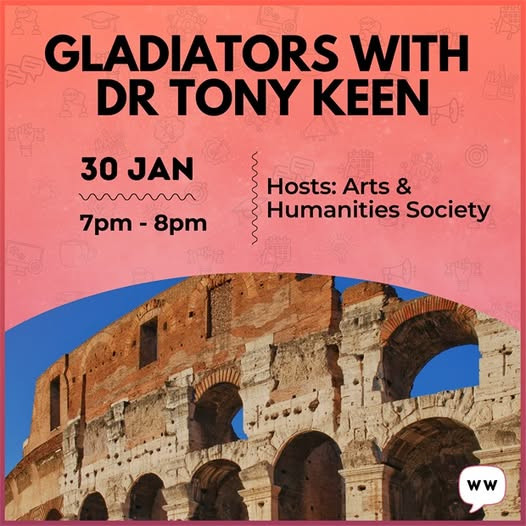
Poster: "Gladiators with Dr Tony Keen, 30 Jan, 7pm - 8pm, Hosts: Arts & Humanities Society", plus picture of the Colosseum at Rome.

It turns out that you can get tickets for my talk this Thursday on 'Gladiators - fact and fiction'. If you're an OU student, staff or alumnus, apparently you can attend for free.

Saturday, January 18, 2025

'Gladiators' lecture


Poster: "Gladiators with Dr Tony Keen, 30 Jan, 7pm - 8pm, Hosts: Arts & Humanities Society", plus picture of the Colosseum at Rome..


In just under a fortnight, I'm doing an online talk for the OU Students Association on 'Gladiators'. You need to be an OU student to attend, but I believe a recording will subsequently be made available.

Friday, January 17, 2025

In memory of Alan Jeffrey (1967-2024)

[Towards the end of 2023, my dear friend Alan Jeffrey was diagnosed with a brain tumour. It killed him the following July. In November, I spoke at the celebration of his life in Oxford. Today, 17th January 2025, would have been Alan's fifty-eight birthday, so it seems an appropriate time to put up a slightly tweaked version of what I said in November. Miss you, mate.]  

One of the last photos of me and Alan together, taken in March 2024. There are photos where you don't see quite so directly up his nose, but he's not in focus in them.

Friends …

I am deeply honoured to be speaking here today, and touched that Alan specifically wanted me to do so. Which means, when you think about it, that everything that follows is actually Alan’s fault. I’d like you to keep that in mind.

When Alan went into hospital earlier this year, Simon Mercer asked me if I wanted to send Alan a message. I replied that of course I did. Here is that message:

‘Get out of bed, you malingering hippy!’

The fact that I knew I could get away with saying that, indeed, that I knew it would bring a smile to Alan’s face, tells you a lot about my friendship with Alan.

I first met Alan Jeffrey in Edinburgh more than forty years ago, in September 1983, when I was eighteen, and he was not remotely old enough to be drinking in the pubs in which we were drinking – but then Alan always could get away with a lot though being tall and self-confident. Fortunately, he never used this power for evil. We met through the science fiction and role-playing societies, found we lived in student houses on the same street in Edinburgh, Gordon Terrace, and we bonded over science fiction, and in particular Doctor Who, comics, and role-playing games. He was smart, funny, erudite and knowledgeable, and his politics were clearly in the right place. We became fast firm friends, quite remarkable considering what a dreadful little shite I was in my late teens and early twenties. I did once throw a drink over him, due to some imagined slight – that was swiftly forgotten and forgiven by him.

Alan's cover for a fanzine that I edited roundabout 1984. Thanks to Simon Tett for the scan. Dr Strange is, of course,© and TM Marvel Comics.

We were soon collaborating, on role-playing scenarios, fanzines, and comics; Alan was a gifted cartoonist, I was a so-so originator of ideas. Such was our contribution to the Edinburgh University role-playing society that we were both awarded honorary life memberships, though I suspect if I turned up there now I would find that no-one currently connected to the society has any memory of that.

When we left Edinburgh, me for Manchester, he for Oxford and then Brighton (via Sweden), we continued our collaborations. To that period belongs out finest work, ‘Steve & Andy’, as illustrated on the t-shirt I am wearing (please don’t ask about the stains, not least because I can’t explain them). This was a series of episodes in the lives of two students, a miserable nerdy one, and his more self-confident friend, a comic probably even more autobiographical than we admitted at the time. I was delighted to learn that Alan still had a page of ‘Steve & Andy’ on his office wall – that page will now take pride of place in my study.

A 'Steve & Andy' strip, though not either of the ones mentioned in the text. Thanks to Jeremy Day for the scan.

I once, presumptuously, described our friendship like that of Morecambe and Wise – since Alan was obviously the tall, handsome one with the glasses, that must make me the one with the short, fat, hairy legs. Alan, naturally laughed at the comparison. But I meant that we understood each other creatively as well as they did, and could spur each other to greater achievements than we could ever manage alone.

We did disagree on some things, though looking back, I have often come to see that Alan was right. Except on crossing the road – I still think he was far too casual about that. Of course, we frustrated each other at times – what close friends don’t? But even that could fuel our creativity. My favourite of all the work we did together, that I’d hoped to show you but couldn’t find, is a comic strip we spitballed after an afternoon when Alan was getting more and more fed up with my relentless negativity – and anyone who’s known me long enough will know how that feels. Two stick figures, identifiably Alan, with his glasses and ponytail, and I, with a mass of uncontrolled curls, are speaking to each other in pictographic speech balloons – his is a flower, mine is a storm cloud. As we talk, the flower gets smaller, and the storm cloud persists. Finally, Alan storms off, his speech balloon now a storm cloud. In the final panel I am alone – and my speech balloon is a flower. My recollection – and fortunately Alan is not here to challenge this – is that the basic idea was Alan’s, but I added the final panel. I think it explains the nature of our friendship better than anything I can say here.

As our respective creative energies became absorbed into our paths as what we now know to call Early Career Researchers (and Jeremy will talk more to that), our collaborations dwindled and then ceased. After he went to the States, naturally we saw less of each other. But we stayed in touch through various forms of social media, and I saw how proud he was of Laura and Janine.

And we still retained that rare friendship where, when we did meet, we just picked up where we left off. Even when I last visited him, in March of this year – and I want to express my thanks to Catherine and David for making that happen – we still had that.

I know that I am reaching the age where I will be going to far more funerals and celebrations of life than to weddings, and I’ve lost friends of my generation already – Claire, Andy, Lesley, among others. Indeed, one of the last times I saw Alan in this country was at John Grandidge’s memorial. But still, fifty-seven is no fucking age, and could he not at least have been allowed to know the UK election results, which he would have found hilarious?

This loss hits me personally worse than most. Still, if, when my time comes, I can face my own imminent demise with half of the dignity and humour with which Alan faced his, I will consider that I have done well.

In any case, this is meant to be a celebration of Alan’s life, and if he is up there, in a heaven that neither of us believed in, he is undoubtedly shouting at me to ‘Get on with it!’

So at this point, rather than do that, I’d like to read a passage from The Lord of the Rings. Alan wasn’t, as far as I can recall, a big Tolkien fan – he preferred his fantasy in a Michael Moorcock mould – but this particular passage says something to me. Meriadoc Brandybuck, hobbit of the Shire, is talking to Aragorn, rightful king in the West.

‘[I]t is the way of my people to use light words at such times and say less than they mean. We fear to say too much. It robs us of the right words when a jest is out of place.’

To which Aragorn replies: 

‘I know that well, or I would not deal with you in the same way.’* 

So many of our close friendships are like that. I know mine with Alan was.

Alan would surely mock mercilessly such sentimentality, and also point out that I’ve gone a bit Alan Bennett’s vicar on you. He would expect me to be witty and irreverent, and I hope I have been. But I don’t think he’d be surprised at me getting sentimental; he knew me better than that. So I want to say, finally, that I am a better person for having known and loved Alan Jeffrey. I’m not quite sure how to deal with a world without him in it. I shall miss him more than I can possibly express, but I am eternally grateful for our time together.

Thank you.

* Return of the King, Book Five, Chapter 8, 'The House of Healing', for those who want to know.

Wednesday, January 08, 2025

Online: Mythology on the Streets of London

A modernist statue of the goddess Minerva, with helmet, shield and spear, by Allan Collins.

In March, I'm giving an online talk to the Glossop Guild on 'Mythology on the Streets of London', as part of their Zooming Through the Spring series. You don't seem to be able to book individual sessions, but a Season Pass for everything is only £30, which seems to me pretty good value.

Saturday, December 28, 2024

Past Vapour Trails

A view of a sky, criss-crossed by vapour trails.

I got asked if any of the Vapour Trails episodes I'd done in the past are still available, and to my surprise, I found most are. In fact, I think actually all of them are there apart from a special Stephen D Brooks and I did on Klaus Voormann in 2024, and the Manfred Mann special that we recorded early in 2024, but were unable for technical reasons to put out, so no-one got to hear it. 
This is the first one I did, 'I Bet You They Won't Play This Song On The Radio', where I look at songs and artists I think unjustly neglected. This one includes both Linus and Spy '51. 
After Neil Innes died at the end of 2019, Steve Brooks allowed me back to do a second show, to look at Innes' career.
COVID put a bit of a block on our plans, but in 2021 I was back with an epic track by track study of Revolver, where we just talk about how awesome it all is. 
Then at the end of 2021, we marked twenty years since the death of George Harrison with a special.
Finally in 2022 we did a two-part Beatles special, looking at some of the more obscure bits of Beatles and Beatles-related music. This is Part 1. And here is Part 2.

Friday, December 27, 2024

Boxing Day Vapour Trails

A bearded, bespectacled, balding man, looking smug. He is wearing a Doctor Who scarf to which is attached a yellow triangular badge.

I did a radio show, talking about some of my favourite tunes. Includes one track I can almost guarantee you've never heard before.

Wednesday, September 11, 2024

An Introduction to Greek and Roman Mythology

The Laocoon: A bearded man and his two young sons being carried of by snakes. A bit harsh.

I have, as ever, completely forgotten to plug this until the deadline is almost upon us. An online course I'm teaching for pre-college kids

Tuesday, August 20, 2024

Virtual launch for AI in Greek and Roman Epic

Greek vase painting showing Talos, the artificial man

This Wednesday I shall be taking part (remotely) in the official launch of the edited volume AI in Greek and Roman Epic.  

Friday, August 16, 2024

Quick updates

Cover of Artificial Intelligence in Greek and Roman Epic, edited by Andriana Domouzi & Silvio Bär. It shows a Greek vase painting with a woman with a wreath and an armed man approaching from different sides a motionless female. She may be a robot.
A few updates on what I've been doing. I have a chapter in Andriana Domouzi & Silvio Bär's edited collection Artificial Intelligence in Greek and Roman Epic, which was published in June (being an academic book, it is, of course, very expensive). My chapter is 'A Perfect Woman to Order: The Pygmalion Myth in Chris Beckett's The Holy Machine'. It's a shortened version of a piece I had published in French back in 2014 in Mélanie Bost-Fievet and Sandra Provini (eds.), L’Antiquité dans l’imaginaire contemporain, but I did thoroughly revise it for this appearance. I think this is probably going to be my only academic publication for 2024, but since 2023 went by without anything from me, I'm probably not doing too badly.

I had another review published on The Slings & Arrows Graphic Novel Guide. It's of a French album called Asterios the Minotaur, so I'm doing reception of myth. I quite liked it.

I got mentioned in an interview Roz Kaveney did about her Catullus volume, which interview I hadn't been aware of before. My name came up because she acknowledged me in the book for a small amount of help I'd given in understanding the ancient context (I'm sure Nick Lowe did more).

Finally, I have a forthcoming chapter in Amanda Potter and Anise K. Strong's Classical Receptions and Impact of Xena: Warrior Princess. This doesn't come out until February, but you can already order it (again, it's not cheap). My chapter is on 'Xena and Britannia', and ties in with the work I've been doing for over a decade now on screen portrayals of Roman Britain. I'm actually very pleased with the final version of the text I submitted.

Saturday, May 18, 2024

Notes on Doctor Who and History: 'Space Babies', 'The Devil's Chord' and 'Boom'

The Doctor (Ncuti Gatwa) and Ruby Sunday (Millie Gibson) in Swinging London apparel (the Doctor's a blue pin-stripe suit), against a brick wall. The Doctor looks off to the left, Ruby looks at the camera.

I have neglected this series of posts about Doctor Who and human history for a long time. My Doctor Who rewatch stalled over a year ago early in Season 2 (largely because I found 'The Rescue' painfully bad), and I'm not likely to get back to it too soon. But, we've got new Doctor Who at the moment, and of course he's going to go back to the past, so it deserves writing about. Let me say right at the start, these are not reviews of the episodes concerned per se, though value judgements may creep in. Also, there are likely to be spoilers, so don't read these before you've seen the episodes if you don't want to be spoiled.

'Space Babies' is mostly set in the far future, though there are a couple of slips backwards in time. The Doctor (Ncuti Gatwa) takes Ruby Sunday (Millie Gibson) back to a beautifully-realised Wyoming 150 million years in the past. There, we get a brief gag that derives from Ray Bradbury's short story 'A Sound of Thunder'. There is also a flashback to Christmas 2004, the day on which baby Ruby was abandoned at the Church on Ruby Road, the one place the Doctor says he can't take Ruby, and therefore the one place we are guaranteed to visit before the end of the season.

But the historical meat of the first three episodes is, of course, to be found in 'The Devil's Chord'. The episode begins in 1925, with a character whose sharing a name with the third Robin (of Batman and... fame) may or may not be a coincidence. 1925 isn't sketched out in any particular detail, but it doesn't need to be. Then we switch to Ruby, asking to go to February 1963 to see The Beatles recording their first album, something the Doctor considers a much better idea than wanting to go to the Titanic or Bethlehem, presumably at the time of the birth of Jesus. (Incidentally, I don't think television Doctor Who has gone to either event, though there is a photo in 'Rose' of the Doctor with a family he persuaded not to go on the doomed liner, and in 'The End of the World' he says he was on a ship that is presumably the Titanic. No surprise that spin-off materials involve both events.)

Doctor Who has, of course, been to 1963 before, in 'An Unearthly Child', which is referenced here, and 'Remembrance of the Daleks', which is not. On neither occasion did 1963 look quite as it does here. The Beatles have also been on Doctor Who before, not that you'd know this from iPlayer, where the short clip of them playing 'Ticket to Ride' has been excised from 'The Executioners' (episode 1 of 'The Chase'), though fortunately not from the Blu-Ray, so it is still possible to watch William Russell's painful attempt to look 'hip'). 'The Devil's Chord' finds a very neat diegetic way in which to get around the fact that even Disney can't afford to license a Beatles song for this episode.

The Doctor and Ruby change into outfits that are very much Swinging London. But Swinging London didn't really exist until 1965, and the Doctor's suit is more redolent of 1967-1969. In 1963, most men dressed like accountants. Most bands dressed like scruffy accountants. Even The Beatles had yet to don their trademark collarless jackets. The truly hip (the Beat Poets, and the like) dressed all in black.
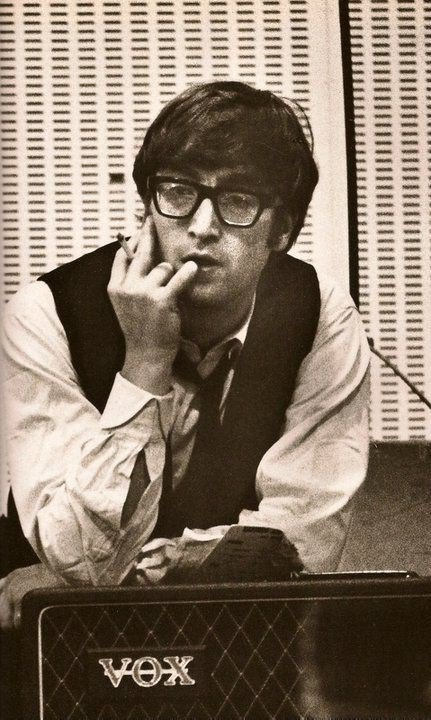
John Lennon in glasses, wearing a shirt and tie, and leaning on a Vox amplifier.
A rare photo of John Lennon in the style of glasses he wore up to 1966.
There are more anachronisms. Cilla Black wasn't even signed to a management contract by Brian Epstein until September 1963, so there's no way that she would be in a recording studio in February. John did wear glasses in the studio (though he whipped them off whenever he thought there was a camera nearby), but the round National Health 'granny glasses' were something he didn't adopt until 1966. The Beatles' hair was a lot shorter in early 1963 than it became later, and Ringo didn't even have his hair brushed forward.

Now, people can, and have, responded to lists of the anachronisms by saying 'look, it's just a silly fantasy episode, it's not meant to be the real Sixties'. To which I say, yes, that's my point. The episode presents an artificial idea of what 'The Sixties' was like. And what interests me is how and why that's been put together. So, John wears those glasses because those are the John Lennon glasses, the ones that everyone expects. The boys have longer hair because that's what everyone thinks The Beatles looked like. (Crueller writers than me might suggest such tactics are necessary because the actors don't look much like The Beatles, but then neither did Christopher Eccleston or Peter Capaldi.) The female singer could have been the more plausible Helen Shapiro (a friend of The Beatles) or Alma Cogan (a future friend of The Beatles), but that would make the viewers go 'who?' Everyone knows Cilla, and that she was associated with The Beatles. Pronouncing Brian Epstein's name as 'Epsteen' would be authentic - that's how Brian himself pronounced it - but the pronunciation as 'Epstine' is pretty ubiquitous these days (I try to avoid it when I do internet radio about the Beatles). When we see the famous Abbey Road zebra crossing, we expect there to be a white Volkswagen parked on the left, and don't worry that the car must, therefore, have been abandoned for six years.

Fiona Moore observed to me that at least since the 1980s people have forgotten how different the early 1960s were from the late, and indeed how much fashion was limited in its distribution. (For an example of this latter point, watch Get Back or Let It Be and compare how The Beatles dress with how roadie Mal Evans or even director Michael Lindsay-Hogg dresses, let alone all the people on the street listening to the band play on the rooftop at Savile Row.) Television quite often prints the legend rather than the reality; the Doctor and Ruby's outfits are all part of this, perhaps slyly sent up by the fact that they change out of outfits that actually were more suitable to 1963 (Russell T Davies' Doctor Who is nothing if not knowing). This is a phenomenon that can be seen in other television, such as, if perhaps to a lesser extent, in the recent television version of The IPCRESS File, also set in 1963. It's much more obvious in fantasy versions of the sixties such as the Austin Powers movies, and the Doctor's suit looks like a deliberate nod in that direction. This sort of conflation is a thing we tend to do to historical periods; note the way cultural differences between the Victorians of the 1840s and the Victorians of the 1890s can get elided in popular culture, or, to choose my own period, differences between first-century Rome and fifth-century Rome. 

This is an episode filled with elements derived from various bits of the 1960s, and especially The Beatles' career. Matthew Kilburn rightly draws attention to the 'Aeolian tones' recalling the 'Aeolian cadences' that music critic William Mann attributed to The Beatles in 1963, and Maestro's outfit in the latter stages has hints of The Beatles' outfits for Sergeant Pepper, and more obviously the hussar jackets that almost everybody seemed to wear in the second half of 1967. Several people have rightly observed that the plot of 'The Devil's Chord' owes quite a bit to The Beatles' 1968 animated movie Yellow Submarine. And the musical number at the end has its roots in endless 1960s pop musicals (though not any The Beatles made, with the possible exception of Magical Mystery Tour) - though again, Austin Powers is perhaps a more immediate influence.

It's a shame the final chord played by John and Paul wasn't the last chord of 'A Day In The Life', but you can't have everything.

The engagement of 'Boom' with the past is largely with the show's own history, in particular 'Genesis of the Daleks'; the main plot is based on the landmine scene from Part One of that serial, with Ruby Sunday in the role of Harry Sullivan. This follows the previous week's call back to 'Pyramids of Mars'. Apart from that, we get the Doctor singing 'The Skye Boat Song', but there's no commentary along the lines of 'I nearly met Bonnie Prince Charlie once'.

Wednesday, May 08, 2024

Octavia

Bust of a white woman. The nose is broken.

Christopher J Garcia has done an issue of The Drink Tank on Ancient Rome, and I have a short piece in it about Octavia, the sister of Augustus. Lots of other interesting stuff in there as well.

Sunday, April 28, 2024

Upcoming MANCENT and LRAC events


I've got quite a few events coming up. I've just started a MANCENT course on the Trojan War. We're coming up to week 2, but you can still book for the whole course and get the recording of week 1. You can also buy a ticket just for this week's session

I also have a couple of myth walks, one along the South Bank on 8 June, and one down Pall Mall to Hyde Park, on 15 June. 

The full MANCENT summer programme is here.

I'm also doing another Roman London walk for LRAC on 1 June.

Finally, these are the last few days for Eastercon members to catch up on recorded sessions they missed. These include me talking about Mercury, horror in antiquity, unusual methods of transport, and Stanier locomotives, plus lots of other people being interesting. Catch-up expires 30 April.

Friday, April 12, 2024

The Trojan War: Myth and history?


The so-called 'Mask of Agamemnon', a gold funerary mask from Mycenae, c. 1550-1500 BCE, now in the National Archaeological Museum, Athens. It depicts a flattened bearded male face, with his eyes closed.
I have a new blog post up on the MANCENT blog, about the 'history' behind the Trojan War. This is to do with my upcoming course on The Trojan War, for which you can book tickets here.

Sunday, January 14, 2024

Screening Britannia: Horrible Histories: The Movie - Rotten Romans

Four Roman officers, of various levels of seniority, around a map table, in front of a large white tent.
Horrible Histories: The Movie – Rotten Romans
. UK. Directed by Dominic Brigstocke. Screenplay by Jessica Swale with Giles Pilbrow and Caroline Norris. Starring Emilia Jones, Sebastian Croft, Nick Frost, Craig Roberts, Kate Nash, Rupert Graves, Alex Macqueen, Lee Mack, Warwick Davis, Sanjeev Bhaskar, Alexander Armstrong, Chris Addison, Derek Jacobi, Kim Cattrall, and Rattus Rattus. Amazon, Ingenious, Silver Reel, BBC Films, Attitude Film Entertainment, Citrus Films, Scholastic Entertainment Inc., Lion Television. 2019.

I showed this to my Roman Britain students at the end of 2022, and again at the end of last year. The first time, they had asked for The Eagle, but I could find neither my own copy not that of the university library (both have since turned up). They nevertheless enjoyed this replacement, as did I. 

Horrible Histories, for those who don’t know, originated as a series of humour books detailing the funnier and grosser elements of history for an audience of children. It became a successful television comedy series for children, and then in 2019 a movie. Interestingly, the movie relies less on the regular TV cast, who are mostly in background roles, if there at all; instead, it turns more to stars who have been brought in for this occasion – the biggest coup is Hollywood's Kim Cattrall, but there's also Lee Mack, Rupert Graves, etc. (And even, in a small role, Ncuti Gatwa; truth be told, he’s a bit anonymous in his role as a legionary, but in the behind-the-scenes feature, star quality pours out of him.)

The topic chosen for this movie is Roman Britain, specifically the revolt of Boudica in 60/61 CE. It’s quite a bold move to treat the Boudica story as a comedy. Unless one is to count a brief mention of her in Carry on Cleo, the only other all-out comedic treatment I am aware of is an episode of the TV Horrible Histories called ‘Bolshy Boudica’ (2015), where the Iceni Queen is played by Lorna Watson (the one of Watson and Oliver who didn’t get to be on Doctor Who), from which this naturally recycles some material, but surprisingly little (and which I really need to watch again). Other than that, the most light-hearted portrayal is in an episode of Xena: Warrior Princess (‘The Deliverer’, one of the grimmer Xena eps).[1]  Other versions tend to be extremely bloody and violent, and wallow in the nastier elements of the story. 

As a consequence of being a comedy, and even more as a consequence of being made for children, albeit for children expected to revel in the grosser parts of history, some of the more horrific moments in the story are toned down here. There’s no room for the rape of Boudica’s daughters, nor is the battle of Watling Street the bloodbath that Tacitus describes, though, from a distance, we do see lots of dead bodies lying about. Rather than dying in battle (the common cinematic outcome) or taking her own life (Tacitus’ account), Kate Nash’s Boudica quietly slips away when it’s obvious that the battle is lost. There is then a reconciliation song-and-dance number between Britons and Romans. (Oh yes, this is a musical, drawing upon styles as diverse as modern rap and Celtic folk.)

Elsewhere, the violence of the revolt is touched upon, but skirted around. Colchester is seen in flames, as is London (from a distance), whilst the destruction of St Albans is merely mentioned. None of the violence in the narratives of the ancient sources is depicted; you don't see any civilians being slaughtered. Nor is there the common link into the English folk horror tradition that Boudican stories often have, because the role of the Druids is very much reduced here. They are present, fought by Rupert Graves’ Suetonius Paulinus, and all looking like refugees from an Eisteddford (though fighting like ninjas). But they are only seen at Anglesey. There are no Druids around the court of Boudica herself, as there often are in movie versions (see, for example, 1927’s Boadicea, 1967’s The Viking Queen, and 2002’s Boudica). 

Other than that, a lot of standard elements of the Boudica story do make their way in. It is the avarice of Catus Decianus (Alexander Armstrong) that provokes the revolt. A common issue in these productions is the fact that, even in these post-imperial days, a British audience wants to identify both with Boudica, as a British heroine and proto-Elizabeth I, and with the Romans, since there’s a long tradition of the Britons seeing themselves as heirs of the Romans. It is common to negotiate this divide through the provision of bad Romans, who provoke the revolt, and much more sympathetic good Romans, who try to avoid conflict, and only very reluctantly take part in the battle. Here, the good Roman is Attilius Minus, known as Atti, played by Sebastian Croft in a performance that owes more than a little to that of Tom Rosenthal in Plebs. The bad Romans are Decianus, Nero (Craig Roberts), and Agrippina the Younger (Kim Catrall, relishing the opportunity to do some serious scenery-chewing). 

Another standard device is to have a romance that crosses the divide between Roman and Briton; Boadicea and The Viking Queen both do this, and so does Horrible Histories, with Atti falling for precocious villager Orla (Emilia Jones); the difference here being that Atti and Orla’s romance has a happy outcome, culminating in the big song-and-dance number that unites Britons and Romans. Also, because the characters are young adults, the romance never gets much beyond them being BFFs. (A thing I have recently come to notice in screen stories of Roman Britain is the preponderance of child or young adult protagonists; fully understandable here, but also to be found in Britannia and other productions aimed at a more adult audience.) 

Like most comedies set in the ancient world, a lot of the jokes rely on the placing of modern stereotypes and situations into ancient dress. So, for instance, the build up to the Battle of Watling Street is presented as if it were a modern sporting event, whilst there are also ancient traffic reports by Chris Addison, where the eye-in-the-sky is merely up a tree. But there are a surprising number of gags that seem aimed at an older audience. Rupert Graves’ Suetonius Paulinus talks about himself in the third person, much as Julius Caesar does in his Commentaries. There’s a marvellous moment in which it becomes obvious that the person impersonating Derek Jacobi’s classic turn as Claudius is in fact Jacobi himself. Lee Mack's character, Decimus Maximus (albeit that his full name is, I think, never stated on screen, only in the behind-the-scenes feature), is surely meant to recall Maximus Decimus Meridius in Gladiator. I also suspect that the sequence where Atti is in search of gladiator’s sweat, whilst being one of the ‘weird but true’ facts on which Horrible Histories prides itself, perhaps also owes something to the mare’s sweat running gag in A Funny Thing Happened On The Way To The Forum. And there is more than one call back to Life of Brian. All of this raises the question that Movies We Dig brings up in their episode devoted to this movie; who is it actually for, given not everything is aimed at children?

There are also some of the standard jokes about the remoteness of Britain. Nero initially thinks that the outline of Britain on the map was actually a weird stain, and refers to Britain as ‘the stain’ for the rest of the movie. And of course some soldiers form the testudo, because they always have to in Roman movies.

I like the movie much more than Movies We Dig do, but they do raise some legitimate issues. They make the interesting point that the movie has difficulty negotiating the transition from a sketch show to a longer narrative. The selling point of Horrible Histories was the weird bits of real history displayed in a funny fashion, and the educational element of the show was always underlined by telling the audience which bits were true. There’s hardly any of that commentary here, just a couple of brief segments at the end where the sources for Boudica's death are mentioned, and some stuff about Agrippina and Nero. A lot of other examples, such as Sycophantus (Alex MacQueen) explaining to Nero that one cannot crucify Roman citizens, and that sewing someone in a sack with a snake, a dog, a rooster, and a monkey and throwing them in the Tiber is the punishment for killing one’s own father, are only really noticeable if you're attuned to Horrible Histories' way of presenting this sort of material. (It’s perhaps also worth noting Horrible Histories can be a bit imprecise when it comes to the things that are true. For instance, there is a reference to dogs licking wounds being a recognised medical technique, which it was, but as far as I can find out this was the case in the Greek and Roman worlds, whereas here it is attributed to the Celts.) 

Another point Movies We Dig make is how traditional this all is. The final song is essentially all about how, in the end, the Roman occupation of Britain is a good thing, because of all the benefits it brings, even if some concessions to the essential brutality of Roman rule are made. This is very much the mid-twentieth century picture of Romanisation. Equally traditionally, the Britons are universally referred to as Celts, a term that has rather gone out of fashion amongst archaeologists, though popular television programmes still use it. But, as Gideon Nisbet said a long time ago, popular culture remains very firmly rooted in ideas that most academics abandoned a long time ago.

Nevertheless, I still like this movie, and would recommend to to anyone.

If you’re interested in learning more about Roman Britain on screen, I’m running a course from mid-January. 

[1] About which I have a chapter coming out this year.

Thursday, January 04, 2024

Obituary for John M. Burns.

A page of John M. Burns comics, for The Bionic Woman.
There's a new post by me (with a little help from Will Morgan) on FA-The Comiczine: An obituary for John M. Burns.

Wednesday, January 03, 2024

My Spring 2024 MANCENT teaching

A group of Roman legionaries determinedly marching up a hill, led by Lee Mack as a centurion. The Fifteenth Doctor is somewhere at the back.
I'm repeating my Mancent online course on Screening Britannia from this January. Anybody who fancies joining, you can sign up through Eventbrite. Anyone who pays the full course fee will get the recordings. Alternatively, you can book for individual sessions here

I'm also doing a London mythology walk for MANCENT, going down Pall Mall and towards Victoria. 

And finally, another walk I'm doing for MANCENT is a visit to Roman Colchester

 MANCENT's full Spring 2024 prospectus can be found here.

New post on FA-The Comiczine: An obituary for Ian Gibson


There's a new post by me on FA-The Comiczine: An obituary for Ian Gibson