Sunday, January 04, 2009

Reception Theory: some preliminary thoughts

I’ve had a project for a while to educate myself more thoroughly in reception theory and methodology, rather than just doing articles on individual instances of reception. I’m always aware (not least because it comes up a lot in readers’ comments on papers I submit) that I am a bit on the theory-light side, and I would like to correct that. Recently, a number of circumstances combined to actually get me started on some of the reading. So, over the past couple of months I have read or reread Lorna Hardwick’s two books Reception Studies (you’ll have to scroll down, I’m afraid, but if you’re going to get a copy I’d rather you got one directly from the Classical Association) and Translating Worlds, Translating Cultures, the collection Classics and the Uses of Reception, edited by Charles Martindale and Richard Thomas, and Martindale’s seminal Redeeming the Text, which set the terms for the debate on reception theory back in 1993, as well as large chunks of the Blackwell Companion to Classical Receptions, edited by Lorna Hardwick and Christopher Stray. I’ve also read a number of related articles, such as Martindale’s entry on ‘reception’ in the Oxford Classical Dictionary, the BMCR reviews of the Martindale/Thomas and Hardwick/Stray volumes (the latter, by John Henderson, is in his usual idiosyncratic style), and one work, Mary Beard and John Henderson’s Very Short Introduction to Classics, that doesn’t mention reception once, but is widely (and rightly) recognized to be a key text on the subject. If I was pointing someone to a quick introduction to the subject, I would recommend Reception Studies, followed by cherry-picking the Blackwell Companion, which includes, among other delights, an excellent article on film by Joanna Paul.

As a result of this reading (and with a memory of other texts I have looked at in the past, such as Goldhill’s Love, Sex & Tragedy), I feel able to present the following, which is a preliminary statement of my response to the theoretical approaches. It is likely to be modified as the project proceeds.

An attitude to theory

I’m a lot less suspicious of theoretical approaches than I used to be. There was a time when I shared what remains outside academic circles (and quite often inside) a common suspicion of theory, ready to write it off as pretentious rubbish. I now recognize that theory can be a useful tool. It doesn’t necessarily lead me to say things that I otherwise wouldn’t say, but it does help me to say them more effectively.

Similarly, I am no longer afraid of jargon. I recognize that technical language can be useful. In this I differ from some Classicists, who can be resistant to the appropriation of terminology from literary theory. There was a debate about this in the pages of CA News back in 2005/2006, including an article by Gideon Nisbet, and a set of letters in the following issue. The letter-writers objected strenuously to Nisbet’s suggestion that classicists should be more open to jargon,[1] but what I feel they were really objecting to was bad use of jargon, when it is used to obfuscate rather than clarify, or when a term like ‘hermeneutics’ is used by people who don’t really know what it means (I’m not too sure myself, which is why I rarely employ it). I’m against that as well.

So, I wish to be theory-aware in my work. But I don’t want to be theory-heavy or dogmatic. Models must fit the evidence – evidence must not be bent to fit models. My original training as a historian makes me primarily an empiricist, and I remain an evidence-led scholar. And theory must not be allowed to get in the way of having something interesting to say.

Reception theory in Classics and elsewhere

Nick Lowe has on a number of recent occasions (most notably at a one-day seminar on Teaching Reception Studies in the Institute for Classical Studies in November 2007) said that Classicists don’t use ‘reception’ in the same way as other academic fields. I felt I ought to check this out, and I did, focussing on film studies, solely because, since I am about embark on a film history course, I have quite a few theoretical works lying about (I consulted in particular Maltby, pp. 549-53, and King). I did also look up ‘reception theory’ in The Oxford Dictionary of Literary Terms, pp. 282-3.

And Lowe is right. In most fields, reception theory is about reader-responses, and concerns itself with how a particular text (using ‘texts’ in the broad manner employed by Roland Barthes, to mean not just written accounts, but any item to be studied) has been received. Classical receptions almost always focus upon a receiving text, and how that has received an originary text. To a degree, it is true, as has been pointed out to me, that this is a natural product of the field. Classicists cannot produce a meaningful study of the original audience of the Aeneid, and so we are forced to looking at other forms of response. Nevertheless, it does mean that Classical reception studies operate differently to other forms.

It’s also probably the case that many early examples of Classical reception studies thought little about theoretical approaches. This has clearly changed, as those working on reception studies have felt the need to be more rigorous and self-critical in their approaches (an observation made by Joanna Paul in the abstract for a paper delivered in 2007).

Martindale’s theory of reception

As I said earlier, Charles Martindale set the terms for reception theory about a decade before reception became all the rage in Classical Studies. And though most people don’t do reception in the way Martindale recommends, there isn’t really a counter-theory out there (I’m channelling Nick Lowe again here). I therefore need to engage with Martindale’s works. This is not easy. I have read most of the Martindale pieces listed in ‘Works cited’ below (with the exception of the Arion article); a number of them I have read repeatedly. And I’m still not sure if I understand the argument fully.

The problem is that Martindale, unlike many Classicists (and certainly unlike the majority of Classicists when he began publishing this material in the early 1990s) is well-read in literary theory. His take on reception, laid out in the various pieces listed, draws heavily on Hans Robert Jauss, and through him on Hans-Georg Gadamer, and on Wolfgang Iser. I have read almost none of these writers (just one article by Jauss). As a result, I don’t find it easy to follow Martindale’s argument. I suspect this is shared by many in Classics, which as a field has always been reluctant to embrace theoretical approaches—indeed, anecdotal evidence would suggest that some (unfairly, I think) reject what Martindale has to say because of what is perceived as an excessive amount of literary theory contained in what he says. I witnessed the debate at the Classical Association Conference in Reading in 2005 between Martindale and Christopher Rowe, recorded in the two pieces from the CUCD Bulletin listed in ‘Works Cited’; there seemed something of a perception that Rowe had won, and I would say that was partly because Martindale seemed to be putting forward a post-modernist argument about which many in the audience were highly suspicious. (On paper, it seems more balanced—in particular I think Rowe goes too far in asserting that he has uncovered the correct reading of Plato’s Lysis, as opposed to a reading.)

Martindale’s argument is most fully expressed in Redeeming the Text, especially Chapter 1, and the introduction to Classics and the Uses of Reception (an abridged version of which is here). My reading of it is as follows (and I suspect Martindale himself would argue that, even if my reading differs from his, that doesn’t make my reading invalid):
 
The traditional approach to study of Classical texts aims to approach the text in its original context, and establish its meaning. This cannot be done. It is impossible to read any ancient text devoid of the cultural associations built up around it since it was created, no matter how hard we try. The traditional approach is excessively positivist. We should reject this, and instead of ignoring later receptions of the texts in which we are interested, use them to formulate new approaches to the texts.

There’s quite a lot in what Martindale says with which I agree. I share his distaste for the overly positivist approach. Positivism in its purest form rests on assumptions about the unproblematic ‘knowability’ of ‘objective’ ‘facts’. There are no absolutely knowable facts. The post-modernists are right that everything we know is only partially known, and influenced by the means in which we receive the information, and the people generating that information. No witness is wholly unbiased. This doesn’t mean that we can believe what we like, and that all views are equally valid. That’s a misuse of the post-modernist view. What post-modernism is saying (in my understanding) is that we should think about how we know what we think we know.

However, once we have done that, I don’t see why we can’t carry on as literary critics or historians, doing much the same thing as we have done before, but with a full cognisance of our limitations. We know that we can never establish fully what happened in the past, or what an author intended in their work—but we do know that events happened in the past, and that authors had intentions when writing. Even though we cannot ever fully achieve our objective, that doesn’t mean that we shouldn’t make the attempt. When talking about establishing the text of an ancient author, Beard and Henderson write (p. 57; p. 61 of the repaginated 2000 printing): ‘there is no alternative to taking the risk and trying, at least, to reach as accurate a view as possible of what ancient authors wrote’ (their italics). I think that applies across the board in study, to historical events and authorial intent. I don’t buy the ‘death of the author’ concept or the intentional fallacy, at least not as fully expressed—every text that we study was created by a human being, and that human being had an object in mind when they wrote. Moreover, the context in which a work is produced is a factor that shapes it, for all that the New Criticism attempts to reject such an approach. Properly qualified, I think that this is a valid way to tackle antiquity.

Moreover, rejecting this strikes me as an unwarranted limit on human imagination. To say that a critic cannot try to imagine their way into the mindset of someone in first century ce Rome is like suggesting that an author of fiction cannot write a black person if they are white, or a woman if they are a man. One can never fully get inside the head even of the person one knows best in the world besides oneself. But we can still try. And as long as the nature of this imaginative exercise is made explicit, I think the exercise can be performed.

I don’t think Martindale would agree, and would probably view my approach as still positivistic, for all my attempts to dress it with some sops to a more post-modern approach. But I’m not sure what he offers in its place. Taken to its logical extent, the reception process as described by Martindale becomes potentially excessively solipsistic, and it would become hard to say anything meaningful about any text whatsoever. I should add that Martindale himself doesn’t take it to that extreme.

In any case, there is, for me, value in Martindale’s approach, even for more traditional textual commentary. Yes, one can never strip away entirely the expectations arising out of subsequent receptions. But if one were to identify the effect of those receptions, as best as one can, then it is possible to get someway towards how that text might seem without the influence of the later receptions. Of course, what one is left with would be one’s personal response to a text, which might, or might not be the response the author intended to create. Looked at in this way, it seems potentially a rather spurious way of approaching the text. But I’m not sure what else one can do.

This does all mean that the study of a text’s reception is crucial to understanding a text, so Martindale’s theoretical approaches are important. But one cannot only study Virgil through Dante, or Ovid through Titian. A complete view of a work’s reception must include how the work was received by its very first readers, which brings us back (though perhaps by a different route) to the sort of looking at the text in its original context that Martindale seems to disapprove of.

And, as I said, most people working in reception don’t go as far as Martindale. He criticizes a lot of reception studies as positivistic. Here again I think he has a point. There are certainly cases where people seem too eager to find Classical receptions where they perhaps don’t exist—I would cite attempts to interpret 2001: A Space Odyssey as a full-blown reworking of Homer, rather than something which occasionally alludes to ancient epic.

Introspection in reception

One thing I have noticed of late is a tendency for reception studies to get quite reflexive. Lorna Hardwick rightly identifies redirecting our attention back on the original source as a key element of reception studies (Reception Studies, p. 4). I agree that a reading of a receiving text can certainly bring new insights to the originary text, though one must be careful not to give way to anachronism. When one says, e.g., that T.S. Eliot reconfigures Virgil, one must be clear what that means. We must always remember that, whilst Eliot read Virgil, Virgil never read Eliot.

But I have seen Hardwick’s comment reformulated as ‘the key element’, and that to me is wrong. Yet often the first question that gets asked in theoretical studies is ‘what does the reception tell us about the original text?’ That is implicit in the title of the Martindale/Thomas volume. Martindale makes a valid criticism (in the Blackwell Companion to the Classical Tradition, p. 303): ‘The assumption is that such receptions tell us only about the receiving culture, little or nothing about the work received.’ It is certainly incorrect to assume that this would be the only way of doing reception. It would be equally incorrect to assert that the only way of doing reception studies is to treat the receiving object as a mere adjunct to the received text.

I can see various reasons why this might appeal. For a start, most research proposals [in Classical reception] have to get past a committee of Classicists, so emphasizing the originary texts is natural. Also, some reception theory has been developed in the context of staging of Greek and Roman drama, where the original text and what the staging reveals about it are important issues.

In an ideal world, of course, every reception study would do both, and have something interesting to say about both receiving and originary text. But that’s not always going to be the case. An examination of the brilliant way in which O Brother Where Art Thou? reconfigures the visit to the Underworld into its cinema scene tells you an awful lot about the Coen Brothers, but it doesn’t necessarily tell you that much about the Odyssey. But that doesn’t make it an invalid approach. To act as if it does works against truly cross-disciplinary studies, and in the end will alienate those to whom the originary texts are important in their own right. (Martindale is on the money here: ‘research on, say, the Victorians must be credible to Victorianists as well as classicists’, Classics and the Uses of Reception, p. 9.)

I should say that a great many instances of reception actually in practice do say interesting things about the receiving text. Such instances can be found throughout the Blackwell Companion, and even in the Martindale/Thomas volume.

An élitist approach?

Another problem, particularly with the sort of reception I do, is that it can fall foul of an élitist agenda. It’s very easy to dismiss study of popular culture as not really being serious scholarship, and from there it’s a short step to tarring all or reception studies with the same brush. One reaction to this is to concentrate upon ‘high culture’ receptions. In the introduction to Classics and the Uses of Reception (p. 11), Martindale writes:
if we abandon a serious commitment to the value of the texts we choose for our attention and those of our students, we may end by trivialising reception within the discipline; already a classics student is far more likely to spend time analysing Gladiator than the Commedia of Dante. I find that worrying. This is not to decry the study of a wide range of cultural artefacts (there are many more good things in the world than the canon knows), and certainly not to criticize the study of film or of popular culture; it is simply to say that we form ourselves by the company that we keep, and that in general material of high quality is better company for our intellects and hearts than the banal or the quotidian (often we use the latter, archly and somewhat cheaply, merely to celebrate our own cultural superiority).
In reading, he added a verbal aside that he didn’t think Gladiator was important. The problem is, this is judging the importance of Gladiator solely on its artistic merit. But Gladiator and films like it are important, because for a great many people, these films their only experience of Classical culture. By dismissing the film in this much criticized statement (by, e.g., Rowe, and Paul in her film article, pp. 304-5), Martindale is saying that those people’s experiences of Classical culture don’t really count. Instead of demonstrating cultural superiority through mocking popular culture (granted, best avoided), Martindale attempts to demonstrate cultural superiority through ignoring popular culture. And indeed the volume [Classics and the Use of Reception] goes on to largely eschew engaging with the media through which most people experience Graeco-Roman antiquity.

This won’t do. We need to understand everyone’s experiences, not just those of an élite. A theme that has just started to appear in recent work is that of the ‘democratic turn’ (see the introduction to the Blackwell Companion to Classical Receptions, pp. 3-4). This identifies a movement that takes Classical culture away from the élites, and reconfigures is a vehicle for dissent. For myself, I wonder if the manifestation of the democratic turn is a product of the development, and increased visibility, of mass culture in the twentieth century, rather than any actual change in attitudes. Whilst élite culture certainly drew heavily upon the Classical past, did it ever have exclusive ownership of the Classical tradition? There is a case for saying that non-élite receptions of the Classics always took place, but were until recently largely invisible (or at least not examined); there are good articles on this by Siobhán McElduff and Edith Hall, and Hall at least plans more in this respect.

I’d like to cite here a recent example from Monty Python’s Life of Brian (1979), the well-known scene where Brian (Graham Chapman) is painting on a wall ‘Romans go home’ in very poor Latin, and is put through his grammar paces by John Cleese’s centurion. This is a sketch written by people who went to posh schools where they were taught Latin, and had encountered teachers who took this sort of approach. I and my immediate companions were laughing our heads off when we first saw it because we were going to a posh school where we were taught Latin, and recognized our teachers in Cleese’s portrayal. But the rest of the cinema were also laughing their heads off, and I doubt they had all gone to posh schools where they were taught Latin. And the scene remains funny. What is it that allows most audiences to connect with that scene? This is something I don’t think has been fully investigated, and it ought to be.

My kind of reception

This is the point where I get solipsistic. But there’s nothing intrinsically wrong with the personal voice where appropriate.[2] So, where do I see my own research fitting within this theoretical framework? I addressed this in a paper given at the Classical Association Conference in Birmingham back in 2007 (I am preparing the ms. for a revised version of this paper, but this passage has been removed from that). Paula James had asked in the abstract for her paper in the same panel a ‘so what?’ question; why were we bothering with this material, could we bring anything to the popular culture material that anyone wanted to hear, and what can it tell us about the Classical texts? My response was:
there remains the question Paula posed—‘so what?’ Can we as Classicists bring something new to the study of this material? I believe we can. I don’t just give papers at CA conferences or in university departments. I also give talks at sf and comics conventions. And the audiences there are fascinated. They want to hear the different perspective that we have to offer.
As for the other part of Paula’s question, how does study of this material enrich our own study of the original Classical culture, perhaps in this case, it doesn’t much. You’ve probably learnt far more about superhero comics than you have about the Roman god Mercury, and I’ve been speaking more about receptions of themes developed initially against a classical background and then moved into other contexts than I have been about direct classical receptions. But, so what? Lorna Hardwick rightly identifies redirecting our attention back on the original source as a key element of reception studies. But does that mean that every paper written about Classical receptions must fulfil that purpose, and if it does not, then that paper has failed? I don’t think so. I looked into the subject matter of this paper because I was interested in it. I wrote the paper because I hope that you might be interested as well, and I want to communicate what I’ve discovered to you. And, for all the concerns about Research Assessment Exercises, and postgraduates wanting to further their careers through presenting papers, ultimately, research is about finding out things because you’re interested, and telling other people because you think they’ll be interested too. For myself, that’s all the justification I need.
This remains my view. My approach is, I think, dictated by the sort of scholar that I am. I am not just a Classicist with an interest in reception studies, who happens to have picked science fiction as my area of interest. I am a Classicist with an interest in reception studies, but at the same time I am a critic of science fiction, and get published in the sf critical journals. Most of the time my work in each field overlaps (for reasons of time if for nothing else). So I am interested in both originary and receiving texts. This isn’t to say that there is anything wrong with coming into a field of reception purely from a Classics background. But that’s not who I am, and who I am shapes how I want to do reception.
The sort of reception works I am interested in are those that are as useful for those concerned with the receiving text as with the received. I point to works like Maria Wyke’s Projecting the Past, or Gideon Nisbet’s Ancient Greece in Film and Popular Culture (I focus on popular culture only because that’s what I know—similar pieces on opera, or painting, or whatever, can be found in the Blackwell Companion, or even in the Martindale/Thomas collection). Significantly, both authors have backgrounds that take them outside a pure classics approach—Wyke has an M.A. in Film and Television Studies as well as her Classics Ph.D., and Nisbet is a long-standing comics and sf fan who I first met at an Eastercon (British National SF Convention). I haven’t read Edith Hall’s The Return of Ulysses fully yet, but from what I’ve skimmed it looks to be another example of the sort of treatment I like; it’s worth noting that the publisher has a long background in cultural studies, and is not a traditional Classical studies publisher. The sort of conferences I enjoy are the likes of Classics Hell: Re-Presenting Antiquity in Mass Cultural Media, which took place in Reading in April 2007 (the proceedings will soon be published), or the schools conference in Oxford last November, with many of the same speakers, and at which I was invited to speak.

When I write, I am aware that I am often writing for two audiences, one of Classicists and one of sf readers—this will be especially the case when (and it remains when, not if) I finally write the book on the subject that I want to. One result of this is that I have to include a lot of explanation of things that one audience would take for granted, but of which the other audience is ignorant. But it also works against a theory-heavy approach. If I write a theory-heavy book, many of the sf readers won’t look at it. There are people in the sf community who do get deeply involved with theory—mostly people in academic institutions. But there are a lot of respectable sf critics and scholars who operate outside academia, and they are as theory-resistant as Classicists.

So my approach is theory-aware, but theory-light, at least in terms of what gets onto the page, and aimed at saying something interesting to both Classicists and sf readers. Given the papers I’m having accepted, and now often invited, and the responses I’m getting, this seems to be working.

But as I say, this is all provisional. My attitude to theory has evolved a lot over the past fifteen years, and I have absolutely no doubt that it will evolve again in the future.

Edited 16/01/09: Coincidentally, there is some very interesting discussion on theory in the context of sf criticism going on here and here.

Works cited

Baldick, Chris (2008) The Oxford Dictionary of Literary Terms, 3rd edn., Oxford, Oxford University Press (1st edn. 1990, 2nd edn. 2001).
Beard, Mary, and Henderson, John (1995) Classics: A Very Short Introduction, Oxford, Oxford University Press (repaginated edn. 2000).
Goldhill, Simon (2004) Love, Sex & Tragedy: How the Ancient World Shapes our Lives, London, John Murray (paperback edn. Love, Sex & Tragedy: Why Classics Matters, 2005).
Hall, Edith (2008) The Return of Ulysses: A Cultural History of Homer’s Odyssey, London, I.B. Tauris.
Hall, Edith (2008) ‘Putting the class into Classical reception’, in Hardwick, Lorna, and Stray, Christopher (eds.), A Companion to Classical Receptions (Blackwell Companions to the Ancient World), Oxford, Blackwell Publishing, pp. 386-97. [Online] Available from http://www.rhul.ac.uk/Research/CRGR/files/Classics_and_Class.pdf (Accessed 12 January 2009).
Hallett, Judith P., and Van Nortwick, Thomas (eds.) (1997) Compromising Traditions: The Personal Voice in Classical Scholarship, London, Routledge.
Hardwick, Lorna (2003) Reception Studies (Greece & Rome New Surveys in the Classics 33), Oxford, Oxford University Press.
Hardwick, Lorna (2004) Translating Worlds, Translating Cultures, London, Duckworth.
Hardwick, Lorna, and Stray, Christopher (eds.) (2008) A Companion to Classical Receptions (Blackwell Companions to the Ancient World), Oxford, Blackwell Publishing.
Hardwick, Lorna, and Stray, Christopher (2008) ‘Introduction: making connections’, in Hardwick, Lorna, and Stray, Christopher (eds.), A Companion to Classical Receptions (Blackwell Companions to the Ancient World), Oxford, Blackwell Publishing, pp. 1-9.
Henderson, John (2008), review of Lorna Hardwick, Christopher Stray (ed.), A Companion to Classical Receptions, Bryn Mawr Classical Review 2008.08.38 [Online]. Available from http://ccat.sas.upenn.edu/bmcr/2008/2008-08-38.html (Accessed 6 January 2009).
James, Paula (2007) ‘Delapsa per Auras or Bat out of Hell?—comparing and contrasting Glorificus (Buffy the Vampire Slayer Season Five) with gods of the Greco-Roman pantheon’, Birmingham, April 13 2007, Classical Association Annual Conference.
Jauss, Hans Robert (1970) ‘Literary history as a challenge to literary theory’, New Literary History 2.1, pp. 7-37 (translated by Elizabeth Benzinger).
Keen, Antony G. (2007) ‘A Flash of Quicksilver: mythology and anti-Nazism in Jack Kirby’s Mercury’, Birmingham, April 13 2007, Classical Association Annual Conference.
King, Noel (1998) ‘Hermeneutics, reception aesthetics, and film interpretation’, in Hill, John, and Gibson, Pamela Church (eds.), The Oxford Guide to Film Studies, Oxford, Oxford University Press, pp. 212-23.
Lowe, Nick (2007) ‘What Classicists do when they do reception’, Teaching Reception Studies, London, November 21 2007, Institute of Classical Studies.
Maltby, Richard (2003) Hollywood Cinema: An Introduction, 2nd edn., Oxford, Blackwell Publishing (1st edn. 1995).
Martindale, Charles Anthony (1992) ‘Redeeming the text: the validity of comparisons of Classical and post-Classical literature. A view from Britain’, Arion (3rd series) 1.3, pp. 45-75.
Martindale, Charles Anthony (1993) Redeeming the Text: Latin Poetry and the Hermeneutics of Reception, Cambridge, Cambridge University Press.
Martindale, Charles Anthony (2003) ‘Reception’, in Hornblower, Simon, and Spawforth, Anthony (eds.), The Oxford Classical Dictionary, 3rd edn., Oxford, Oxford University Press, first published 1996, corrected paperback edn. 2003, pp. 1294-5. [Online] Available from http://www.oxfordreference.com/views/ENTRY.html?subview=Main&entry=t111.e5507 (Accessed 6 January 2009; requires login). Reprinted without bibliography in Hornblower, Simon, and Spawforth, Anthony (eds.) (1998) The Oxford Companion to Classical Civilization, Oxford, Oxford University Press, p. 586 ([Online] Available from http://www.oxfordreference.com/views/ENTRY.html?subview=Main&entry=t133.e538 (Accessed 6 January 2009; requires login)).
Martindale, Charles Anthony (2005) ‘Reception and the Classics of the future’, Council of University Classics Departments Bulletin 34 [Online]. Available from http://www.rhul.ac.uk/classics/cucd/martindale05.html (Accessed 11 January 2009).
Martindale, Charles Anthony (2006) ‘Introduction: thinking through reception’, in Martindale, Charles Anthony, and Thomas, Richard F. (eds.) (2006) Classics and the uses of reception, Oxford, Blackwell Publishing, pp. 1-13.
Martindale, Charles Anthony (2006) ‘Reception’, in Kallendorf, Craig W. (ed.) A Companion to the Classical Tradition (Blackwell Companions to the Ancient World), Oxford, Blackwell Publishing, pp. 297-311.
Martindale, Charles Anthony, and Thomas, Richard F. (eds.) (2006) Classics and the uses of reception, Oxford, Blackwell Publishing.
McElduff, Siobhán (2006) ‘Fractured understandings: towards a history of Classical reception among non-elite groups’, in Martindale, Charles Anthony, and Thomas, Richard F. (eds.) (2006) Classics and the uses of reception, Oxford, Blackwell Publishing, pp. 180-91.
Murnaghan, Sheila (2007), review of Charles Martindale, Richard F. Thomas, Classics and the Uses of Reception, Bryn Mawr Classical Review 2007.07.19 [Online]. Available from http://ccat.sas.upenn.edu/bmcr/2007/2007-07-19.html (Accessed 6 January 2009).
Nisbet, Gideon (2005) ‘Argos and the Jargonauts’, CA News 33 (December), p. 17.
Nisbet, Gideon (2008) Ancient Greece in Film and Popular Culture, 2nd edn., Exeter, Bristol Phoenix Press (1st edn. 2006).
Paul, Joanna (2007) ‘Pompeii: towards an alternative model of Classical receptions’, Current Debates in Classical Reception Studies, Milton Keynes, May 18-20 2007, Open University. [Abstract Online] Available from http://www2.open.ac.uk/ClassicalStudies/GreekPlays/Conf2007/abstracts.htm (Accessed 11 January 2009).
Paul, Joanna (2008) ‘Working with film: theories and methodologies’, in Hardwick, Lorna, and Stray, Christopher (eds.), A Companion to Classical Receptions, Blackwell Companions to the Ancient World, Oxford, Blackwell Publishing, pp. 303-14.
Rowe, Christopher (2005) ‘Reply to Charles Martindale’, Council of University Classics Departments Bulletin 34 [Online]. Available from http://www.rhul.ac.uk/classics/cucd/rowe05.html (Accessed 11 January 2009).
Wiseman, Peter, Bulley, Michael, and Miller, David (2006) ‘Argos and the Jargonauts’, CA News 34 (June), p. 5.
Wyke, Maria (1997) Projecting the Past: Ancient Rome, Cinema and History, London, Routledge.


[1] Sometimes, I feel, going over the top. Michael Bulley, for example, asserted that classicists had no need of technical language, which begs the question of how one classifies such terms as ‘anapaests’ and ‘hexameter’, as well as the usages classicists put to such terms as ‘tragedy’ or ‘satire’.
[2] The personal voice was much promoted as an alternative to dry ‘objective’ scholarship about a decade ago (Compromising Traditions being a key text), but seems rather to have been subsumed into reception studies, at least in Classics.

Tuesday, November 04, 2008

May I borrow your teacup please? I have a storm.

The Daily Telegraph reports that certain councils are banning the use of certain Latin phrases, such as ad hoc or ex officio in official documents (it's also been reported in the Daily Mail, but since (a) their article plagiarizes the Telegraph, and (b) it's the Mail, I shan't provide a link). Mary Beard describes such a policy as "ethnic cleansing applied to language."

It may surprise some of you that I'm on the side of the councils. Yes, of course, Latin enriches the English language, and it is true, as Harry Mount says, that these Latin tags express certain concepts far more neatly than equivalent English circumlocutions. But, crucially, only if the reader already knows the meaning of the phrase. If not, then use of such terms becomes a bar to communication. Peter Jones complains that "This sort of thing sends out the message that language is about nothing more than the communication of very basic information." But communicating basic information is precisely what council documents are supposed to do. They don't have literary aspirations, and need to be written in a language comprehensible to their readership. Terms like ad hoc or ex officio may be part of the common vocabulary of educated middle-class people who read the Telegraph or take Classical subjects in prestigious universities. But they're not part of the language of EastEnders, and that is the language council documents must be written in. Yes, of course it's a good thing to encourage immigrants to aspire to a vocabulary that includes Latinisms. But you don't do that by including them in basic council documents.

We all adjust our language according to the audience. I would happily use terms like this in documents for the Open University. But in my day job, I produce process documentation. I would never put terms like ad hoc or ex officio in those, because the readers wouldn't know what they meant. All the councils have done is suggest that certain terms be avoided (not, incidentally 'banning' them).

This doesn't, of course, mean that I or the councils are advocating the expunging of all Latin derivations from English, or those derived from other languages. Words like 'virtue' or 'cul-de-sac' are commonly understood, so there is no need to find alternatives. To move the argument onto such vocabulary is setting up a straw man, unrelated to what the councils are actually doing. Referring to "ethnic cleansing" seems a bit silly.

At worst, the councils have been overzealous in the terms they have excluded. Most people probably understand 'etc.' or 'N.B.' (which are terms I've used in process documentation). But even the most obvious terms aren't always as broadly understood as you might expect - I've lost count of the number of reasonably intelligent and educated OU students I've had who don't know the difference between 'e.g.' and 'i.e.', so I can see the argument for using 'for example' and 'that is' instead.

The bottom line is that councils have a responsibility to communicate clearly to all people likely to be using their documents. It may be regrettable that this means many Latin phrases are no longer appropriate for use. But it's unfair to blame councils for acknowledging reality.

Sunday, September 21, 2008

Camelot! Camelot! (It's only a CGI effect.)

Yes, I watched the BBC's new fantasy series, Merlin.

Good things about Merlin:

Unlike the last two screen examples of Arthuriana, I've seen, King Arthur and The Last Legion, there is no attempt here to do a 'historical Arthur'. Instead, it's all set in a timeless quasi-mediaeval fantasy world (seemingly using leftover sets and costumes from Robin Hood). In general, I approve. When Geoffrey of Monmouth and Chretien de Troyes wrote down these stories, the main fonts from which all subsequent versions come, they set them in a timeless mediaeval fantasy world. Doing a historical Arthur strikes me as slightly missing the point.

Gwen from Torchwood! Actually showing more acting skills than she's ever displayed in that role.

Bad things:

Richard Wilson's frightwig is rather unsettling.

The music, overly dependent on Howard Shore, and over-emphasizing the emotional content of each scene, which seems to be the fashion these days.

And there's not much of a sense of otherness about Camelot. Everyone talks, behaves, even to a degree dresses as if this is 2008 London. Roll that up with a bunch of cliches (the bullying prince, the servant who saves everyone but can't tell), and, though this is not bad, it doesn't climb much above most other semi-competent Arthur versions.

Tuesday, September 16, 2008

Forthcoming films?

There's a Facebook group for people interested in Classical reception studies. I don't look at it as often as I should, though it's pretty quiet most of the time. When I looked today, there was a news item with a list of Greek and Roman themed films that we can look forward to, nine in total (and that list leaves out John Boorman's Memoirs of Hadrian, and I, Claudius, which has just leapt back to life with Jim Sheridan supposedly attached). And I found myself wondering, how many of these films will ever get made. I may be cynical, but I'd be surprised if more than ten percent actually appear in a cinema.

All these projects are in 'pre-production'. What this means is that people have talked about maybe making a movie. Perhaps some actors have been sounded out. Maybe even a script is being laboured over somewhere. But only a small proportion of films that get announced as in pre-production ever actually get made. As Gideon Nisbet says, advance publicity is 'so much hot air until someone starts nailing a set together'. So, Variety may announce that Zak Penn, writer of X-Men 3 and The Incredible Hulk, has signed with Twentieth-Century Fox as writer and producer of The Argonauts, but that doesn't mean that they are committed to putting serious money behind it, however much the publicity department may talk as if this is the case. Reading between the lines, it looks like this is a pet project of Penn's, that he's got some money out of Fox to write a script for. What will become of it depends on a variety of different, and unpredictable factors, not all of them relating to quality.

Last year, for instance, there was much talk of a film of Robert Harris' novel Pompeii, to be directed by Roman Polanski. Plans were afoot to begin filming in Italy, with Orlando Bloom and Scarlett Johansson 'in talks' (another term which, like 'pre-production', covers a multitude of sins) to star. Then the project was delayed due to the possibility of a strike by the Screen Actors Guild, Polanski couldn't commit to the revised schedule, and various distributors pulled out. No new director has been assigned since Polanski left, and though the film still appears on the Internet Movie Database, it seems to me not unreasonable to assume that the project is dead in the water.

What's happening at the moment is that the success of 300 last year has encouraged studios to look at more similar ideas, in the hope of repeating that film's success. The present vogue for films adapted from comic books is also a factor; Hercules: The Thracian Wars is a comic that has been optioned. But this is just a cycle that comes and goes. People talked up the epic when Gladiator was a hit, then talked it down again when Alexander flopped. If Watchmen tanks, comic book films may go out of fashion.

So, I don't expect to see most of the films that have been announced. Some I'm sure will never happen. Vin Diesel has been trying to get his Hannibal the Conqueror since at least 2002. No-one seems interested (Gideon Nisbet has an interesting examination of why this might be in Ancient Greece in Film and Popular Culture), and I certainly don't believe IMDb's suggestion that it will get a release in 2009, when not a frame of film seems to have yet been shot. Even the animated prequel, which at one point had its own webpage, suggesting it might really happen, seems to have gone into limbo.

Of all these films, Boorman's Hadrian has the most chance of actually appearing. It's got a name director, a big name star in talks (Daniel Craig, or is is Antonio Banderas? Personally I'd like to see Peirce Brosnan in the role, but that's just me, I guess), and a schedule to start filming next spring. But it's currently no more solid a prospect than Pompeii was this time last year, just before it all fell apart. For a film to get made requires not just the allocation of a budget, but some serious spending of it, not just on rights and scripts (relatively cheap in the overall scheme of things), but on locations, and sets and actors.

Once that investment starts, a film can survive all sorts of disasters, and usually (though not always) will make it to the screen. Gladiator's second script got thrown out just before filming started, and Oliver Reed died before completing his scenes, and that still got to the multiplexes. Of course, sometimes it takes a while, if the execs are worried that their project isn't any good; The Last Legion was delayed by over a year.

I'd love to be able to see a classically-based film in the cinema about every other month over the next two years. The Hadrian and Claudius pics have the potential to be classy pieces of work. But until the cameras start rolling, I'm not holding my breath.

Friday, September 05, 2008

The matter of Troy

By coincidence, my last trip to the comics shop I patronize produced the last issue of Marvel Illustrated: The Iliad, and the latest issue of Age of Bronze. Which gives an opportunity to compare two completely different approaches to reinterpreting the Trojan War.

When people retell the tales of Troy, there are four aspects that I think are always worth looking at (these are notions I've developed partly out of conversations I've had with the likes of Nick Lowe, Paula James and Lynn Fotheringham, so they deserve credit). First, there's the issue of the 'canon'. Most of us know these stories in their most famous versions, and this can sometimes lead to imagining that they are fixed in that form. This tends to manifest itself in attacks by some classicists on retellings for 'changing things', which was the fate of Wolfgang Petersen's film Troy. Other treatments stick pretty closely to the received version, such as Daniel Morden and Hugh Lupton's version of The Iliad, which, as I recall (it's a while since I saw it), only deviates in certain minor details (and even this received criticism from some quarters). In fact, the 'canon' is a mirage. Euripides, Chaucer and Shakespeare did not feel themselves bound by Homer, and it is unfair to expect modern writers to be (see here for a fuller discussion of this in relation to Petersen's film).

Then there's the scope of the retelling. Most versions choose to tell 'the story of the Trojan War', from the rape of Helen to the Wooden Horse; Petersen's Troy fits into this, as does Lindsay Clarke's The War At Troy, and indeed Morden and Lupton's work. But Greek and Latin versions don't do this (as far as I'm aware - I may have missed something minor on this point). For an ancient author, the Trojan War was like World War II is to modern writers, a background against which to tell stories, rather than a story in its own right.

Thirdly, the attitude to the gods. Most modern treatments don't like the gods - they don't know how to cope with them. So they get removed, along with most other elements of the fantastic, leaving little more than prophetic dreams. Again, Troy is a good example of this.

Finally, there's homosexuality. Homer does not emphasize a sexual side to the relationship between Achilles and Patroclus, and it can be argued that he did not intend one to be read into his writings. Nevertheless, people have done so, ever since the fifth century BC at the latest, and it is a potential nightmare for anyone coming to the story in the twentieth and twenty-first century. Play the relationship up, and conservative critics will attack the work - but play it down, and activists will comment on the removal of a gay subtext. This happened to Troy, though I have suggested (in a piece for CA News in June 2006) that, whilst the film plays the gay relationship down in the dialogue, it is restored in the visual semiotics.

So how do these comics stack up against these points? Marvel's Iliad is part of a line of retellings of well-known literature, taking up the mission of the Classics Illustrated line. So it is the Iliad, not the tale of Troy. A prelude explains the background, but writer Roy Thomas sees no reason to add a postscript describing the final fall of Troy - the comic ends where Homer ends, with the funeral of Hector. In terms of the Homeric canon, obviously there are no conflicts. There is much omitted, as you'd expect when compressing twenty-four books of poetry into eight issues of a comic, but no changes.

And the gods are present. When you actually think about it, this is hardly unexpected, even were it not for the requirement to tell the Iliad, in which the gods are crucial. Roy Thomas has been writing superhero comics since 1965, in which gods like Hercules and Thor have regularly featured. So it's not too surprising that he has no issue with writing the gods here. If anything, they come across as better rounded characters - Thomas seems to have enjoyed writing the gods more than writing the heroes.

Pity about the art by Miguel Angel Sepulveda. It's serviceable, and at least it's not ugly in the way a lot of superhero art is these days. But all the women look like Californian porn stars, and Athena is dressed up like an Amazon from Xena: Warrior Princess.

Eric Shanower's award-winning Age of Bronze is a different matter entirely. Shanower is very definitely telling the story of Troy, according to the ancient accounts, except carefully writing out the gods, beyond the dreams of Cassandra and other prophets. Key events of divine intervention, such as the Judgment of Paris or Iphigenia being spirited away from the sacrificial altar, are reported, by people who may not be telling the truth. It's meticulously drawn and meticulously researched. Shanower makes sure to set the War against the geopolitical background of the twelfth century B.C., so far as that is known. Everyone is clothed in Bronze Age outfits, in contrast to Marvel Illustrated: The Iliad, where the arms and armour of historical Greece are depicted.

The trouble is, it's also very slow. Shanower is determined to get every part of the 'Trojan story', so we have seen the stories of Telephus, the sacrifice of Iphigenia, the story of Palamedes. Every possible author, from Homer and Aeschylus, down to obscure Latin playwrights like Accius, is drawn upon. As a result, ten years and twenty-seven years down the line, and we're only just getting to the first Greek attack on Troy. This amount of characters makes it difficult to keep track of who's who (especially on the Trojan side, where many of the main characters look alike). And combining so many different stories means that, as a whole, Age of Bronze lacks dramatic shape.

Besides, setting the story in an authentic historical background may seem like a good idea, but I can't help but feeling that, like 'historical' King Arthur stories, it's ever so slightly missing the point. These are timeless legends, that have become unshackled, at least to a degree, from whatever historical origins they may have had, and exist in an invented time that never truly was. In that respect, Sepulveda's Corinthian helmets, and the like, which look right to the general reader, are perhaps truer to the spirit of Homer, who happily mixed up elements remembered from the past and from his own time, than are Shanower's boar's-tusk helmets, which are right for the Late Bronze Age.

Shanower does make explicit a sexual relationship between Achilles and Patroclus, something Marvel Illustrated: The Iliad doesn't really engage with (but then neither does Homer, so you can see why). But Shanower does this in a very twenty-first century way. Achilles meets Patroclus, falls in love with him, and immediately loses all interest in his wife Deidamia. To me, this doesn't really accord with Greek attitudes.

I feel quite bad about my reaction to Shanower's work. It's beautifully drawn, an obvious labour of love, and unquestionably, it's a more serious piece of art than Marvel Illustrated: The Iliad. But the latter seems in some respects a little more successful.

Saturday, August 30, 2008

Tutankhamun at the O2

Last Monday, I finally got around to seeing Tutankhamun and the Golden Age of the Pharaohs, and, incidentally, making my first ever visit inside the Millennium Dome. Seeing this has made me appreciate the British Museum's Hadrian: Empire and Conflict rather better than in my somewhat lukewarm write-up. I'm not saying that Tutankhamun and the Golden Age of the Pharaohs is a bad exhibition - it isn't. But it's nothing like as good as Hadrian.

Let's start with the things I did like. I was a little concerned that it would be overly theatrical, but after an opening video (90 seconds of Omar Sharif), and despite the fact that some of the staff are expected to wear Pharaonic headdress, there is very little overtly contrived in the presentation. The objects are laid out in reasonably spacious and well-enough lit galleries, and the numbers admitted kept to reasonable levels. So there aren't many jams (except at the beginning, where they keep you waiting before admitting you and letting you watch the video), it's never impossible to get up close to a case, if you're prepared to wait, and only occasionally is there not a clear route through the exhibits, leading to confusion as people try to go in different directions. I particularly appreciated the repetition of labels in large print on the tops and sides of cases, allowing one to read about the contents even when there's a crowd in front; other exhibitions could learn from this. Those labels seemed to me concise, and informative (though my companion thought they were dumbing down).

I liked the opening galleries, that set Tutankhamun in context, by displaying objects and images associated with his predecessors in the Egyptian royal family, to whom the boy-king was clearly related (though the exhibition makes clear that exactly how is still up for debate). And it was a bit of an eye-opener how many of Tutankhamun's own objects emphasize military prowess, and victories over the Nubians to the south.

That said, the exhibition is slightly disappointing. None of the really famous Tut objects have travelled from Cairo - no chariots, no couches, no sarcophagi, no death mask (the image used to promote the exhibition is actually a miniature coffin for the Pharaoh's viscera). Contrast this with the impressive centrepieces of Hadrian - the Sagalassos head, the Beth Shean bronze. And there's less than Hadrian - I got round in an hour, whereas I'd allow two for Hadrian (the first time I went it took three, but that was reading everything and listening to all the audio guide).

And there's a certain lack of purpose. Hadrian categorically sets out to educate the visitor about Hadrian, and to change their mind about some things they may have believed. Tutankhamun and the Golden Age of the Pharaohs doesn't have much more of a purpose than showing off some nice (if minor) objects from Tut's tomb. The labels convey concise information, but there's not as much to get your teeth into as in Hadrian.

All of which might not matter so much were Tutankhamun and the Golden Age of the Pharaohs not significantly more expensive than Hadrian. I'm still glad I went, but it's far from being the most impressive exhibition I've seen.

Sunday, August 24, 2008

Marking an anniversary

On the morning of 24th August AD 79, the long-dormant volcano of Vesuvius blew its top. The events of the next forty-eight hours resulted in the provision of a unique insight into daily life in Campania in the first century AD, through the cities of Pompeii, Herculaneum and Stabiae, and other sites, such as the villas in Boscoreale and Oplontis. I've been to Pompeii four times over the past twenty-two years, and to Herculaneum three times, and there's lots still to explore. I will go again.

I've only written a few posts about Pompeii, and it's not my area of expertise, though I have taught the material quite often. There are many books, of course. The Electa Guides to Pompeii and Herculaneum are excellent, as is only to be expected. I'd definitely recommend Alex Butterworth & Ray Laurence, Pompeii: The Living City. I haven't looked inside Joanne Berry, The Complete Pompeii, but it seems likely to be impressive, and has been favourably reviewed. And there's a new book on the city from Mary Beard.

Anyway, I don't have much to say on this, but thought the date should be marked.

Tuesday, August 19, 2008

What's the message here?

I've just read a review in the Wall Street Journal by Sir Peter Stothard of Maria Wyke's Caesar: A Life in Western Culture. I haven't actually read the book myself, though I know I really need to at some point. And I'm not going to do more than note the slightly sniffy tone Sir Peter takes towards the field of reception studies.

What drives me to comment is the following sentence:

Ms. Wyke, however, is a sophisticated practitioner of her craft, a professor of Latin at University College London and a graduate of the British Film Institute.


For me, this raises the question: if Sir Peter knows Wyke is a professor, then why not refer to her as "Prof. Wyke"? Instead, Sir Peter uses "Ms. Wyke" throughout. This looks, on the face of it, an instance of diminishing the status of female academics, by not using the same courtesy title as one would grant to a male. It's more common than you'd think. As a male myself, I've largely been insulated from it, but a Ph.D.-qualified friend of mine described receiving an e-mail from a female student that correctly referred to two of the academic's male colleagues as 'Dr', but addressed her as 'Miss'. And this wasn't the first time something like this had happened to her.

But perhaps I'm being unfair to Sir Peter. I'm fairly sure this is Sir Peter's choice, rather than something imposed by a WSJ sub-editor, as it's repeated in his blog entry referring to the review. Now, as far as I recall, the practice in Oxbridge colleges used to be to refer to members of staff as 'Mr' or 'Ms', regardless of doctorates or chairs. Sir Peter is a Trinity, Oxford, man, so perhaps he's following that practice.

Well, no. Glancing over Sir Peter's blog, his practice appears to be to refer to male writers by surname alone, without title. Perhaps Sir Peter feels he's being polite and courteous by using 'Ms.' for a woman, but actually it strikes me as rather patronizing. I'm not for a moment accusing Sir Peter of being deliberately misogynist or sexist. But it remains all too easy for males (and not for a moment do I except myself here) to slip without thinking into unexamined chauvinist attitudes.

There's still a long way to go before women are treated equally for doing the same work as men. But we can certainly make a step in the right direction if we remember to refer to, e.g., Maria Wyke as "Prof. Wyke", or "Wyke", but never "Ms Wyke".

Monday, August 18, 2008

I, Hadrian

Well, I've now seen the exhibition three times, read both the books, heard an introductory lecture from the curator, seen the DVD, and read a lot of press coverage. So what did I think?

The first thing to say is that the space in the Reading Room is well-used. It's certainly a lot better than that used for the Persian Empire exhibition a few years back, and possibly they've laid things out more effectively than for The First Emperor. There are points at which the crowds clog up (Vindolanda Tablets, Cave of the Letters material), but by and large I didn't find this oppressive. I was a little concerned that the floor wasn't as solid as it might be beneath my feet, especially as I watched the Beth Shean bronze Hadrian wobble as people walked by.

I've already posted some preliminary comments on what I thought the BM was trying to do with this exhibition, capitalize on the name recognition whilst drawing in people who don't actually know much about the emperor's life, but want to learn. And there's definitely a sense that they want to overturn some myths.

First target is Hadrian as the philosophically-minded philhellene. The recent revelation that the statue of Hadrian in Greek dress is a Victorian composite of Hadrian's head and someone else's body helps this. The notion that the emperor grew his beard in imitation of Greek practice is rather pooh-poohed - soldiers grew beards on campaign, and Hadrian probably picked the habit up in the army. For a British audience, this, I think, is somewhat pushing at an open door - I was introduced to Hadrian the soldier long before I read about Hadrian the philhellene. But it's worth remembering (as, of course, the curators of this exhibition know) that the philhellenic Hadrian is not entirely dependent upon a single statue - rather the statue was composed to reinforce what was already believed of the emperor, though the works of Philostratus and Hadrian's donations in Athens (little touched on in this exhibition). It's also worth bearing in mind what a radical departure Hadrian's portrait was in terms of imperial iconography. Up until Hadrian imperial portraits had, to one degree or another, followed the lead of Augustus, and been clean-shaven, with straight hair, close-dropped in a fringe. Hadrian's full beard and mop of curls was something new.

The other myth attacked is Hadrian the peacemaker. Hadrian's Wall (which from the illustrations one might almost think only survives from slightly west of Housesteads to slightly east of Housesteads) is presented not as a peaceful demarcation, but a symbol of power intended to divide an humiliate the locals, with more than a little in common with the Israeli Wall in Gaza and the planned fence along the Mexican border. There's not much new in this for anyone who's been teaching or studying Hadrian's Wall recently, but the general public perhaps haven't kept up.

Emphasizing Hadrian as a war leader, there is a large section on the Bar Kokhba rebellion in Judaea, which ended with the expulsion of Jews from the province, an act that we are still dealing with the consequences of. At moments one feels the despair of the last of the rebels, trapped in small caves above the Dead Sea, unable to escape, or even get out in the light very often. But one of my students noted a tendency in the labelling to distance Hadrian from direct responsibility.

And that fits in with the general tenor of the exhibition. For all the questioning of certain aspects of his image, I emerged from this exhibition with the feeling that almost all involved (with the exception of the Jewish archaeologists who brought the Bar Kokhba material) retain an enormous amount of admiration for Hadrian. Little controversies are swept under the rug. Hadrian's birth in Rome is taken as a given fact, not, as some have argued, something Hadrian made up in his autobiography to make him seem more authentically Roman. The deathbed adoption of Hadrian by Trajan is only said to lead to rumours and uncertainties - little space is given to the notion that the adoption might have been concocted by Trajan's wife Plotina and the Praetorian prefect Attianus.

My own relationship to Hadrian is very ambivalent. I was brought up to admire him as one of Gibbon's Five Good Emperors, but the more I read about him, the more I feel that we let Hadrian get away with stuff that the likes of Nero would be pilloried for. Hadrian's Villa at Tivoli is every bit as grandiose and indulgent at Nero's Golden House or Tiberius' Villa Jovis at Capri, but Hadrian's does not have the same bad associations, perhaps because it was not in the centre of Rome, taking up people's home's as Nero's was, or inaccessible from the capital as the Villa Jovis.

But I don't want to come across as having a go at the exhibition. It's a good exhibition, with a good collection of material. I'm not sure how much I learnt from it, but then I'm probably spoilt for a lot of this material. I hear people around me being surprised at the notion that Hadrian was from Spain, not Italy, which is something I've known for decades. I'm clearly not the target audience. Nevertheless, there were some things I hadn't seen before. The busts of young Hadrian show him looking like nothing so much as a European prince of the 1830s (and also bearing a resemblance to some portraits of Nero). And it was nice to see Gismondi's model of Hadrian's Villa. And the Mondragone head of Antinous is as sexuality-transcending as it ever was.

And through all of this, the face of the emperor follows you. There are fourteen statues or portrait busts (plus one headless, and a few coin portraits), and you are presented with the image repeated in photographic form throughout the exhibition. And that is the impression I will take away with me - the face of the emperor, and perhaps a sense that I know the complicated man behind that face a little bit better.

Saturday, August 16, 2008

A couple of discoveries

It's been a week for archaeological discoveries. and for once I'm not blogging them because I disagree with something that's been said about them,* simply because they're interesting.

First of all, a colossal head of a Roman imperial woman was found in Sagalassos in southern Turkey, in the same baths complex where last year the remains of a statue of Hadrian were found. My first thought was that this might be Hadrian's wife, Vibia Sabina. This also was the first thought of the excavators, but they soon realized that this doesn't look like most portraits of Sabina (that's a statue from Hadrian's Villa in Tivoli, like the Sagalassos head of Hadrian, currently in the British Museum's Hadrian: Empire and Conflict exhibition, which I will blog about - I'm going again tomorrow). Instead, they now think it's Faustina, wife of Hadrian's successor Antoninus Pius. David Meadows on Rogueclassicism kindly provides another example for comparison. I'm not absolutely sure I buy the ID, but it certainly isn't Sabina.

Accepting that it is Faustina, this doesn't mean it's not connected with the statue of Hadrian. Sagalassos was an important centre for the imperial cult (Hadrian had made it so), and what one could have here is part of a group of statues from the Antonine period, with the emperor's deified (adoptive) father, and his deified wife. The excavators suggest that the statues come from a Kaisersaal ('emperor's room') from within the baths complex. There's no word in the reports as to whether the female toes found last year, and thought at the time to be part of a stature of Sabina, go with the head, but it's surely plausible.

The other discovery, again with a Hadrianic connection, comes from Newcastle, where two Roman sarcophagi have been found. What's refreshing about this are some of the comments made by Richard Annis, in charge of the dig. I can't now find where these comments were made, so you'll have to take my word for it, but instead of saying "this completely changes our picture of Roman Newcastle", what he said was that the dig confirms what had always been thought to be the case. Just about every fort along Hadrian's Wall has produced evidence for a vicus or civilian settlement, with Vindolanda, Housesteads and Birdoswald merely being amongst the best known. It stands to reason, then, that the Roman fort at Pons Aelius (now under Newcastle Castle Keep) should have had something similar. These excavations, with the discovery of buildings and roads as well as the cemetery, now prove it.

* Well, apart from a comment about Vibia Sabina being "forced into a marriage with the homosexual emperor [Hadrian] at the age of 14", which is calculated to make the readers view the marriage of Sabina in twenty-first century cultural terms.

Wednesday, July 30, 2008

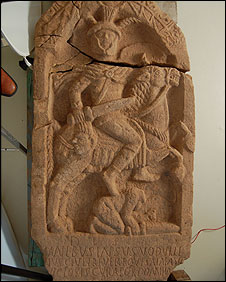
A Roman Tombstone


This is the tombstone of Insus, son of Vodullus. It was found in Lancaster in 2005, and a BBC news report last week (from which I have taken the photo) talked about plans for it to go on display in the Museum of Lancashire by the end of the year. The inscription reads:

DIS MANIBVS INSVS VODVLLI [ ]IVS CIVE TREVER EQVES ALAE AVG [ ] VICTORIS CVRATOR DOMITIA [ ]*


which means (filling in the gaps):

To the spirits of the departed. Insus, son of Vodullus, citizen of the Treveri, cavalryman of the Ala Augusta, curator [a junior officer] of the troop of Victor. Domitia [made this?].


But what I want to talk about is a comment by Stephen Bull, the Museum's curator of Military History and Archaeology. He says:

To depict him in such a dramatic and war-like position, when none of the other tombstones of this period show such a thing, makes it very likely that we are looking at something either real, or very similar to an event that happened.


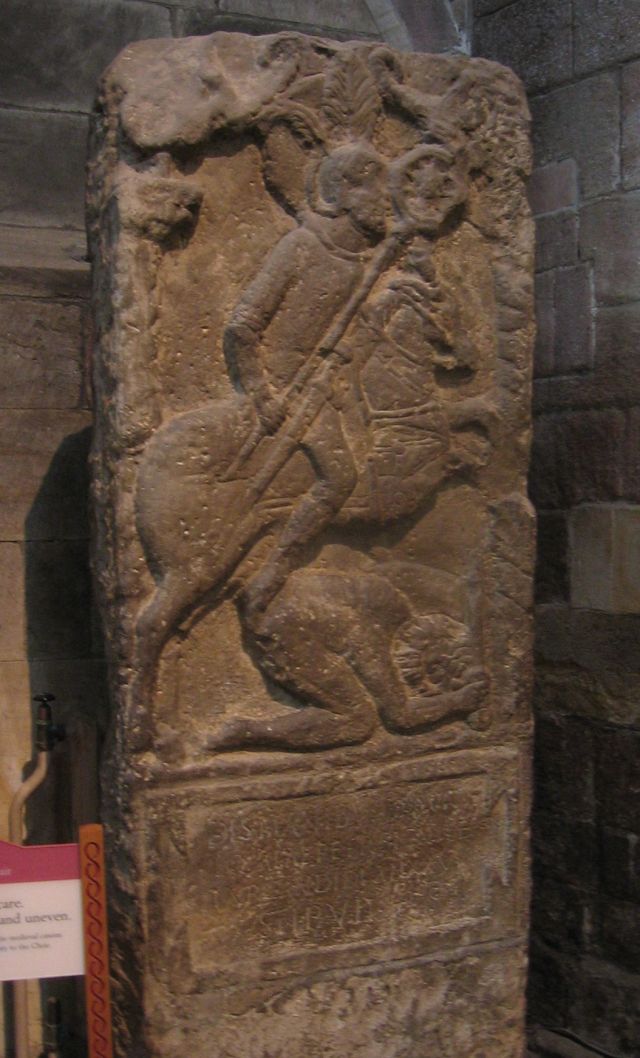
I find that a very curious thing to say. Because this sort of image, of a cavalryman riding down a barbarian, is not uncommon on Roman tombstones. As it happens, I've been making student assignments on this sort of image over the weekend. This, for example, is the tombstone of Flavinus from Hexham Abbey:


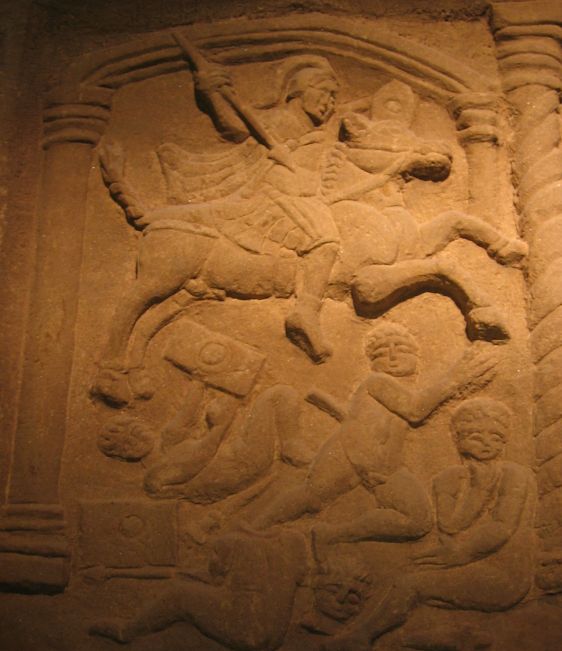
Other examples I can think of are those of Longinus Sdapeze from Colchester, Rufus Sita from Gloucester, and Sextus Valerius Genialis from Cirencester. It's also found in non-funerary contexts. This is a detail from a distance slab put up by the II Legion Augusta on the Antonine Wall, found in Bridgeness and now in the National Museum of Scotland, where I was admiring it on Saturday:


According to this report, there are a dozen such reliefs that have been found in the UK. The beheading shown on the tombstone of Insus does appear to be unique. But is there any need to see this as anything more than a variation on a theme? Is it even necessary to connect it with Celtic head cults, as David Shotter does? Real events were sometimes depicted on tombstones, as, for example, when Tiberius Claudius Maximus depicted his encounter with the dying Dacian king Decebalus. But he also added a detailed text explaining the event. This is not the case with Insus.

Some of Bull's other comments (e.g. "The carving and inscription will add detail to what we know about the Roman auxiliary cavalry and its equipment.") seem perfectly sensible. What I think has happened here is that he has succumbed to the temptation to 'sex the story up' by suggesting that there is an actual event being depicted, rather than just generic imagery. It's the same motivation, to make things more concrete, that is behind suggesting that a Roman bust is of Julius Caesar when there isn't really any evidence.

But perhaps I'm being unfair. Perhaps Bull (an expert in 20th century military history and that of the English Civil War) has addressed these issues. He has written a pamphlet on the tombstone, which I'll be following up. If nothing else, I want to know what he thinks about Domitia. A lot of tombstones have text at the end suggesting that the soldier's heirs (usually fellow soldiers) set the tombstone up. Sometimes it's someone else. Here it's Domitia. Who was she? soldiers weren't officially allowed to marry, but often had common law wives. Is that who Domitia was?

* There's a nice picture of the inscription on this webpage, though their translation is a bit odd.

Tuesday, July 22, 2008

They found Boudicca's brain!

Bonekickers is a show that seems to divide people. The division is between those who think it's utter nonsense, and those who think it's utter nonsense but enjoy it anyway.

This week's seemed more nonsensical than usual, but perhaps because I know the history that's being abused more than in previous episodes. But maybe it's the arsenal of live Roman napalm grenades. It's almost not worth listing all the lunacies in this. Mosaics on walls? Well, perhaps. The Life of Marcus Quintanus is, of course, completely made up - but can you really imagine that if they'd been researching this they wouldn't know that there were other more complete copies? And palimpsests made out of printed pages? Do what, guv'nor? And why does Professor Parton wear his hat at night?

It might have been interesting to spin off this into a discussion of the attitudes towards Boudicca that the programme shows, especially Boudicca as British queen, sheltered by villagers in the West Country, when there's no evidence that she cared about them or that they cared about her. But really, this is so bonkers and bears so little relationship to history that it's hardly worth it. (If you want to read what I think about Boudicca, it's all here.)

But yes, I'll be watching next week.

Sunday, July 20, 2008

Hadrian

Hadrian is probably emperor of whom people in Britain are most likely to have heard, through his association with the Wall that runs across Northumberland and Cumbria. But not many people will know much more than that about him. His biography has not really seeped into the public consciousness. I can't, for instance, think of a single screen portrayal of Hadrian off the top of my head, whereas I can immediately think of at least two or three for the likes of Augustus, Claudius, Nero, Vespasian, and other first century AD rulers. I'm sure such portrayals of Hadrian exist, and if anyone wants to point them out I'll be happy to hear of them, but it doesn't change my point. The fact that I can't think of any shows how little Hadrian is known in this respect.

The British Museum's new exhibition clearly means to change that. I'll be talking about the exhibition itself after I go on August 3rd. What I want to write about now is the media commentary that's appeared in advance of the opening. There have been articles in The Guardian, The Telegraph and Sunday Telegraph, Times and Sunday Times. The BBC repeated a somewhat superficial Timewatch programme on Hadrian's Wall, featured the exhibition on Newsnight Review, and showed a not-too bad, if occasionally overheated, documentary by Dan Snow (all of which are still available, if you're in the UK, on the BBC's iPlayer page, though they'll gradually disappear over the next week). And that no doubt only scratches the surface.

What strikes me is how pro-Hadrian almost all of this coverage has been. A good example is this Guardian editorial; faults are noted, but overall he's seen as a good thing. Snow, though not ignoring such things as the suppression of Jewish identity, in an event as traumatic as the destruction of the Temple at Jerusalem in AD 70, cannot hide his admiration of the man. Articles talk admiringly of how Hadrian pulled out of a war in Mesopotamia, modern Iraq (take heed, America's new president, seems to be the message).

But are these pieces all treating him as too modern, too much the benevolent dictator, too much someone we can identify with? After all, this was a man who was so hated by the Senate that only the threat of civil war forced through approval of his deification. His relationship with Antinoos always seems accompanied in these modern reports by a comment to the effect that such a liaison would not raise an eyebrow in the Roman world. Well, yes the ancients had different attitudes to sex between men than those we have, but, as Dan Snow reveals as he reads a passage from Aurelius Victor (De Caesaribus 14), reporting rumours attacking Hadrian for his lasciviousness, there were some Romans who though Hadrian went too far in this respect. I don't particularly want to go on about this, not least because I've already written on the subject, but I do wonder if we still can't see this emperor clearly.

Fortunately, we still have Mary Beard. She concludes a lengthy piece in The Guardian by pointing out how Hadrian's image is something that we have invented for ourselves, the modern version going back I would say to when he was canonized by Gibbon (whom Beard does not mention) as one of the good emperors. She points out how the goalposts are moved, partly because of the state of the evidence. Where Nero can only be seen as a tyrant, she says, if Hadrian does the same thing, it gets a much more favourable spin put on it. She's absolutely right.

Thursday, July 17, 2008

Historical consultants

UK TV History are currently repeating Ancient Rome: The Rise and Fall of an Empire, the BBC's 2006 drama-documentary series. On an internet conference I frequent, someone said that it should be all right, because Mary Beard was the historical consultant on some of them. Unfortunately, it doesn't work like that. Mary Beard is undoubtedly a fine scholar. But the role of historical consultant in these sort of programmes is an advisory one. They are someone that the programme-makers turn to for ideas, but they do not write the scripts, or dictate how the programme should be made. They do not have the final say, and one suspects that they are often overruled. As a for instance, Mark Horton is the archaeological consultant on Bonekickers. Now, he may well have told the creators that anyone using a magnetometer must ensure that they have no metal about their person. He may even have said that this includes underwiring on bras. But I doubt he explicitly endorsed a scene where students are told by a member of staff to remove their bras, making that instruction in front of another, male, member of staff (something that I would expect to lead to a complaint of sexual harassment in any university I've ever been associated with). The power is with the programme and film-makers. The historians only know how to write books; the directors and producers are (they will argue) the ones who know what will work on the screen. And sometimes they will be right - good history does not always make good drama. Just look at Oliver Stone's Alexander, a film that (in my view) is dramatically weak because it pays too much respect to history. But sometimes decisions seem to me to be symptomatic of a lack of faith in their audience. Beard's post about her involvement with Ancient Rome is interesting. At a seminar, the producers explained that their prime objective was to prevent people changing channel. A lot of careful research has been done into people's viewing habits, and this is used to shape programmes. So complexity is avoided, for fear that people will change channel to something less taxing. If they want to get more of the story, the idea seems to be, they can always buy the accompanying book (I've certainly had that argument put to me, though not by a programme-maker). This seems unethical to me. History programmes should not be in the business of falsifying history. It's not enough to say that the true story is in the book - most viewers won't read the book. And the BBC's reputation as a maker of historical documentaries was not built on catering to the lowest common denominator. Programmes like Civilisation assumed an interested, intelligent audience, who might not know the subject being discussed, but didn't need patronizing. To return to my point about consultants - why do programme-makers make such a play of using consultants, if they will overrule them where necessary? Because consultants lend authority, to give the impression that their programmes are unquestionably historically accurate. This is important to programme-makers - a lack of perceived authenticity will hit their audiences. By hiring Mark Horton, the makers of Bonekickers hope to promote the notion that the show displays an authentic version of life in an archaeology department (which it isn't, of course). The hiring of Mary Beard and others allows the makers of Ancient Rome to back up their opening caption that the programme is dealing with real people and events, based on ancient accounts (as if those weren't problematic), and with the collaboration of modern historians. So what you see is true. Personally, I worry about the pernicious affect of such statements, and the way that the drama-documentary actualizes a particular version as The Way It Happened. Take, for instance, the programme on Tiberius Gracchus. Not only does the version show excise Tiberius' brother Gracchus from the account (too complicated, one presumes), but at the start brings together two pieces of evidence in a way that may not be sustainable. We know that Gracchus was present at the fall of Carthage in 146 BC. We also know that he won acclaim for being the first onto an enemy city's wall in the African campaign. But we don't know what the programme postulates, that the city concerned was Carthage. Indeed, one might suggest that it probably wasn't Carthage, as if it was, our source, Plutarch, might have been expected to tell us. Television drama strips this from the accounts. So, remember, don't consume the packaging. The quality of historical consultant is not necessarily a guide to the historical integrity of a programme. So why do historians still serve as consultants on these programmes? Obviously, I can't speak for anyone. And I shall put aside the notion of sheer ego-boost from being connected to the telly, though were I ever to be offered such a role (which is highly unlikely) it would be an influential factor for my decision. I think many get involved because they see an opportunity to do some good, at the very least to stop some mistakes being made. Bonekickers has its clearly 'educational' moments, such as the mini-lecture on how Bristol, though built on the profits of the slave trade, never actually had slaves in its ports. And Mark Horton has a series of mini-films on the website on the background. So those interested in learning more about the history can be directed. Maybe that's the right attitude, as long as your ambitions aren't too lofty - in which case you'll be disappointed, as Kathleen Coleman was when she worked on Gladiator. But maybe it's appeasing the enemy? Will Bonekickers have the same effect as Time Team, in encouraging a false view of what life in an archaeology department is like? I'm not sure I know the answer to that one. Edit (23/07): There's a good article here by Paul Cartledge, talking about his involvement in The Greeks, why he did it, and why he'd do it again (as indeed he did, for The Spartans).

Wednesday, July 09, 2008

Bonekickers

There was a time when, whenever Time Team started, I'd turn the sound down and hum the theme to The Avengers, because I thought sometimes that this was the feel Time Team was going for. For Bonekickers, the new BBC1 action-drama about a team of dedicated archaeologists, I guess it should be the music from Torchwood (if it was more memorable). And that's basically what Bonekickers is - Time Team meets Torchwood. There are plenty of visual references to both shows. In terms of archaeology, there are a few authentic touches - points are scored early for telling people not to stand at the edge of the trench. This and other similar moments are no doubt down to archaeological adviser Mark Horton, who has lent the show the authority of his name, and apparently his wardrobe, to judge from how Hugh Bonneville is dressed. But anyone whose had any contact with real archaeology departments will soon notice the differences. For a start, the show promulgates the Time Team myth that all archaeologists have limitless supplies of top-of-the-range equipment. And I've never been to a black tie do-cum-book signing-cum-professorial welcome do. And certainly archaeologists, even on rescue digs, don't work round the clock unless there's a really good reason to do so, and never have their labs open all night. And they don't have silly adventures either. But then Bonekickers wouldn't be much of a drama otherwise, I suppose. It's not that it's particularly bad - it's no worse than Torchwood. It's just not particularly good. And there is a problem with shows like this, or Channel 4's unlamented Extreme Archaeology, that try to make archaeology breathlessly exciting. Archaeology's excitement is not of the adrenaline-rush variety; it's much more cerebral. You can communicate this through television - just ask Mortimer Wheeler, or (since Sir Mortimer's dead) Julian Richards. But I can't see Bonekickers succeeding, or getting a second season.

Tuesday, July 08, 2008

Help?

I found this image in the Bridgeman Education database.


The database tells me that it is of Mercury, from Pompeii, now in the Naples Archaeological Museum, is in the Fourth Style of Pompeian wall-painting, and dates to the first century AD. What it doesn't tell me is which house in Pompeii it's from, and I can't find this painting illustrated in any of my books on Pompeii. Googling isn't producing anything. Anyone out there know?

Monday, July 07, 2008

What sort of emergency?

You may well have read over the weekend about a 'state of emergency' being declared at Pompeii. To anyone with an interest in Roman history, this will not exactly be a surprise. One regularly sees papers, or chapters, or news items, about how Pompeii and Herculaneum are about to be lost for ever. From personal experience, I can tell you how much less of the site (particularly in the private houses) was open in 2007 as compared to 1999 or 1986. It's not too surprising. Pompeii was never meant to last as long as it has. The bright colours of the graffiti on the walls was only meant to last for a short period, weeks, or moths at the most - it's not surprising that after two hundred and fifty years of being exposed to the Italian summer, it's all faded. The interior decoration was mostly repainted every decade. The houses were probably meant to be more robust, but most of them lost their roofs, and hence their structural integrity.

What interests me is some radical differences in how the story had been reported. The BBC report is much as you'd expect - statistics about how much is being lost every year through lack of funds. The Guardian has a rather different approach. Hardly a word there about the threat to the archaeology. Instead, the report is all about the poverty of the tourist experience:

The daily Corriere della Sera this week deplored the squalid conditions at Pompeii, where visitors run a gauntlet of hawkers and self-appointed car park wardens to a vast and poorly signposted complex with no restaurants and just three toilet facilities.


For a start, this seems a bit unfair. There aren't many toilets, but it's five, rather than three, and, unless it's closed in the past year, there is a restaurant in the shell of the Forum Baths. There are free maps given out at the entrance, and the official guides published by Electa Napoli in collaboration with the Soprintendenza Archeologica di Pompei are as good as any other Electa publication (i.e. an exemplary model of how to do an archaeological guide).

The real question, though, is which report represents the intent behind the move to appoint a special commissioner. If he is to be led by the need to protect the archaeology above any other considerations, then that's by and large a good thing (though giving his salary directly to the Soprintendenza would be better). But if the initiative is to be tourist-led, then I rather share some of the qualms of Mary Beard (who, of course, blogged this before I got around to it). There are no toilets except by the exits and entrances because there's no running water on the site. Do we really want the roads of Pompeii ripped up to lay water pipes? Or Portaloos outside the amphitheatre? And where would one put further restaurants? In some of the houses? In one of the large gardens at the eastern end of the site?

So what is this all about? Protecting the site, or (as is mentioned in the video accompanying the BBC report) exploiting a cash cow?

Friday, July 04, 2008

Judea AD 33. Saturday afternoon. About tea time.

When I see a headline stating 'Doubt over date for Brit invasion' (original press release, and another report), I expect to find a dramatic change, redating it to 56 BC, or AD 54. Instead, it turns out that the date is being shifted by a mere four days, from August 26/27 to August 22/23.

So it's not really that significant. In any case, what do either of these dates mean? I can tell you what they definitely don't mean - they don't mean the 22nd/23rd or 26th/27th days of the month Sextilis (not renamed August until 8 BC) in the consulship of Gnaeus Pompeius Magnus and Marcus Licinius Crassus (yes that Pompey and that Crassus). The Roman civic calendar was in a mess by the first century BC. A failure to apply intercalary months properly meant that the Roman civic year was about three months ahead of the solar year, something that Caesar had to rectify in 46 BC. So the last week of 'August' would have the conditions that would now be expected in May. This is certainly not when Caesar invaded Britain. He clearly states in De Bello Gallico 4.20, that the invasion was launched when there was little of the summer left (exigua parte aestatis reliqua). So 'August 22/23' actually means 'the equivalent of August 22/23 if the Roman civic calendar and the solar year were properly aligned' (i.e. on the Julian calendar). At which point the dates become, for me, rather meaningless.

I'm not even sure that the event can be dated to where August would have been. Apart from the reference to the summer, the only other dating evidence is that the landing took place four days before a full moon. I'm not sure why September is ruled out - in 1940 the Germans were certainly contemplating invasion in late September. Perhaps the astrological work and the studying of the tides demonstrates that the invasion cannot have been four days before a full moon, but eight or nine days (a textual correction proposed by R.G. Collingwood in 1937). But even this may be open to possible objections (as raised by others) that changes to the coastline over two thousand years have altered the currents. In any case, neither the 'traditional' date nor the new one seem to me to be terribly helpful.

At least these dates are less meaningless than the recent attempt to date the return of Odysseus (full article) to April 16, 1178 BC, on the basis of astronomical evidence from the text. Now, I'm happy with the notion that genuine astronomical phenomena are described in the Odyssey. It may be that the reference to the obliteration of the sun at Odyssey 20.356 is meant to be an eclipse. What I find far less plausible is the notion that Homer is able to insert consistent astronomical data into his imaginative account, that point to an eclipse five centuries before he wrote. Even the authors concede that their theory only works if one assumes that Zeus sending Hermes to Ogygia represents movement of the planet Mercury. Given that there are perfectly good dramatic reasons in the framework of the Odyssey for this trip (he's been sent by Zeus to tell Calypso to release Odysseus, and who else would Zeus send than the messenger god?), I don't see the need for an allegorical interpretation.

What both these items share, it seems to me, is a positivist outlook on the ancient world. Caesar invaded Britain on a particular day. Odysseus returned on a particular day. Since these are facts (an arguable proposition for Odysseus' return), then, the idea seems to be, it must be possible, with enough investigation, to discover those facts. With my own little post-modernist toolkit, I conclude that some facts simply aren't recoverable.

The title of this post, by the way, is a quotation from Monty Python's Life of Brian a series of captions that satirizes exactly this sort of attempt to advance precise dates.

Friday, June 27, 2008

Me vs. Wikipedia

Shortly before writing this post, I went to Wikipedia to correct the entry. I've just found that those changes got reverted almost immediately, by someone citing Lofficier, Pixley, and the Discontinuity Guide. To be fair, I hadn't added comments to the effect that my edit was based on the actual episodes (which trump anything in secondary sources). I have now restored my changes, and added an explanation. I've also edited the Doctor Who Wiki. let's see how long those changes last.

Thursday, May 15, 2008

Bust of Caesar?

You may have seen reports (e.g. here, here, here or here) that a bust of Julius Caesar has been found, that dates to the last five years of his life. Mary Beard fairly comprehensively demolishes most of the claims made for it; in short, there's no evidence that it's Caesar (though it might be, with the eye of faith), none that it dates to the early 40s BC, and none that it was thrown in the river in the aftermath of Caesar's assassination (which is intrinsically unlikely). The best we can say for sure is that it's Roman.

It all reminds me of an edition of Hidden Treasure, BBC's rather breathless archaeology programme of a few years back, when they talked about the quality of the torc from the Winchester hoard, and concluded that it was 'very likely' a gift from Julius Caesar to a British chieftain, on the flimsiest of evidence.

Saturday, May 10, 2008

Science Fiction as a Literary Genre

I went to a one-day symposium on this on Thursday. But rather than write it up, I'll point you towards this report.